What a cyber security degree means for UK security careers
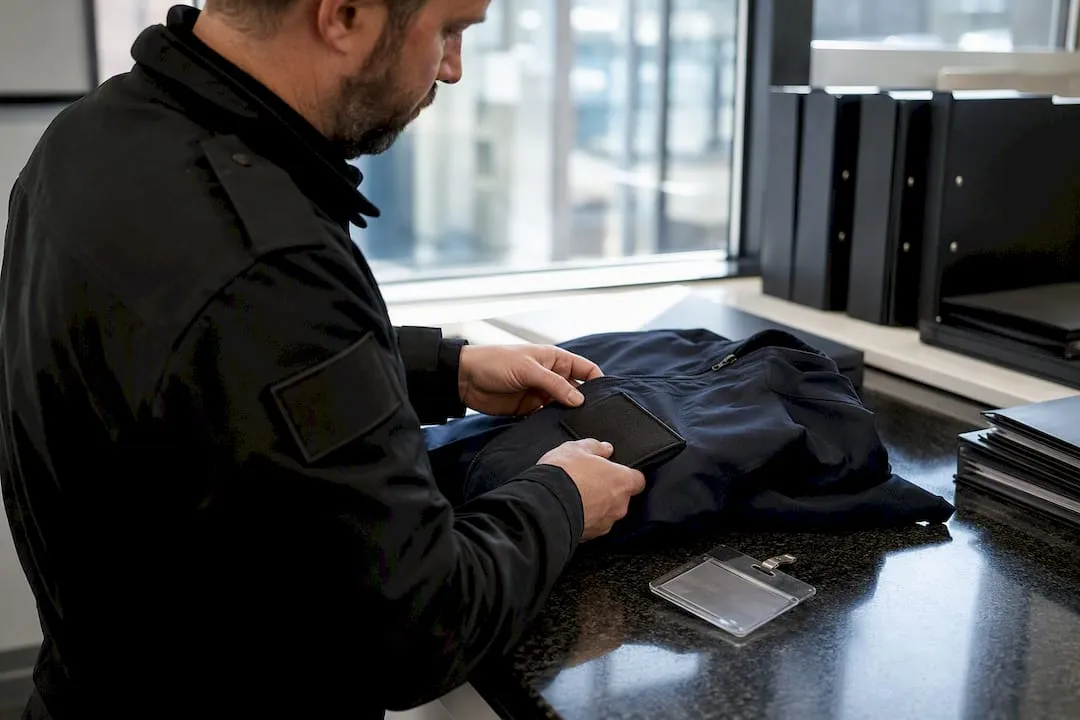
A cyber security degree opens the door to frontline and supervisory roles across the UK physical-security sector, provided you pair it with the right SIA licence-linked training. Employers value the analytical thinking, report-writing and technical literacy your degree builds, but the licence itself is what actually gets you working on-site.
The roles your degree maps onto most naturally include:
- Security guard or security officer (frontline, licence-linked)
- Door supervisor (frontline, licence-linked)
- CCTV operator, formally Public Space Surveillance (frontline, licence-linked)
- Keyholding and mobile patrol officer (frontline, licence-linked)
- Site or shift supervisor (often licence-linked depending on duties)
- Security manager (frequently non-frontline, though this depends on the tasks you personally carry out)
The Security Industry Authority regulates all frontline roles, and the Government Security Profession career framework shows how operational experience can lead into advisory or design roles later on. Around 46 distinct roles sit across that framework’s advisory, operations and research families, giving degree-holders a clear route beyond entry-level shifts.
Your next moves are straightforward: check which SIA licence your target role requires, book approved licence-linked training, and build a profile on Security Jobs Board so employers can find you while you complete your qualification.
Key Takeaways
A cyber security degree combined with the correct SIA licence-linked qualification is what actually qualifies you for UK frontline and supervisory security roles.
| Point | Details |
|---|---|
| Licence comes first | A degree helps your application, but you still need the correct SIA licence-linked qualification to work frontline. |
| Door supervision often preferred | Training providers frequently recommend it over the standard guarding licence for its wider employment scope. |
| Timing matters | Qualifications generally need to be achieved within three years of your SIA application, so plan renewals ahead. |
| Progression is real | Operations experience can lead into advisory or design roles through the Government Security Profession framework. |
| Use Security Jobs Board | Create a free profile and set alerts to match your licence type with live UK vacancies. |
Table of Contents
- What jobs can you get with a cyber security degree in UK physical security?
- How does your degree strengthen your CV for security roles?
- What SIA licence checks and qualifications do you need?
- How do you progress from operative to management?
- How should you apply and use Security Jobs Board?
- Sources
- FAQ
What jobs can you get with a cyber security degree in UK physical security?
Each role below sits at a different point on the frontline spectrum, and employers judge them by different criteria. Knowing the distinctions before you apply saves you from chasing the wrong licence.
Security guard or security officer. This is the most common entry point. Duties include access control, patrols, incident reporting and basic customer interaction. It requires a front-line SIA licence, and most people enter through a short approved course rather than any degree route.
Door supervisor. Covers venues like pubs, clubs and events, with heavier emphasis on conflict management and physical intervention. This licence is frontline and, notably, training providers often steer candidates toward it over the standard guarding licence because the slightly longer course gives broader employment scope. If you’re choosing between the two, door supervision tends to open more doors.
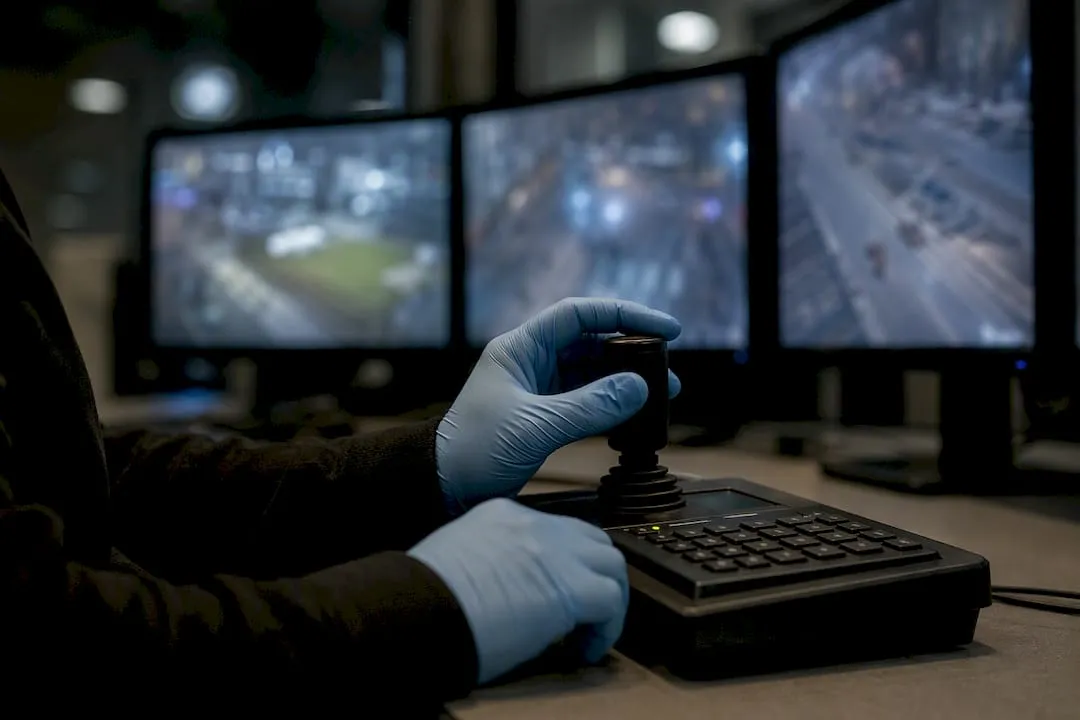
CCTV operator (Public Space Surveillance). A natural fit for degree-holders comfortable with monitoring systems, pattern recognition and evidence logging. Frontline licence required. This role rewards the technical literacy a cyber security degree builds more directly than almost any other entry-level post.
Keyholding and mobile patrol officer. Lone-working roles covering multiple sites overnight or on call-out. Frontline licensing applies, and employers weight reliability and independent judgement heavily here.
Site or shift supervisor. Manages a team of guards or door staff, handles rota planning and escalations. Whether this needs a frontline licence depends on whether you personally perform licensable activities, not your job title.
Security manager. Often non-frontline, focused on contracts, compliance and staffing rather than hands-on duties. This is usually where a degree carries the most weight, since the role leans on planning, reporting and stakeholder communication rather than physical presence.
How does your degree strengthen your CV for security roles?
Cyber security degrees teach risk assessment, incident investigation, basic networking and digital evidence handling. These translate directly into physical-security work: risk assessment underpins site security surveys, incident investigation mirrors the structured reporting SIA-licensed staff produce after every notable event, and technical literacy helps you get more out of CCTV and access-control systems than someone without that background.
The soft skills matter just as much. Report writing, critical thinking and attention to detail are exactly what separates a security officer who gets promoted from one who doesn’t.
- Frame degree modules using outcome language: “conducted risk assessments for simulated network environments” reads to a hiring manager as “can assess physical vulnerabilities too.”
- Mention any dissertation or project involving investigation, data protection or incident response.
- Use job-focused phrasing rather than academic phrasing. “Analysed security logs to identify anomalies” lands better than “studied intrusion detection systems.”
Pro Tip: Don’t bury your degree under a generic “Education” heading with no context. Add one line under each relevant module explaining how the skill applies to physical security. Employers scanning dozens of CVs will not make that connection for you.
What SIA licence checks and qualifications do you need?
Before you can start most frontline roles, you need to clear a specific sequence of checks and training. Here’s the order employers and the SIA expect:
- Identify the correct licence type for your target role and confirm you understand what it covers.
- Complete a licence-linked qualification through an SIA-approved training provider.
- Confirm you’re 18 or over, since this is a minimum requirement across all frontline licences.
- Pass identity verification and a criminal record check as part of your application.
- Provide evidence of your right to work in the UK.
- Where the licence requires it, complete a recognised first-aid qualification before applying.
Front-line licences cover security guarding, door supervision, Public Space Surveillance, and Cash and Valuables in Transit. Non-frontline licences exist for people, often managers or directors, who don’t personally carry out licensable activities, which avoids unnecessary vetting for purely administrative roles.
Timing matters too. Your qualification generally needs to have been achieved no more than three years before your application, and renewals increasingly involve refresher or top-up training rather than starting from scratch. Training providers are approved through bodies including Ofqual, SQA, Qualifications Wales and CCEA, so check your provider sits within one of these frameworks before booking.
First aid isn’t an optional extra for most door supervision and security guarding licences. If your course doesn’t include it, you’ll need to book it separately, and leaving that until the last minute is one of the most common reasons applications stall.
How do you progress from operative to management?
Most careers in this sector follow a recognisable shape: security operative, then shift supervisor, then site or operations manager, then potentially a specialist advisory or design-focused role. A degree doesn’t skip you past the early stages, but it does make the later jumps easier to justify to an employer.
Apprenticeships and internal progression schemes are common routes from frontline to management, particularly within larger contract security firms. Qualifications that carry real weight at this stage include Level 3 and Level 5 security management awards, NEBOSH for health and safety responsibility, and ILM for leadership and supervisory training.
- Operative → shift supervisor: usually 12 to 24 months of consistent, logged experience.
- Shift supervisor → site/operations manager: often requires a management qualification alongside experience.
- Operations → advisory or design roles: this is where your degree does its heaviest lifting, particularly within the Government Security Profession framework, which explicitly maps routes from operations into advisory and research/design role families.
Employer references and continuing professional development matter throughout. A degree gets you noticed; a clean employment record and demonstrable incident-handling experience get you promoted.
How should you apply and use Security Jobs Board?
Getting hired comes down to matching what you can prove against what employers are screening for. Follow this sequence:
- List your SIA licence status prominently on your CV, including licence type and expiry date.
- Translate degree modules into job-relevant bullet points rather than academic descriptions.
- Add first-aid and any supplementary certifications in a clearly labelled section.
- Include right-to-work documentation details so employers can move quickly.
- Create a profile on Security Jobs Board and set alerts for door supervisor, CCTV operator or mobile patrol vacancies, depending on your target route.
At interview, punctuality and appearance matter more in this sector than most, since they signal reliability under shift conditions. Come ready with one or two concrete examples of de-escalation or incident reporting, even from unrelated work, and you’ll stand out from candidates who only talk in generalities.
What hiring managers actually look for
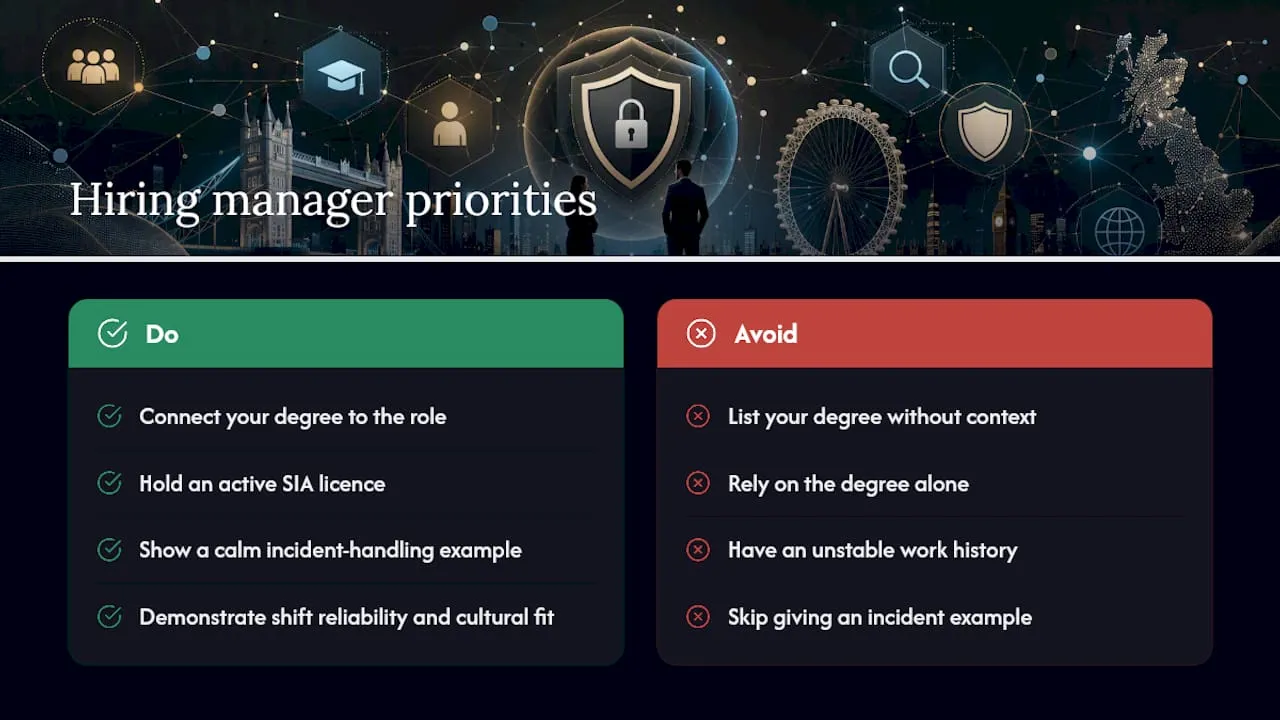
Degrees get read positively when candidates connect them to the job, not when they’re left to speak for themselves. I’ve seen plenty of strong applicants undersell a genuinely relevant qualification just by listing it flatly.
Beyond the paper, hiring managers want an active SIA licence, a stable work history, and at least one example of handling a real incident calmly. Shift reliability and cultural fit on-site often decide the final call, degree or not.
Find your next role through Security Jobs Board
Security Jobs Board gives you free, direct access to UK security vacancies without the delays that come from going through general recruitment sites that don’t understand licence requirements. Whether you’re chasing a door supervision role in Belfast or a CCTV post in the Midlands, filtering by licence type means you only see jobs you’re actually eligible for.

If you’re job hunting, upload your CV, list your SIA status clearly, and set alerts for the categories covered in this article, from CCTV operator through to site supervisor. Employers using the platform can browse candidate profiles directly and post licence-specific vacancies, which cuts out a lot of the back-and-forth typical of general job boards. For jobseekers wanting more structured guidance on CVs and training routes, the career advice hub is worth reading before you apply, and if you’re specifically looking in Northern Ireland, regional listings are already live. Set your profile up today and let relevant roles come to you.
Sources
FAQ
Do I need a degree to work in UK physical security?
No. Entry to frontline security roles is primarily through short, SIA-approved licence-linked courses rather than degree-level study, though a degree can help with progression.
Which SIA licence should a cyber security graduate consider first?
Door supervision or Public Space Surveillance (CCTV) both suit graduates well, since CCTV monitoring in particular rewards the technical literacy a cyber security degree builds.
Do security managers need an SIA licence?
Only if they personally carry out licensable activities; purely administrative managers may not need a front-line licence.
How long does an SIA qualification stay valid before I must apply?
Qualifications are generally accepted if achieved no more than three years before your application, after which refresher training may apply.
Where can I find security vacancies matched to my licence type?
Security Jobs Board lets you filter vacancies by licence category, including door supervision, CCTV and mobile patrol roles, and set alerts for new postings.


