What certifications for cyber security do UK guards need?
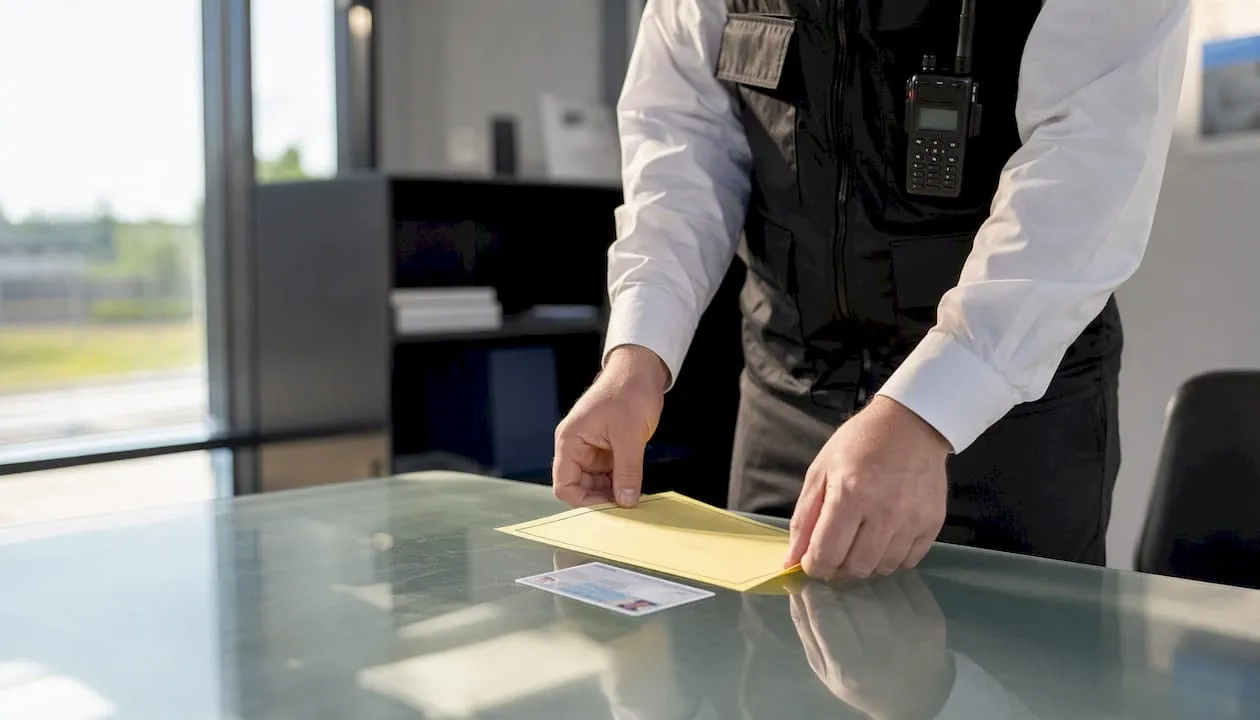
The short answer: you need a Security Industry Authority (SIA) licence, a role-specific licence-linked qualification, and the right first-aid award. That trio covers almost every front-line physical security role in the UK, from door supervision to close protection.
There’s no separate “cyber security certification” pathway for physical security staff. The confusion often comes from search results built around IT credentials. If you’re guarding a building, checking IDs on a door, or monitoring CCTV feeds, what matters is:
- An SIA licence matching your job activity (door supervisor, security guard, CCTV operator, close protection, cash and valuables in transit, or vehicle immobiliser in Northern Ireland)
- A licence-linked qualification from an SIA-recognised awarding body, gained within the last three years
- Emergency First Aid at Work (EFAW), or a higher award such as Level 3 FAW/FREC for close protection
Every qualification must sit on the Ofqual framework or an equivalent UK regulator, and you apply for your licence through your personal SIA online account. Security Jobs Board sees this trip candidates up constantly, usually because they train for the wrong category or apply too early.
Key Takeaways
Front-line UK security work requires an SIA licence, a matching licence-linked qualification gained within three years, and the correct first-aid award for the role.
| Point | Details |
|---|---|
| Three certifications, always | SIA licence, role-specific licence-linked qualification, and EFAW or higher first aid together form the minimum. |
| Match training to licence category | Door supervision, guarding, CCTV, close protection, CVIT and NI vehicle immobiliser each need their own specific qualification. |
| Timing rule is strict | Your qualification must be achieved within three years of the licence application, and licences run for three years. |
| Wait for upload before applying | Applying before your training provider uploads your result to your SIA account is a leading cause of delay. |
| Security Jobs Board speeds hiring | Candidates who list licence details, qualification code and provider name on their Security Jobs Board profile get shortlisted faster. |
Table of Contents
- What certifications does each front-line security role need?
- How do you actually get the qualification and licence?
- Where do you find an approved training provider?
- How long does it take and what does it cost?
- What mistakes do candidates make, and what do employers check?
- How Security Jobs Board sees hiring in this space
- Ready to apply once you’re qualified?
- Sources
- FAQ
What certifications does each front-line security role need?
Matching training to the correct licence category avoids wasted money and rejected applications. Here’s what each role actually requires.
Door supervision. You need an SIA-recognised door supervisor qualification (commonly a Level 2 Award for Door Supervisors) plus EFAW. Physical intervention modules must be delivered face-to-face; there’s no online shortcut for this part.
Security guarding (manned guarding). A Level 2 security guarding qualification is the baseline, alongside EFAW. If you already hold a door supervisor licence, you’ll still need to complete the security guarding conversion units unless your provider explicitly bundles both.
Public space surveillance (CCTV). This route needs a dedicated CCTV operator qualification. There’s no physical intervention component, but the SIA’s specification documents still set out required knowledge on data protection, incident reporting and equipment use.
Close protection. This is the most demanding category. You’ll need a Level 3 close protection qualification and a higher first-aid standard, typically Level 3 FAW or FREC, rather than basic EFAW.
Cash and valuables in transit. A dedicated CVIT qualification is required, distinct from general guarding awards.
Vehicle immobiliser (Northern Ireland only). This licence category applies solely in Northern Ireland and needs its own specific qualification, not a guarding or door supervision award.
Older qualifications or overseas training aren’t automatically rejected. The SIA reviews these on a case-by-case basis and may ask for supplementary UK-based modules before granting a licence.
Pro Tip: Only train for the licence category you actually intend to apply for. A door supervisor qualification won’t get you a CCTV operator licence, and re-training because of a mismatch costs both time and money.
How do you actually get the qualification and licence?
Six steps, in order, get you from “interested” to “licensed” with fleet security best practices:
- Confirm which licence you need. Match the job activity to a licence category. If you have a criminal record and you’re unsure how it might affect eligibility, use the SIA’s criminal record indicator before spending money on training.
- Check your first-aid validity. Your first-aid certificate must have at least 12 months left before it expires at the point you start your security qualification. Book EFAW, or Level 3 FAW/FREC for close protection, if you don’t already hold it.
- Book training with an approved provider. Choose a course delivering a qualification from an SIA-endorsed awarding organisation.
- Complete the practical modules in person. Physical intervention and other hands-on elements can’t be completed remotely.
- Wait for the result to appear in your SIA account. Your training provider uploads your pass to the ‘My qualifications’ section of your personal SIA online account.
- Apply for your licence. Register or log into your personal SIA account, complete identity and right-to-work checks, pay the fee, and submit only once your qualification shows as recorded.
Pro Tip: Ask your training provider to confirm, in writing, that your result has been uploaded before you submit your licence application. It takes thirty seconds and saves weeks of delay if something’s gone wrong on their end.
Applying before your qualification appears in your account is one of the single biggest causes of avoidable delay in the entire process.
Where do you find an approved training provider?
The SIA doesn’t run training itself. It licenses awarding organisations to certify qualifications, and you need to check that link before you book anything.
Recognised awarding organisations include the British Institute of Innkeeping Awarding Body (BIIAB), Highfield Qualifications, Qualifications Network (QNUK), Pearson, and SFJ Awards. Each is accredited by a national regulator: Ofqual in England, the Scottish Qualifications Authority (SQA) in Scotland, Qualifications Wales, or CCEA in Northern Ireland. A qualification gained in any UK nation is accepted regardless of where you apply for your licence.
Before booking, verify:
- The awarding organisation’s name and accreditation
- The exact qualification title and code
- Whether the training centre is genuinely endorsed to deliver that qualification
- Written confirmation the provider will upload your result to the SIA system
Avoid any course marketed as “online-only fast track” for a role requiring physical intervention. If a provider can’t explain how they’ll deliver in-person practical assessment, that’s a red flag, not a convenience.
Pro Tip: Search the qualification title plus “SIA approved” before paying a deposit. Legitimate providers list their awarding body and qualification code openly on their course page; vague providers tend to bury or omit it.
How long does it take and what does it cost?
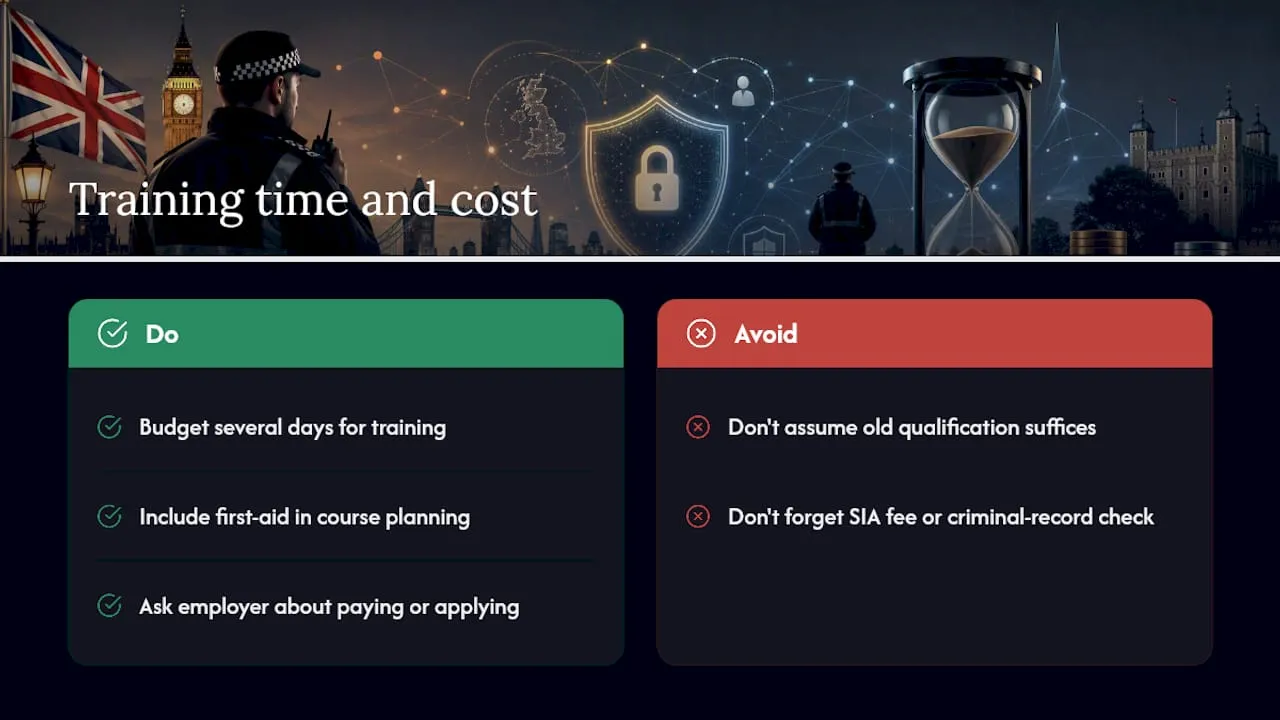
Budget several days for training itself, plus time for assessment and results processing. Door supervision and guarding courses often run across a working week when you include the first-aid element; close protection courses run considerably longer given the depth of the Level 3 syllabus.
On cost, expect to pay for: the training course itself, a separate first-aid award if you don’t already hold one, the SIA application fee, and potentially a criminal record check depending on your circumstances. Some employers cover training costs or apply on a candidate’s behalf, so it’s worth asking before you pay out of pocket.
Two key timing criteria are important: your qualification must have been achieved recently relative to your licence application, and licences themselves have a limited validity period. Refresher or top-up training requirements have applied to renewals since October 2021, so check current renewal rules rather than assuming your original qualification still covers you indefinitely.
What mistakes do candidates make, and what do employers check?
The same errors come up again and again: training for the wrong licence category, applying before the qualification is uploaded, booking a course without checking first-aid validity first, or trusting an online-only certificate for a role that legally requires in-person assessment.
Employers, for their part, tend to check the same handful of things at shortlisting stage:
- Correct SIA licence category and current expiry date
- Valid first-aid certificate matching the role’s requirement
- Qualification achieved within the three-year window
- Right to work and, where relevant, DBS or criminal record considerations
- General ‘fit and proper’ character indicators the SIA expects licence holders to meet
To speed things up, employers can simply ask candidates to confirm their training provider uploaded results, or request a screenshot of the licence details from the candidate’s own SIA account.
How Security Jobs Board sees hiring in this space
Employers using Security Jobs Board consistently shortlist by licence category first and experience second. Candidates who list their exact qualification title, qualification code, and training provider name get seen faster than those who simply write “SIA licensed.”
The improvements we’d flag most often: state the licence expiry date clearly, name the awarding organisation, and don’t assume “trained in door supervision” implies a CCTV or CVIT qualification too.
Pro Tip: Upload scanned copies of your licence and first-aid certificate directly to your Security Jobs Board profile. It cuts out a back-and-forth email exchange and lets employers verify you in one glance.
Ready to apply once you’re qualified?
Once your SIA licence lands in your account, the actual job search shouldn’t be the hard part. Security Jobs Board is built specifically around licence categories rather than generic job titles, so candidates can filter straight to roles matching their door supervisor, CCTV, or close protection qualification instead of wading through irrelevant listings.

Jobseekers can create a free profile, upload their licence and first-aid certificates, set alerts for new roles in their category, and apply directly without a lengthy registration process. Employers get the reverse benefit: they can post vacancies, filter the CV database by exact licence category, and message shortlisted candidates without needing to run their own verification from scratch.
If you’ve just completed vehicle immobiliser training or another Northern Ireland-specific licence, browse current security jobs in Northern Ireland to see what’s live right now. For every other category, start from the main Security Jobs Board homepage and filter by licence type to see roles matching your qualification.
Sources
FAQ
Do security guards need a cyber security certification?
No. UK front-line security roles need an SIA licence and a role-specific licence-linked qualification, not an IT or cyber security credential.
What is the minimum first-aid award for door supervisors?
Emergency First Aid at Work (EFAW) meets the requirement for door supervision and general security guarding roles.
Can I use an overseas security qualification for an SIA licence?
The SIA reviews overseas qualifications individually and may require additional UK-based training before granting a licence.
How long is an SIA licence valid once granted?
SIA licences are normally valid for three years, and your underlying qualification must have been achieved within that same three-year window at the point of application.
Why was my SIA licence application delayed?
The most common cause is applying before your training provider has uploaded your qualification result to your personal SIA online account.
How can employers verify a candidate’s licence quickly?
Employers can ask candidates to share their SIA ‘My qualifications’ details or upload scanned certificates to their Security Jobs Board profile for faster verification.


