What is a security CV: your complete UK guide
A security CV is a formal UK employment document that presents your qualifications, Security Industry Authority (SIA) licence, work experience, and relevant skills specifically for security officer or guard positions. Unlike a generic CV, it must demonstrate compliance with UK legal requirements and show recruiters at a glance that you are licensed, trained, and ready to work. The SIA licence is a legal requirement for most front-line roles, so its absence from your CV is an immediate red flag for any hiring manager.
A strong security CV typically includes:
- Full contact details (name, phone, email, location)
- SIA licence number, type, and expiry date
- Professional summary tailored to the target role
- Key skills (both technical and interpersonal)
- Work experience in reverse chronological order
- Education and relevant certifications (first aid, CCTV, etc.)
- References available on request
What format works best for a security CV in the UK?
The standard UK security CV runs to two pages maximum. Recruiters spend seconds scanning it, so a clean layout with clear headings and bullet points is far more effective than dense paragraphs or heavy graphics. Font choices such as Calibri, Arial, or Times New Roman at 10–12pt body text keep things readable without looking amateurish.
Organise your CV in this order:
- Contact details at the top (name, phone, professional email, town/city)
- Professional summary (3–4 lines tailored to the specific role)
- Key skills (a brief, scannable list)
- Work experience (most recent first, with bullet points per role)
- Education and qualifications (GCSEs, NVQs, relevant training)
- Certifications (SIA licence, first aid, CCTV operator certificate)
- References (two referees or “available on request”)
Tailoring matters more than most candidates realise. A CV sent for a retail security post should emphasise customer interaction and theft prevention, while one targeting corporate security should foreground access control and report writing. Role-specific CVs consistently outperform generic ones because they mirror the language of the job description, which also helps pass automated applicant tracking system (ATS) screening.
Pro Tip: Save your CV as a PDF unless the job advert specifically requests a Word document. PDFs preserve your formatting across every device a recruiter might use.
How to write a security CV step by step
Step 1: Write your contact details and professional summary
Your name goes at the top in slightly larger text. Below it, list your phone number, a professional email address, and your town or city (no need for your full home address). The professional summary sits directly beneath and does the heavy lifting. Keep it to three or four sentences that name your licence type, your years of experience, and one or two standout qualities.
Example: “SIA-licensed security officer with four years’ experience in retail and event environments. Proven ability to de-escalate conflict calmly and write accurate incident reports. Reliable, punctual, and comfortable working lone shifts or as part of a team.”
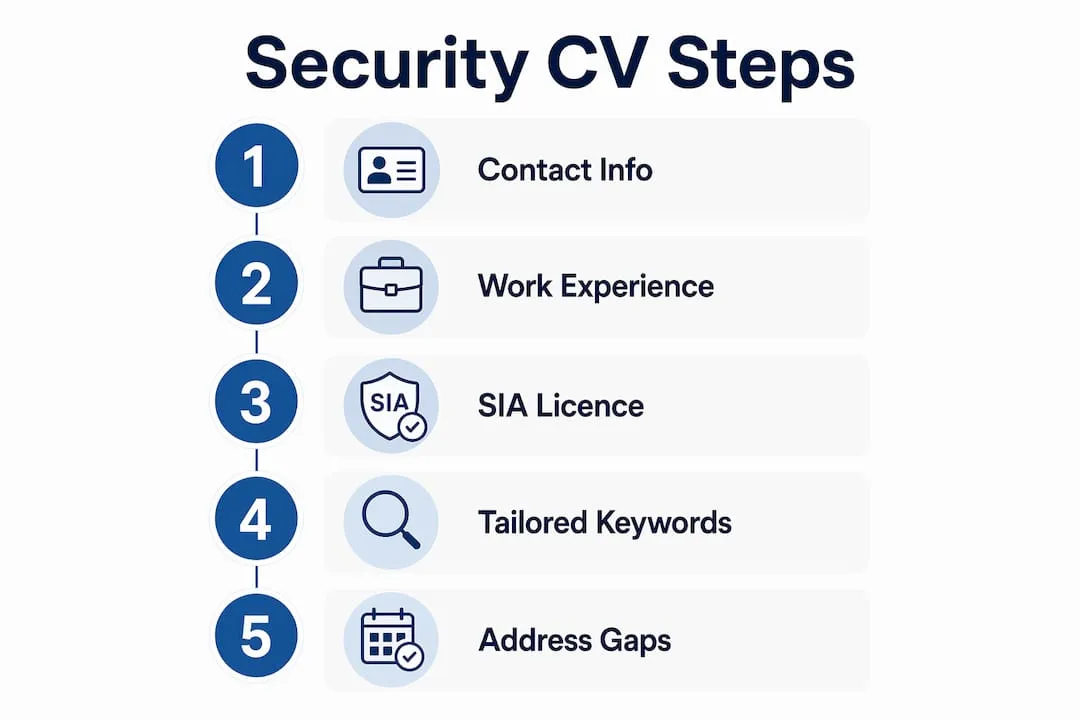
Step 2: List your work experience with action verbs
Each role needs a job title, employer name, location, and dates. Under each, use three to five bullet points starting with action verbs: “monitored,” “responded,” “conducted,” “reported,” “controlled.” Quantify where you can. “Monitored a 48-camera CCTV system across a 12-floor office building” tells a recruiter far more than “responsible for CCTV.”

Transferable skills matter when direct security experience is limited. Roles in retail, the armed forces, door work, or customer-facing environments all produce reliability, safety awareness, and composure under pressure — qualities security employers actively look for.
Step 3: Include your SIA licence and certifications
List your SIA badge number and validity dates clearly in the certifications section. Recruiters often check the SIA licence register before shortlisting, so accuracy here is non-negotiable. Add any first aid qualifications (such as a Level 3 Award in First Aid at Work), CCTV operator certificates, and conflict management training.
Step 4: Tailor keywords to the job description
Read the job advert carefully and mirror its language. If it mentions “access control,” “lone working,” or “patrol duties,” those exact phrases should appear in your CV where they honestly reflect your experience. This is not keyword stuffing; it is matching your evidence to the employer’s stated needs.
Step 5: Address employment gaps honestly
A gap of a few months rarely concerns a recruiter if you acknowledge it briefly. A short note such as “career break: personal development and voluntary work” is enough. Leaving unexplained gaps invites suspicion, whereas a one-line explanation removes the question entirely.
Which skills should you feature on a security CV?
Security employers look for a blend of technical competence and personal qualities. Neither alone is enough. A candidate who can operate a CCTV system but cannot communicate calmly with an agitated member of the public is a liability in most front-line roles.
Technical skills to include:
- SIA licence compliance and knowledge of relevant legislation
- CCTV monitoring and digital reporting tools
- Access control systems and visitor management software
- Body-worn camera operation
- Incident logging and report writing
- First aid and emergency response procedures
- Patrol techniques (foot and vehicle)
Interpersonal skills to include:
- Conflict de-escalation and verbal communication
- Situational awareness and threat assessment
- Reliability and punctuality (particularly for lone-working roles)
- Customer service under pressure
- Team coordination and handover briefings
UK security managers prioritise de-escalation and communication over technical jargon, reflecting how many roles involve direct public contact. Listing “conflict management training completed” alongside a brief example of when you applied it is far more persuasive than a bare skills list.
For event security, emphasise crowd management and radio communication. For retail, highlight loss prevention and customer interaction. Corporate roles reward report writing, access control, and professional presentation.
UK licensing requirements and modern skills for 2026
The SIA is the public body that regulates the private security industry under the Private Security Industry Act 2001. Working in a front-line licensable role without a valid licence is a criminal offence. Your CV must reflect that you meet every eligibility criterion before a recruiter will consider you seriously.
To qualify for a front-line SIA licence, you must:
- Be aged 18 or over
- Pass an identity check
- Pass a criminal record check
- Hold a recognised, licence-linked qualification achieved within the last three years
- Have the right to work in the UK
Front-line licence categories include security guarding, door supervision, close protection, public space surveillance (CCTV), cash and valuables in transit, and key holding. Each requires its own licence-linked qualification from an approved training provider.
Beyond the licence itself, 2026 employers increasingly expect candidates to demonstrate digital proficiency. CCTV platforms, access-control software, and body-worn camera systems are now standard kit across retail, corporate, and public-sector contracts. Listing specific systems you have used (even by category if you cannot name the brand) signals that you will not need hand-holding on day one.
Pro Tip: If your licence-linked qualification is approaching its three-year limit, renew it before applying. An expired qualification means the SIA will not grant or renew your licence, and no reputable employer will wait.
The compliance checklist for your CV:
- SIA licence number, type, and expiry date listed clearly
- Licence-linked qualification named and dated
- First aid certificate included if required for your licence category
- Right to work in the UK confirmed (you do not need to state your nationality, but employers will verify this)
- Criminal record disclosure handled honestly (spent convictions under the Rehabilitation of Offenders Act 1974 need not be declared unless the role is exempt)
Should you include background check information on your CV?
Keep this section brief and factual. You do not need to volunteer the outcome of every check you have ever undergone, but stating that you hold a current DBS (Disclosure and Barring Service) certificate and its level (Basic, Standard, or Enhanced) is genuinely useful. Many security contracts, particularly those involving vulnerable adults or children, require an Enhanced DBS, and confirming you already hold one removes a step for the recruiter.
If you hold security clearance above the standard DBS level, such as SC (Security Check) or DV (Developed Vetting) for government or defence contracts, list it clearly. These clearances take months to obtain and are a genuine competitive advantage. State the level, the issuing body, and the date it was granted or last renewed.
Do not fabricate or exaggerate clearance levels. Employers verify these directly, and a discrepancy ends your application immediately. If a clearance has lapsed, note the level and date and be prepared to discuss renewal at interview.
Key takeaways
A security CV must lead with your SIA licence details, tailor its content to the specific role, and balance technical skills with clear evidence of communication and de-escalation ability.
| Point | Details |
|---|---|
| SIA licence is non-negotiable | List your licence number, type, and expiry date; its absence disqualifies you immediately. |
| Tailor every application | Mirror the job description’s language to pass ATS screening and appeal to recruiters. |
| Balance hard and soft skills | Technical proficiency and de-escalation ability together are stronger than either alone. |
| DBS and clearance add credibility | State your DBS level and any higher clearance to remove verification steps for employers. |
| Digital skills are now expected | Name CCTV platforms, access-control software, and body-worn camera experience where you have it. |
FAQ
What does a security CV look like?
A security CV follows a clean two-page layout with clear headings for contact details, professional summary, skills, work experience, certifications, and references. The SIA licence number and expiry date appear prominently in the certifications section.
What are five qualities of a good security guard?
Reliability, situational awareness, calm communication, conflict de-escalation, and honesty are the qualities UK security employers consistently prioritise, particularly for roles involving lone working or direct public contact.
How do you write a cover letter for a security job?
Open with your SIA licence type and years of experience, name the specific role and employer, and give one concrete example of a situation where you managed a security incident effectively. Keep it to one page.
How do you handle employment gaps on a security CV?
Add a brief one-line note for any gap longer than three months, such as “career break: personal development” or “voluntary work.” Leaving gaps unexplained invites doubt; a short, honest explanation removes it.
Do you need to include your DBS certificate on a security CV?
You do not attach the certificate itself, but stating that you hold a current DBS check and its level (Basic, Standard, or Enhanced) reassures recruiters and speeds up the compliance process for contracts that require it.
Ready to put your CV to work? Browse security vacancies across the UK, including roles in Northern Ireland, on Securityjobsboard. You can upload your CV, set job alerts, and apply to relevant positions free of charge. For a deeper look at structuring your application, the security CV writing guide on Securityjobsboard covers every section in detail.


