Types of security checks: a complete UK guide

TL;DR:
- Most security checks in the UK extend beyond criminal record searches, including identity, vetting, and financial verification. Different roles require tailored, layered checks to ensure legal compliance, risk mitigation, and trust-building with candidates. Understanding and implementing role-specific, continuous vetting procedures is essential for effective, compliant security recruitment.
Most people assume a security check means one thing: a quick criminal records search. That assumption is wrong, and it costs employers time, exposes businesses to compliance risk, and leaves candidates unprepared. The types of security checks used across the UK security industry span everything from basic identity verification to multi-level government vetting, and each serves a distinct purpose. Whether you are hiring a door supervisor or seeking clearance for a sensitive government site, understanding what each check covers, and why it exists, is not optional. It is the foundation of professional security recruitment.
Table of Contents
- Key takeaways
- Types of security checks and what they cover
- Criminal background checks explained
- UK security vetting and clearance levels
- Identity, employment, credit, and drug checks
- Legal compliance and best practices
- My perspective on security checks in 2026
- Find your next step with Securityjobsboard
- FAQ
Key takeaways
| Point | Details |
|---|---|
| Checks are not uniform | Different roles require different screening packages, from basic DBS to Developed Vetting. |
| Layered checks are most effective | Combining national databases with local and sector-specific searches produces the most reliable results. |
| Legal compliance is non-negotiable | Employers must obtain written consent and follow adverse action procedures to avoid legal risk. |
| Continuous vetting changes obligations | Clearance holders must actively self-report life changes, not just wait for automated systems to flag them. |
| Role-tailored screening protects everyone | Matching the check to the risk level of the role protects both the organisation and the candidate. |
Types of security checks and what they cover
According to 2025 to 2026 guidance, 92% of employers conduct some form of background check on job candidates. Yet the gap between a basic name search and a full security clearance is enormous, and most people working outside the industry have no idea how wide that gap is.
A security check is any formal process used to verify a person’s identity, history, or suitability for a role. In the UK security industry, these checks are not just good practice. They are frequently a legal or contractual requirement, particularly for roles covered by the Security Industry Authority (SIA) licensing regime.
The main categories you will encounter include:
- Criminal records checks, ranging from basic Disclosure and Barring Service (DBS) checks to enhanced disclosures with barred list checks
- Identity and right to work verification, confirming a person is who they claim to be and legally entitled to work in the UK
- Employment and education verification, confirming previous roles and qualifications are genuine
- Credit and financial checks, used for roles where individuals handle cash or have access to financial systems
- Drug and substance screening, particularly relevant for roles requiring alertness and physical competency
- Government security vetting, required for roles that involve access to classified information or sensitive sites
Each of these operates within a legal framework. In the UK, the Data Protection Act 2018 and UK GDPR govern how personal data is collected and processed during screening. Employers have a duty to handle candidate data lawfully, fairly, and transparently throughout the security screening process.
Criminal background checks explained
Criminal checks are the most frequently requested type of background check in the security sector, and they are also the most misunderstood. There is no single criminal check. There are several, and choosing the wrong one for a given role produces results that are either incomplete or disproportionate.
Here is a breakdown of the main variations and their typical applications:
| Check type | What it covers | Best suited for |
|---|---|---|
| Basic DBS check | Unspent convictions only | Low-risk roles, volunteers |
| Standard DBS check | Spent and unspent convictions, cautions, reprimands | Positions of trust or responsibility |
| Enhanced DBS check | Standard plus local police intelligence | Roles working with children or vulnerable adults |
| Enhanced with barred list | Enhanced plus check against prohibited persons lists | Regulated activity with vulnerable groups |
| International criminal check | Criminal records in countries where candidate has lived | Candidates with international history |
A common myth is that a national database search is sufficient on its own. Effective criminal screening combines national databases with targeted local and sector-specific searches, because not all records appear at the national level. County court judgements, local cautions, and records from overseas jurisdictions can all be missed by a database-only approach.
For security roles specifically, an enhanced DBS check is typically the minimum standard. Roles protecting high-value assets, working in custody environments, or operating within government facilities will generally require a deeper investigation, moving into the vetting tiers described in the next section.
Different criminal checks cover felonies, misdemeanours, sex offender registries, federal cases, and international records depending on role requirements. The sex offender register check deserves particular attention for anyone working in environments where they have unsupervised access to the public.
Pro Tip: Do not rely on a candidate’s self-disclosure of criminal history as your only source. Always run the appropriate DBS check independently, even when a candidate has previous clearance, because circumstances change.
UK security vetting and clearance levels
Government vetting is a separate tier from standard DBS checks, and it applies specifically to roles where individuals need access to protectively marked government assets or sensitive national security information. The levels in the UK, managed by UKSV (UK Security Vetting), are distinct and progressive.
The four primary levels are:
- Baseline Personnel Security Standard (BPSS): The entry-level check required for most civil servants and contractors working on government sites. It covers identity, right to work, three years of employment history, and a basic criminal records check.
- Counter Terrorist Check (CTC): Required for roles that involve unescorted access to certain government establishments or proximity to public figures. It adds a more detailed background enquiry.
- Security Check (SC): Used for roles requiring access to SECRET classified material or involvement in covert activity. This involves a detailed review going back five years, covering finances, personal relationships, and character references.
- Developed Vetting (DV): The highest level, required for TOP SECRET access. It includes in-depth interviews, extensive background enquiries, and a review of the candidate’s psychological suitability.
Understanding which level applies to a role is part of responsible UK security clearance management. Applying for a higher clearance level than a role requires wastes resources and can delay hiring significantly.
Continuous Evaluation (CE), introduced as part of the Trusted Workforce 2.0 initiative, shifts the clearance model from periodic reviews to real-time, ongoing monitoring. This means clearance holders can no longer treat their clearance as a fixed status that simply renews every five years.
Clearance holders must self-report foreign travel, arrests, financial difficulties, and changes in foreign contacts even where automated monitoring systems are in place. Under SEAD 3 requirements, failure to self-report life events, even those an automated system might eventually detect, can itself become a security concern. The obligation to report proactively is not a technicality. It is a core part of maintaining clearance.
For employers, this means building self-reporting expectations into contracts and onboarding processes. For individuals, it means understanding that continuous vetting shifts clearance from a one-time event to an ongoing responsibility.
Identity, employment, credit, and drug checks
Beyond criminal and vetting checks, a thorough security screening package typically includes several additional verification types. These are often treated as secondary, but in practice they are where fraud and misrepresentation are most frequently discovered.
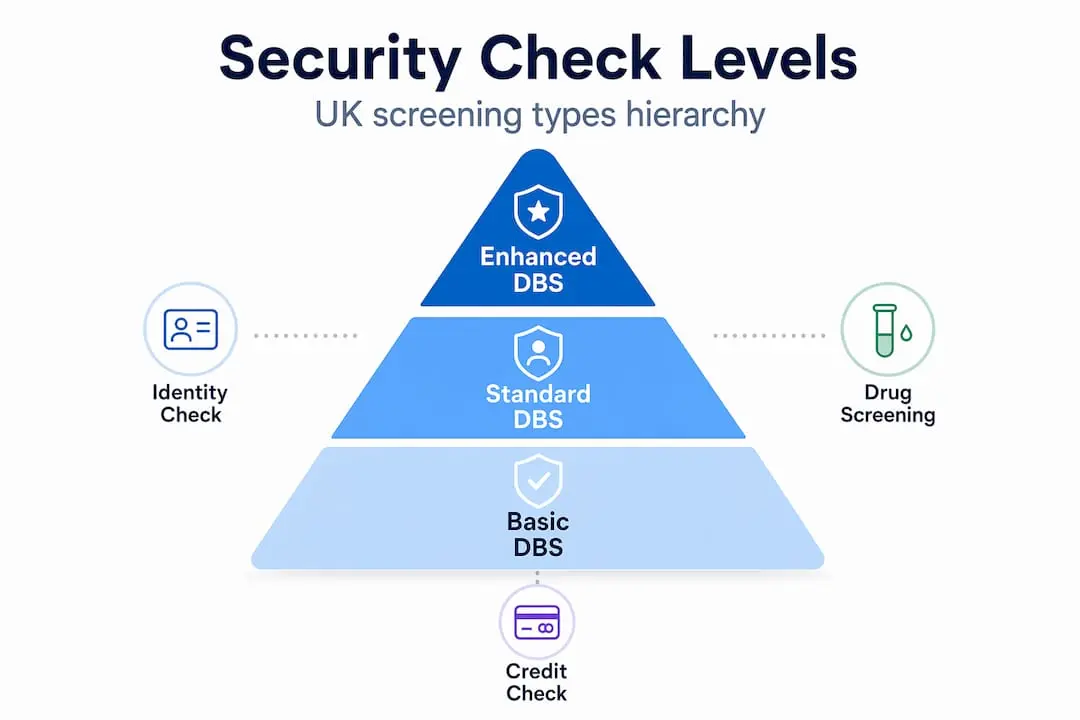
Identity and right to work checks are mandatory for all UK employers. For security roles, the SIA requires proof of identity as part of the licensing process. Right to work checks for security staff must be completed before employment begins, not during onboarding.

Employment and education verification confirms that the career history a candidate presents is accurate. In the security industry, false claims about previous roles, qualifications, or SIA licence history are not uncommon. Contacting previous employers directly, rather than relying solely on candidate-supplied references, is far more reliable.
Credit checks apply in specific circumstances. They are not standard across all security roles, but are appropriate for:
- Cash-in-transit operatives
- Security managers with procurement responsibilities
- Roles in financial institutions or data centres
- Senior positions involving budgetary oversight
Drug and substance screening is increasingly common across the sector, particularly for roles requiring the use of physical force, operating vehicles, or working in environments with zero-tolerance substance policies. Testing methods include urine, saliva, and hair follicle analysis, with hair follicle testing providing the longest detection window.
The key principle across all these checks is role-based tailoring. No single screening package suits every position. A layered approach, matching the depth of investigation to the actual risk profile of the role, produces far better outcomes for both employers and candidates.
Legal compliance and best practices
Getting the checks right is not only about the information they produce. It is about how you collect, use, and act on that information. Employers who cut corners on compliance face genuine legal exposure, and candidates who are not treated fairly in the process have real recourse.
The core obligations for employers running security checks in the UK are:
- Obtain written consent before initiating any background check. Verbal consent is not sufficient. The candidate must understand what checks will be run and why.
- Use accredited third-party providers where specialist checks are required, particularly for DBS and government vetting. Verify that any provider you use is registered with the relevant authority.
- Apply adverse action procedures correctly. If a check reveals information that might affect a hiring decision, the candidate must be notified. Final adverse action notices must clarify that the screening agency did not make the decision and cannot explain the reasons behind it.
- Store data securely and delete it appropriately. UK GDPR sets strict rules on data retention. Background check results should not be kept longer than necessary and must be stored with appropriate access controls.
- Apply checks consistently. Screening only certain candidates for the same role, particularly based on protected characteristics, is discriminatory and unlawful.
The FCRA-equivalent framework requires disclosure, consent, pre-adverse notification, and a waiting period before final decisions are made. Whilst the FCRA is a US instrument, UK employers working with international frameworks or US-based clients may encounter these obligations directly.
Pro Tip: Keep a written record of every consent obtained, every check run, and every decision made based on screening results. If a hiring decision is ever challenged, documentation is your primary protection.
A practical background check checklist can help employers systematise this process and reduce the risk of missing a compliance step.
My perspective on security checks in 2026
I have spent years watching organisations treat security checks as a formality, a box to tick before issuing a contract. What I have found, consistently, is that this approach produces the worst outcomes: missed risks, delayed hires, and candidates who feel like suspects rather than professionals.
The shift that matters most right now is the move towards continuous evaluation. I have seen clearance holders genuinely surprised to learn they are expected to self-report. They passed their vetting, they feel settled in the role, and suddenly there is an expectation of ongoing disclosure that nobody explained clearly. That gap between expectation and reality is where clearances get pulled, and often for reasons that were entirely preventable.
My view is that adjudicators use a holistic whole-person approach when reviewing clearance cases, which means context and documentation genuinely matter. A well-documented, proactively disclosed foreign contact is rarely a problem. An undisclosed one, discovered later, often is.
For employers, the most productive shift is framing checks as part of a trust-building process rather than a gatekeeping exercise. Explain to candidates what you are checking and why. Make the consent process a conversation, not a form. The candidates who engage openly with that process are frequently the ones you most want to hire.
The industry as a whole is still catching up with the pace of change in vetting technology and regulation. The organisations that invest in understanding the different security checks now, and build coherent, role-tailored screening programmes, will recruit faster and more reliably than those that do not.
— Rob
Find your next step with Securityjobsboard
Whether you are an employer building a compliant screening programme or a security professional preparing for your next role, understanding the checks involved is only part of the picture.

Securityjobsboard connects security professionals and employers across the UK, with listings and career advice resources designed specifically for the sector. If you are based in or recruiting for Northern Ireland, browse the current security jobs in Northern Ireland to find roles that match your background and clearance level. The platform is affiliated with the BSIA, free for candidates, and built to move at the pace the security industry demands.
FAQ
What are the main types of security checks in the UK?
The main types include DBS criminal records checks (basic, standard, and enhanced), government vetting levels (BPSS, CTC, SC, and DV), identity and right to work checks, employment and education verification, credit checks, and drug screening. The appropriate combination depends on the specific role and risk level.
What is the difference between a DBS check and security vetting?
A DBS check covers criminal records history and is administered by the Disclosure and Barring Service for most employment roles. Security vetting, managed by UKSV, is a more extensive government process required for access to classified information or sensitive government sites, and includes detailed personal, financial, and character enquiries.
Do employers need consent before running a security check?
Yes. UK employers must obtain written consent from a candidate before conducting any background check. Running checks without consent breaches data protection law and may expose the employer to legal liability.
What is continuous evaluation for security clearances?
Continuous evaluation monitors cleared individuals on an ongoing basis rather than relying solely on periodic reinvestigations. Clearance holders must self-report changes such as foreign travel, arrests, or financial difficulties, even where automated monitoring systems are already in place.
How often should employers update their security screening processes?
Employers should review their screening processes at least annually, or whenever there is a significant change in role requirements, applicable legislation, or the risk profile of the business. Screening methods and legal obligations in the UK security sector do evolve, and an outdated process creates genuine compliance gaps.


