What is a job ad? Security job posting essentials

TL;DR:
- Effective security job ads focus on skills, clear requirements, and transparent salary to attract qualified candidates.
- Using specialist platforms enhances relevance, reduces screening time, and improves hiring quality for security roles.
A job advertisement is far more than a simple listing of duties and requirements. In the UK security industry, the way you craft and place a job ad can determine whether you attract twenty well-matched candidates or two hundred poorly suited ones. Research now confirms what experienced security recruiters have long suspected: the structure, language, and platform of a job ad directly shape the quality of your applicant pool. Whether you are a recruiter trying to fill a control room vacancy or a jobseeker trying to understand what employers actually want, getting to grips with job ad fundamentals will save you significant time and frustration.
Table of Contents
- Defining job ads in the security sector
- Key features of effective security job ads
- Why specialist platforms matter for security job ads
- How to write and optimise a security job ad
- What most security job ads get wrong (and how to fix it)
- Find your next security role or recruit top talent
- Frequently asked questions
Key Takeaways
| Point | Details |
|---|---|
| Skills trump qualifications | Security job ads prioritising skills and communication outperform those focused on formal qualifications. |
| Salary transparency attracts talent | Including salary details significantly increases the quality and seniority of applicants. |
| Specialist boards speed up hiring | Niche platforms dedicated to security roles reduce candidate screening time and improve results. |
| Clear, tailored ads perform best | Well-structured ads with defined requirements and context draw better applicants and support efficient recruitment. |
Defining job ads in the security sector
A job advertisement, often called a job ad or job posting, is a formal communication from an employer to the labour market. Its purpose is to inform, attract, and filter. In the security sector, this means doing more than listing “must hold a valid SIA licence.” The best security job ads paint a clear picture of the role, the environment, and the kind of person who will genuinely thrive in it.
Security roles span an enormous range. You might be advertising for a door supervisor in Manchester, a cyber security analyst in London, or a CCTV operator supporting a logistics hub in the Midlands. Each of these roles carries its own professional culture, risk profile, and skill set. A job ad written without that context is effectively sending the wrong signal to the right candidates.
The essential elements of any security job ad include:
- Job title that reflects the actual role and mirrors common search terms
- Key duties and responsibilities, written in plain language
- Required skills and experience, separated from nice-to-haves
- Organisational context, so candidates understand the team structure
- Compliance details, such as SIA licence requirements or vetting clearance levels
- Clear application instructions with realistic timelines
One finding worth noting: communication skills appear in 50.9% of Security Operations Centre (SOC) job postings, compared to just 18.9% for technical skills. This tells us something important. Security roles are increasingly relational and communicative, not just procedural. Understanding the qualities employers seek in security staff gives both recruiters and candidates a grounded starting point for writing and reading job ads with real purpose.
“The best security job ads are not about what candidates have done. They are about what candidates can do, communicate, and adapt to. Skills-first language changes who applies and who gets hired.”
Key features of effective security job ads
With the basics established, we move into what makes a security job ad stand out and succeed.
Effective security job ads share several measurable traits. They are focused. They are honest about the demands of the role. And they prioritise skills over credentials in a way that modern research supports. The data is clear: skills-based ads attract more relevant candidates than those built around qualifications lists.
Here is a comparison of what weak versus strong security job ads typically include:
| Feature | Weak job ad | Strong job ad |
|---|---|---|
| Job title | “Security officer needed” | “SIA-licensed door supervisor, Manchester city centre” |
| Skills focus | Lists qualifications only | Emphasises communication and situational awareness |
| Salary | “Competitive” | Specific hourly rate or annual salary range |
| Duties | Vague, generic list | Specific tasks linked to the security environment |
| Application process | “Send CV” | Named contact, closing date, steps clearly stated |
| Organisational context | None | Team size, shift pattern, reporting structure |
The communication skills finding deserves more attention. In SOC (Security Operations Centre) roles specifically, communication over technical skills appears as the dominant requirement across postings. SOC roles involve monitoring threats and coordinating responses, which demands clear verbal and written communication under pressure. If your job ad says nothing about communication expectations, you are missing a signal that many of the best candidates look for.
Salary transparency is another major factor. Senior candidates, particularly in cyber security and management roles, are far less likely to apply when salary is listed as “competitive” or omitted entirely. They are experienced enough to know their market value and will skip ads that hide compensation details. Your job ad is not the place for negotiating leverage. It is the place for honest, direct information.

Pro Tip: Always define abbreviations on first use. SOC (Security Operations Centre) and SIEM (Security Information and Event Management) may be second nature to you, but candidates newer to the sector will disengage if they feel lost in jargon.
Our security job posting guide goes into further detail on structuring ads for UK security roles, and our security job advert tips offer employer-specific guidance. For a broader look at what functionality to look for when choosing where to post, the article on job board features for security is particularly useful.
Why specialist platforms matter for security job ads
Understanding what to include is important, but where you advertise can be just as crucial.
General job boards like Indeed or Reed have enormous reach. That reach is also their weakness for security recruitment. When you post a security officer vacancy on a general platform, you are competing for attention alongside thousands of unrelated roles. Your ad may technically be visible, but it is surrounded by noise that dilutes its impact.
Specialist security job platforms solve this by concentrating the audience. Every candidate visiting a dedicated security jobs board is already in the industry or actively trying to enter it. That means your ad starts with a qualified audience rather than a general one. The result: specialist sites reduce the screening time required to find genuinely suitable applicants.
Here is how general and specialist platforms compare for security recruitment:
| Factor | General job board | Specialist security board |
|---|---|---|
| Audience relevance | Mixed | Security-focused |
| Candidate filtering | Generic keyword filters | Industry-specific fields |
| Licence verification prompts | Rarely included | Often built-in |
| Screening time | Longer | Shorter |
| CV database quality | Variable | Sector-relevant |
| Employer credibility signals | Limited | Strengthened by sector affiliation |
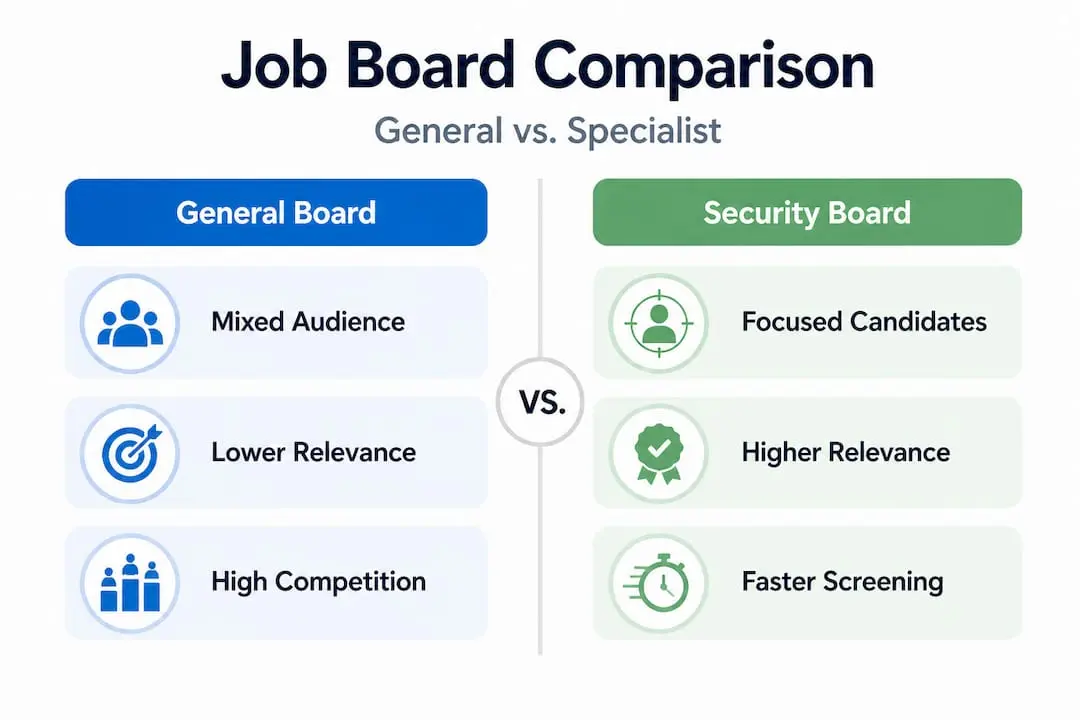
For recruiters working across transportation, logistics, or cyber security, the benefits of specialist platforms are even more pronounced. Roles requiring specific clearance levels or sector knowledge attract very different applicant profiles. Casting your net on a general board means filtering through a high volume of irrelevant applications. Specialist boards for logistics consulting and security roles alike demonstrate that niche advertising consistently outperforms general reach for technical or regulated roles.
The key advantages of specialist platforms, ranked by impact on recruitment efficiency:
- Higher proportion of industry-qualified candidates in the applicant pool
- Built-in filters for licence type, clearance level, and role specialism
- Faster time-to-shortlist due to pre-qualified candidate profiles
- Greater trust among experienced candidates who prefer industry-specific sources
- Access to passive candidates who maintain profiles on niche boards but rarely browse general sites
If you are ready to compare your options, the article on the best job posting sites for security recruiters provides a detailed breakdown. And if you are ready to move directly to posting, you can advertise jobs directly on The Security Jobs Board with flexible pricing options to suit your recruitment volume.
How to write and optimise a security job ad
After platform selection, the next step is to create job ads that genuinely attract the right talent.
Writing a security job ad from scratch can feel overwhelming if you have never done it with a structured approach. The following process cuts through that uncertainty and gives you a repeatable workflow.
- Analyse the role in detail. Talk to the hiring manager or the team the new recruit will join. Understand the day-to-day reality, not just the job description template from HR.
- Identify the three to five most critical skills. These should be non-negotiable for the role. In physical security, that might be conflict de-escalation and report writing. In cyber, it might be incident response and log analysis.
- Define the job context clearly. Where is the role based? What are the shift patterns? Is lone working involved? Candidates need this information to self-select appropriately.
- Specify requirements honestly. Separate essential from desirable. An SIA licence may be essential. A specific vendor certification might be desirable. Blurring this line wastes everyone’s time.
- Write the application process out explicitly. Name the contact, state the closing date, and explain what happens after submission. Ambiguity kills engagement.
- Remove unnecessary jargon. Every acronym or insider term you leave unexplained is a reason for a strong candidate to click away.
Cyber ads without salary consistently attract fewer senior applicants. This is not a minor issue. Senior security professionals, especially those with CISM (Certified Information Security Manager) or CISSP (Certified Information Systems Security Professional) credentials, have options. They filter by salary first and by job title second. If your ad does not show a figure, it often does not make their shortlist.
Pro Tip: Replace generic phrases like “excellent communication skills required” with specific behavioural language such as “able to produce clear written incident reports within two hours of an event.” Specificity improves screening efficiency and signals a well-organised employer.
Our guide to the job posting workflow walks through this process in more detail, and if you are a jobseeker trying to decode what employers are really looking for, the guide on optimising security job searches gives you the other side of the same picture. For a broader data view, the security job ad benchmarks source referenced throughout this article offers empirical context.
What most security job ads get wrong (and how to fix it)
Having covered practical steps, let us look at the bigger picture and what really matters for success.
The uncomfortable truth about UK security job ads is that most of them are still built on templates from a decade ago. They lead with formal qualifications, list duties in vague terms, and avoid mentioning salary. These are not just stylistic problems. They actively reduce the quality of applicant pools and extend time-to-hire.
The shift has already happened in the data. Skills over qualifications is now the dominant pattern in high-performing security job postings, with communication skills appearing in more than half of SOC ads. Yet walk through any general job board today and you will still find security ads that open with “must hold Level 2 Award for Door Supervisors” and say nothing about the candidate’s ability to manage conflict verbally or write a coherent incident log.
There is also a cultural resistance to salary transparency that harms security employers more than it protects them. Hiding compensation feels strategic. In practice, it filters out confident, experienced candidates who have better options and leaves you with applicants who are either desperate or unaware of market rates. Neither is the ideal starting point for a hire.
The real fix is not complicated. It requires moving from a compliance mindset, where the job ad is simply a legal document listing what the role requires, to a communication mindset, where the job ad is the first impression a candidate has of your organisation. Every word sends a signal. A vague ad signals a disorganised employer. A skills-first ad signals a progressive one.
Understanding the full job posting life cycle helps recruiters see that the job ad is not the end of the process. It is the beginning of a relationship with a candidate, and first impressions in recruitment matter as much as they do anywhere else.
Find your next security role or recruit top talent
Ready to put these strategies to work? Here is how The Security Jobs Board can help you find the perfect fit or the right talent.
Whether you are a recruiter trying to fill a critical vacancy or a security professional looking for your next opportunity, The Security Jobs Board is built specifically for this industry. Our platform connects candidates and employers across physical security, cyber security, CCTV operations, and specialist roles throughout the UK.

Jobseekers can browse roles including security jobs in Northern Ireland and across every UK region, with free profile creation, CV upload, and job alerts. Employers benefit from a targeted CV database, flexible posting plans, and a candidate pool that actually understands the industry. Explore everything available across UK security careers and start connecting with the right people today. Affiliated with the BSIA, The Security Jobs Board brings credibility and sector expertise to every search.
Frequently asked questions
What makes a job ad effective for security roles?
A skills-based approach, clear communication of requirements, and transparency in salary combine to attract qualified candidates and speed up hiring. Skills over qualifications now drives better results across most UK security postings.
Why should I use specialist job boards for security jobs?
Specialist platforms target industry-specific candidates, reducing screening time and improving the quality of applicants significantly. Evidence shows that specialist sites reduce time-to-shortlist compared to general job boards.
Should I always include a salary in a security job ad?
Yes, including salary is proven to increase senior candidate applications and overall ad effectiveness. Cyber ads without salary consistently attract fewer experienced applicants across the UK security market.
What skills are most valued in SOC security job postings?
Communication skills appear in over half of SOC job ads, overtaking technical expertise and qualifications as the primary requirement. Research confirms that communication over technical skills is the defining trend in current SOC postings.
How do I optimise my job ad for best results?
Define your three to five key skills, provide a clear role overview, include a transparent salary range, and avoid unexplained jargon throughout. Skills-based ads attract the most relevant applicants when combined with specific behavioural language.


