Qualify in 1–2 Weeks: UK Entry Level Security Roles Mistaken for Cyber
Door supervisor, security guard, CCTV operator, mobile patrol and keyholding officer are the main entry-level roles in UK physical security. Nearly all of them need an SIA front line licence, which means completing a licence-linked qualification first. The immediate next step is simple: work out which licence your target role needs, then book an SIA-approved course or ask a prospective employer whether they’ll sponsor the application.
TL;DR:
- Most entry-level security roles require an SIA front line licence, which necessitates completing a specific licence-linked training course beforehand.
- Door supervisor training takes about a week and allows access to both crowd control and security guard roles, doubling job prospects with one qualification.
- The typical pay ranges from £17,000 to £28,000 depending on the role and venue, with night shifts and weekends often commanding higher wages.
- The licensing process involves application fees, background checks, and waiting times that can extend beyond the training period, requiring careful planning.
- Candidates are advised to target specialized security job platforms and employers offering licence sponsorship to accelerate their hiring chances.
Table of Contents
- What are some entry level security jobs, and what do they actually involve?
- How do you qualify: SIA licences, courses and first aid?
- What can you expect to earn, and how does progression work?
- Where do you actually find these jobs, and how do you apply well?
- What should employers check before hiring entry-level security staff?
- What entry-level roles exist in the wider security workforce?
- What qualifications and training actually count in this sector?
- What skills matter most for these entry-level roles?
- Who’s actually hiring for these roles?
- What trips up new candidates the most?
- Rob’s perspective: what actually shortens the hiring gap
- Post a vacancy or find your next shift with Security Jobs Board
- Sources
- FAQ
What are some entry level security jobs, and what do they actually involve?
Each role suits a different temperament, and the licence you hold often dictates which doors open first.
- Door supervisor: crowd control, ID checks and de-escalating conflict at the entrance of pubs, clubs and licensed venues. The Door Supervisor licence is one of the most useful entry qualifications because it also permits you to work as a security guard, giving you two job types from one course.
- Security guard: static guarding at retail units, office receptions and construction sites. Expect patrols, incident logging, visitor management and a fair amount of customer-facing work, especially in retail.
- CCTV operator: monitoring live feeds, reviewing footage and liaising with police or venue management when something happens. This role demands a working grasp of data protection, since footage often counts as personal data and mishandling it creates real liability.
- Mobile patrol / keyholding officer: driving between sites, responding to triggered alarms and carrying out scheduled site checks. It suits candidates who’d rather not sit in one spot all shift and who hold a full driving licence.
- Event steward and store detective: lower-barrier entry points that often don’t require a full SIA licence on day one, though many stewards and loss-prevention staff go on to take a licensed qualification once they’ve decided guarding is for them.
Employers hiring for these roles range from pub and nightclub groups to retail chains, facilities management firms, construction contractors and specialist guarding companies. Most expect the correct licence in hand, or clear evidence you’re actively training towards one, before they’ll put you on a rota.
How do you qualify: SIA licences, courses and first aid?
The SIA sets out which “licensable activities” need a front line licence, and each maps to a specific licence-linked qualification you must hold before applying.
- Door supervision needs the Level 2 Award for Working as a Door Supervisor. As the National Careers Service confirms, this qualification is required before you can even apply for the licence, not after.
- Security guarding needs the Level 2 Award for Working in the Private Security Industry (Security Guarding).
- Public space surveillance (CCTV) needs the Level 2 Award for Working as a CCTV Operator, plus a solid understanding of evidence handling.
- Cash and valuables in transit, and vehicle immobilisation in Northern Ireland, have their own specific licence-linked awards.
All of these qualifications are delivered by SIA-approved training centres using awarding bodies such as Highfield, Pearson or Ofqual-regulated equivalents, and every route includes a mandatory first aid element, usually Emergency First Aid at Work, which you must hold or complete before starting the licence-linked course itself.
Before you’re eligible for any licence, you need to be 18 or over, prove your right to work in the UK, and pass an enhanced criminal record check as part of the application. Fees and processing times vary, so check current timescales directly with the SIA before booking training around a start date.
Pro Tip: Ask your training provider whether their course includes refresher training guidance. Refresher training became mandatory for security guarding licence renewals from October 2024, and this became a general requirement from April 2025, so a course that ignores it will leave you out of date fast.
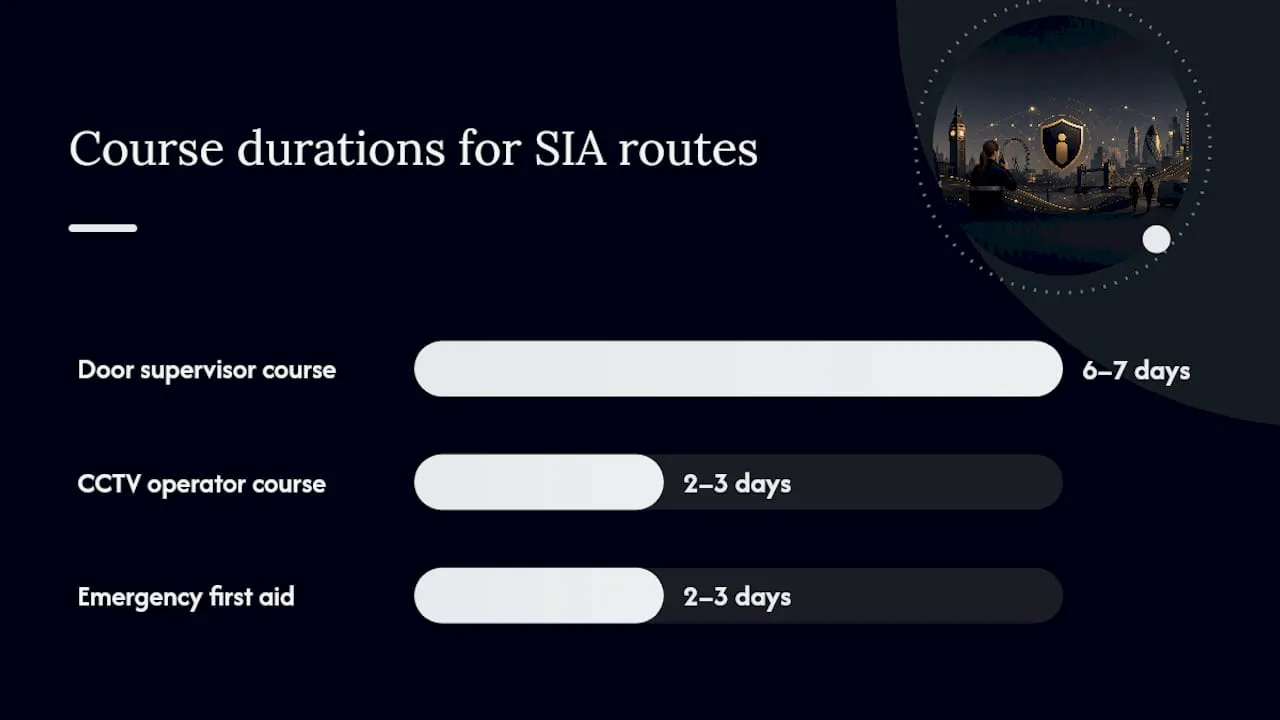
Training providers report that door supervisor courses typically run 6 to 7 days, while CCTV operator and first aid courses often take just 2 to 3 days. That’s a realistic week or two from a standing start to a licensable qualification, not months.
What can you expect to earn, and how does progression work?
Pay in entry-level security work varies more by hours and venue type than by job title alone, so treat any single figure as a rough guide rather than a promise.
- Door supervisor: often £20,000 to £28,000, reflecting late-night and weekend premiums at licensed venues.
- Static security guard: typically £17,000 to £21,000, usually on standard shift patterns.
- CCTV operator: roughly £19,000 to £25,000, often with a control room shift pattern including nights.
- Mobile patrol officer: pay tends to sit close to static guarding rates, with mileage or vehicle allowances added on top in many contracts.
Nights and weekends are the norm across nearly every one of these roles, and overtime during peak periods (festive trading, event season, festival calendars) is common. Progression usually starts with adding a second licence, door supervisors picking up a security guard qualification or vice versa, before moving into supervisor or team leader positions, or specialising into control room, close protection or CCTV management work.
Where do you actually find these jobs, and how do you apply well?
Specialist platforms such as Security Jobs Board list roles specifically for licensed operatives, which cuts out the noise you get on general job sites where “security” often means something else entirely. Agency registers, individual employer career pages and local college apprenticeship listings are worth checking too.
- Build a short, focused CV that leads with your SIA licence status (held, or licence-linked qualification in progress), your right to work, and any first aid certificate you hold.
- Upload that CV and set job alerts so relevant vacancies come to you rather than the other way round.
- Use fast-apply features where available. Response speed matters in this sector because shifts often need filling within days, not weeks.
- Target employers who advertise paid training or licence sponsorship. Some cover the SIA fee or apply on a candidate’s behalf, so it’s always worth asking directly if it isn’t stated in the advert.
Browsing a CV database of licensed candidates also gives you a sense of how competitors present their qualifications, useful intelligence before you finalise your own CV.
What should employers check before hiring entry-level security staff?
Getting the pre-hire checks right protects the business and speeds up onboarding.
- Verify right to work and run an enhanced background check appropriate to the role.
- Confirm the SIA licence is current and matches the licensable activity you’re hiring for, not just any security licence.
- Check training certificates, including first aid validity, since an expired certificate can invalidate a candidate’s eligibility to work unsupervised.
- Write a clear advert: state the exact licence type required, shift pattern, whether training or the licence fee is paid, an honest pay range, and whether a DBS check is part of the process.
- Cover onboarding basics: confirm first aid renewal dates, keep secure digital records of qualifications, and set clear expectations for incident reporting from day one.
What entry-level roles exist in the wider security workforce?
Security analyst, junior penetration tester, SOC analyst and incident responder titles show up frequently in general career searches, but they sit in IT and digital security rather than the frontline, licensed roles covered here. Anyone typing “entry level security jobs” into a search engine and landing on those titles is often looking for something entirely different from door supervision, static guarding or CCTV monitoring.
That distinction matters practically. If you’re aiming for physical, on-site security work, the roles that actually match your search are door supervisor, security guard, CCTV operator, mobile patrol officer and keyholder, each requiring an SIA front line licence rather than a computing qualification. If your interest genuinely lies in digital systems and networks, you’re looking at a different training pathway altogether, one built around IT certifications rather than SIA licensing.
Confusing the two wastes time. A candidate who trains for a Level 2 CCTV Operator award and then applies to SOC analyst vacancies, or vice versa, has picked the wrong ladder entirely. The good news for physical security jobseekers is that the licensed pathway is shorter and clearer: a defined qualification, a defined licence, and a defined set of employers actively recruiting for it right now.
What qualifications and training actually count in this sector?
The credentials that matter for licensed security work are narrower and more specific than general “security” certificates you might see advertised online.
The Level 2 Award for Working as a Door Supervisor, the Level 2 Award for Working in the Private Security Industry (Security Guarding), and the Level 2 Award for Working as a CCTV Operator are the three that unlock the majority of entry-level frontline vacancies. Each is delivered by SIA-approved training centres, assessed against a national standard, and directly tied to a specific licence category.
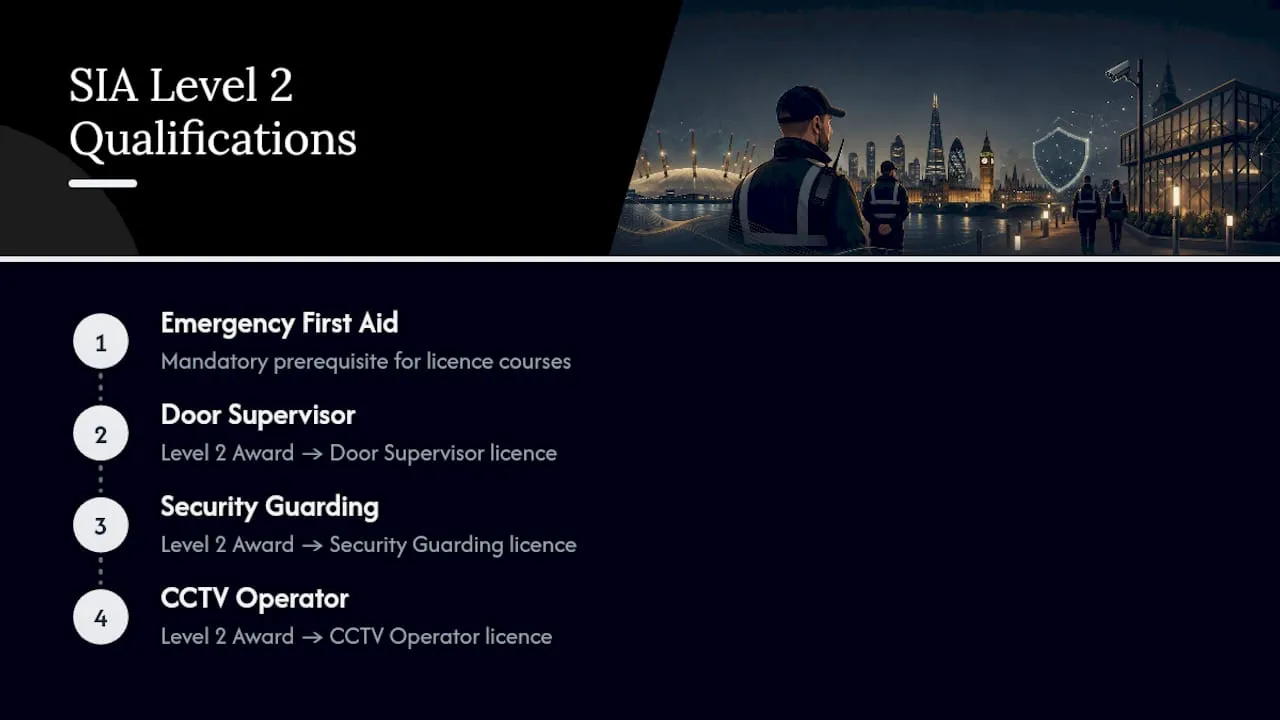
First aid certification, usually Emergency First Aid at Work, sits alongside these as a mandatory prerequisite rather than an optional extra. You cannot complete most licence-linked courses without it already in hand or built into the course structure.
Beyond the mandatory minimum, some candidates add short CPD courses in conflict management, counter-terrorism awareness or physical intervention to strengthen their CV, particularly for door supervision roles at higher-risk venues. These aren’t legally required but often make a candidate more attractive to venues with a history of incidents. None of this replaces the core licence-linked qualification. It supplements it, and employers can usually tell the difference between a padded CV and a genuinely well-prepared one.
What skills matter most for these entry-level roles?
Technical competence in this sector is mostly procedural: knowing how to conduct a proper ID check, how to write an incident report that would stand up if the police needed it, and how to operate CCTV or alarm systems correctly under data protection rules.
Soft skills carry just as much weight, arguably more in the first few months. Conflict de-escalation is the single most valuable skill a door supervisor can bring to a shift, since most incidents are resolved through calm, confident communication rather than physical intervention. Customer service matters constantly in static guarding, where a large share of the job is directing visitors and answering questions rather than confronting problems.
Reliability and a level head under pressure tend to separate candidates who last from those who don’t. Shifts are often solitary, sometimes at night, and the job occasionally throws up situations with no script to follow. Physical fitness helps for mobile patrol and door supervision, but it’s rarely the deciding factor employers mention when asked what makes a good hire; judgement and communication rank higher on most lists.
Who’s actually hiring for these roles?
Pub and nightclub groups, hotel chains and event venues are the biggest recruiters for door supervisors, particularly around weekends and the festive trading period when licensed premises need extra cover. Retail chains and shopping centres hire static guards and store detectives in volume, often through facilities management contractors rather than directly.
Construction firms and their principal contractors need site guarding around the clock, frequently on rolling shift patterns tied to project timelines. Local authorities and larger corporate estates run their own CCTV control rooms or contract them out, creating steady demand for CCTV operators, especially in town centres with public space surveillance schemes.
Mobile patrol and keyholding work tends to come through specialist guarding companies who service a portfolio of client sites overnight, from warehouses to retail parks. Across all of these, the outlook for the sector has stayed consistently active because licensed guarding, unlike many entry-level jobs, can’t be automated or outsourced overseas.
What trips up new candidates the most?
The biggest misconception is assuming you can start work first and sort the licence out later. You can’t. The licence-linked qualification comes before the licence application, and the licence comes before you’re legally allowed to work the role, full stop.
A second common mistake is training for the wrong licence for the job you actually want. Someone hoping to work nightclub doors who only holds a security guarding qualification will find themselves turned away from door supervisor vacancies, because the two licences aren’t interchangeable despite sounding similar.
Candidates also underestimate processing time. Between booking a course, sitting it, and waiting for the licence application to clear identity and criminal record checks, the timeline can stretch well beyond the few days the training itself takes. Building in that buffer before you need to start earning matters more than most guides admit.
Rob’s perspective: what actually shortens the hiring gap
The single biggest lever in this sector isn’t marketing spend or clever adverts. It’s licensing. A candidate who walks in with the right SIA licence already in hand removes almost all the risk an employer is weighing, and that confidence shortens time-to-hire more than anything else I’ve seen discussed in recruitment circles.
Specialist platforms and affiliations matter for the same reason. A board built specifically around security roles, with BSIA backing behind it, filters out the mismatched applications that flood general job sites and leaves employers looking at candidates who actually understand what the licence means. If you’re job hunting or hiring right now, that’s worth exploring properly rather than skimming past.
— Rob
Post a vacancy or find your next shift with Security Jobs Board
There are specialist platforms providing direct routes to licensed security work in the UK, built specifically for this sector rather than adapted from general recruitment sites. Candidates can access CV upload, job alerts and fast-apply tools on some platforms, helping their licence-linked qualification translate into interview opportunities faster than on generic applicant pools.

Employers can use job postings, CV database access and candidate communication features on some platforms, often supported by BSIA affiliations, GDPR compliance and mobile-friendly designs suitable for various work settings. If you’re recruiting or job hunting in Belfast, Derry or anywhere else across the region, the Northern Ireland security jobs listings are live now, so check current vacancies or post your own role today.
Sources
Verify licensing detail directly through SIA guidance on GOV.UK, the SIA get licensed PDF, and the National Careers Service door supervisor profile.
- Door supervisor | Explore Careers | National Careers Service
- Gov
- How to start a security career in the UK (JFK Tech, 2026)
- The complete guide to starting your career in the UK security industry (Mango Solutions, 2025)
FAQ
What is the fastest entry-level security job to qualify for?
CCTV operator and first aid courses often run just 2 to 3 days, making the CCTV licence-linked qualification one of the quickest routes into a licensed role.
Do I need a licence before applying for security jobs?
You generally need to complete the licence-linked qualification and hold the SIA licence itself before starting frontline work, though some employers will sponsor the application or fee for a candidate already in training.
Which entry-level security job pays the most?
Door supervisor roles often sit at the top of the entry-level range, around £20,000 to £28,000, reflecting late-night and weekend premiums at licensed venues.
Can one licence cover more than one job type?
Yes. A Door Supervisor licence also permits security guarding work, making it one of the more flexible first qualifications for new entrants.
Where can I find entry-level security vacancies quickly?
Specialist platforms such as Security Jobs Board list licensed vacancies directly, and setting up a profile with job alerts speeds up matching considerably over general job sites.


