Streamline security recruiting: smart job board integration

TL;DR:
- Automating job posting reduces manual effort and speeds up hiring by up to 20%.
- Proper integration ensures compliance with UK regulations like GDPR and SIA licensing.
- Using sector-specific platforms improves candidate quality and mitigates legal and reputational risks.
Manual job posting is quietly costing UK security employers more than they realise. Between re-entering vacancy details across multiple platforms, chasing SIA licence verifications, and wrestling with GDPR obligations, recruitment teams are burning hours that could go elsewhere. Modern job board integration changes that equation entirely. By automating the connection between your applicant tracking system (ATS) and external job boards, you can reduce time-to-hire by 20% and focus your energy on assessing candidates rather than managing spreadsheets. This guide covers what integration actually means for security hiring, why it matters, how to implement it, and the pitfalls that catch even experienced recruiters off guard.
Table of Contents
- What is job board integration in security recruitment?
- Core benefits of job board integration for security employers
- How to implement job board integration: practical steps
- Avoiding common pitfalls and ensuring compliance
- Why the right integration strategy matters for the security sector
- Connect with specialist security job platforms
- Frequently asked questions
Key Takeaways
| Point | Details |
|---|---|
| APIs outperform scraping | API-based integrations deliver better reliability, compliance, and data quality than scraping approaches for the UK security sector. |
| Specialist boards boost compliance | Using SIA-aware and GDPR-compliant job boards greatly improves legal and candidate-matching outcomes in security hiring. |
| Time and error savings | Automated job board integration can cut hiring times and reduce repetitive manual errors, freeing up hiring teams. |
| Plan for compliance early | Integration setup must account for UK legal checks like GDPR, right-to-work, and DBS to avoid critical pitfalls. |
What is job board integration in security recruitment?
Job board integration is the automated connection between your ATS and one or more external job boards. Instead of manually logging into each platform, copying job descriptions, and updating statuses by hand, integration lets your system push vacancies, pull applications, and sync data automatically. For security employers, this is not just a convenience. It is a compliance necessity.
Security roles carry specific regulatory requirements that generic hiring workflows often ignore. Candidates need valid SIA licences, right-to-work documentation, and in many cases a Disclosure and Barring Service (DBS) check. Your job posting workflow must accommodate these checks from the very first touchpoint, not as an afterthought once a candidate has already applied.
There are three main types of integration worth understanding:
- Direct API integration: Your ATS communicates with a job board via a structured application programming interface. Data flows reliably in both directions.
- ATS multi-post tools: Middleware platforms that distribute a single job post to multiple boards simultaneously, often via API connections under the hood.
- Web scraping: Automated bots that extract job data from websites without a formal data agreement.
The distinction between scraping and API matters enormously. APIs are more reliable and compliant than scraping, which frequently breaks when a website updates its layout, triggers anti-bot defences, and raises serious questions about data ownership and GDPR compliance.
Here is a quick comparison of integration types:
| Integration type | Reliability | Compliance risk | Setup complexity |
|---|---|---|---|
| Direct API | High | Low | Medium |
| ATS multi-post | High | Low | Low |
| Web scraping | Low | High | Low initially |
For UK security recruitment, the stakes around compliance are especially high. GDPR governs how candidate data is stored and processed. Right-to-work checks are a legal obligation. SIA licensing must be verified before placement. Any integration you choose needs to support these requirements natively, not as a bolt-on feature. Choosing a platform built for the sector means these compliance layers are already baked in, rather than something you have to engineer yourself.
Core benefits of job board integration for security employers
The advantages of proper integration go well beyond saving a few clicks. When done right, it reshapes how your entire recruitment function operates.
Speed and volume. Posting a vacancy manually across five platforms might take 45 minutes. With integration, the same task takes seconds. That efficiency compounds quickly when you are hiring for multiple sites or managing high-turnover roles like door supervisors and CCTV operators.
Better candidate matching. Hybrid retrieval improves candidate matches, combining keyword search with contextual filtering to surface applicants who genuinely fit the role. Integration with specialist boards means your vacancy reaches people who are actively looking for security work, not just anyone browsing a general jobs site.

Compliance consistency. Every application that enters your ATS through an integrated board carries the same data fields, in the same format. That consistency makes it far easier to run systematic right-to-work and DBS checks without missing anyone.
Here is how manual and integrated recruiting compare in practice:
| Factor | Manual recruiting | Integrated recruiting |
|---|---|---|
| Time to post across 5 boards | 45+ minutes | Under 5 minutes |
| Candidate data consistency | Variable | Standardised |
| GDPR audit trail | Manual | Automated |
| SIA licence field capture | Ad hoc | Structured |
| Application volume | Limited | Significantly higher |
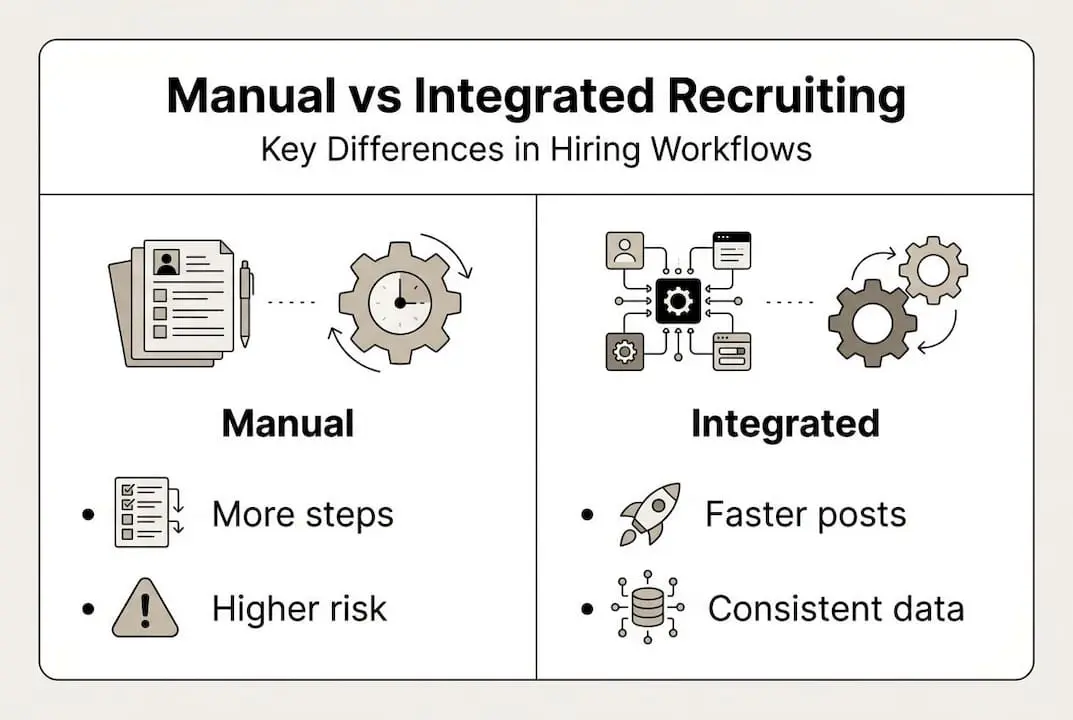
Job board integration reduces time-to-hire and increases placements, with some firms reporting nearly 20 percent faster hiring cycles after switching from manual processes. That is not a marginal gain. For a security company filling urgent site cover, it can be the difference between winning and losing a contract.
Key benefits at a glance:
- Eliminates duplicate data entry across platforms
- Reaches specialist SIA-licensed candidate pools via best job posting sites
- Automates candidate data handling in line with GDPR recruitment guidance
- Synchronises application statuses in real time
- Reduces human error in compliance-critical data fields
Pro Tip: Do not rely solely on general job boards. Pairing a broad platform with a specialist security board gives you volume and quality simultaneously. The two serve different candidate pools and work best together.
How to implement job board integration: practical steps
Getting integration right requires more than flipping a switch. Here is a realistic roadmap for security employers.
-
Evaluate your ATS compatibility. Check whether your current ATS supports API connections to external job boards. Many modern systems do, but older platforms may require middleware. Confirm what data fields your ATS exports and whether they map to the fields required by your target boards.
-
Select your job boards. Choose a mix of general and specialist platforms. General boards expand reach; specialist security boards improve candidate quality and SIA-licence filtering. Consider boards that are already familiar with UK compliance requirements.
-
Connect via API. Work with your ATS provider or a developer to establish the API connection. Avoid scraping solutions for compliance-critical roles. Test in sandboxes, monitor errors, and map data precisely before going live. A sandbox environment lets you catch formatting errors and missing fields without affecting live vacancies.
-
Map your data fields carefully. Job title, location, salary, required licences, and application deadline must all transfer accurately. Pay particular attention to SIA licence type fields and DBS requirement flags. Sloppy mapping here creates compliance gaps downstream.
-
Synchronise job status and expiry. Use ISO 8601 date formatting for expiry dates to avoid timezone conflicts. When a role is filled or withdrawn, that status must update across every board simultaneously. Stale listings attract unsuitable applicants and damage your employer brand.
-
Monitor results and iterate. Track application volumes, source quality, and time-to-fill by board. Use this data to reallocate posting budgets toward the platforms delivering the best candidates for your specific roles.
You can also explore best hiring tools to find ATS platforms already optimised for security sector workflows, which can significantly shorten your setup time.
Pro Tip: Allocate your posting quota strategically. High-value or hard-to-fill roles such as close protection officers or control room managers deserve priority placement on specialist boards, not just general ones.
Important: Quota prioritisation and status mapping are key error sources in job board integrations. If your ATS does not handle status updates gracefully, you risk live listings for roles that are already closed, creating a poor candidate experience and potential compliance issues.
A well-structured job posting workflow that incorporates these steps will save significant time and reduce the risk of errors that could expose your business to legal or reputational harm.
Avoiding common pitfalls and ensuring compliance
Even well-planned integrations run into problems. Knowing where things typically go wrong puts you ahead of most security recruiters.
The most common errors include:
- Duplicate listings: Poor deduplication logic pushes the same vacancy multiple times, confusing candidates and inflating your apparent vacancy count.
- Mishandled job expiry: Roles that close in your ATS but remain live on job boards waste candidate time and generate applications you cannot process fairly.
- Ignored apply_id validation: When applications arrive without a valid apply_id, they can be orphaned in your system, meaning candidates never receive a response.
- Inconsistent data formats: Date fields, salary ranges, and location data formatted differently across boards create reconciliation headaches.
Prioritising UK compliance including GDPR, DBS, and right-to-work in every stage of your integration is not optional. It is the foundation on which everything else rests.
UK-specific do’s and don’ts:
- Do ensure every integration partner is GDPR compliant and can demonstrate a lawful basis for data processing
- Do include SIA licence type as a structured field, not free text
- Do set automatic expiry for all listings and test that status sync works in both directions
- Do not use scraping tools for roles requiring sensitive candidate data
- Do not store candidate data beyond the retention period specified in your privacy notice
- Do not assume a general board’s compliance framework covers UK security-specific requirements
For a deeper look at what GDPR compliant boards look like in practice, and what best job posting practices mean for security roles specifically, both resources are worth bookmarking before you go live.
Pro Tip: Map every ATS status field to its job board equivalent before launch. “Under review,” “shortlisted,” and “rejected” mean different things in different systems. Mismatches here are one of the most common causes of candidate communication failures.
Why the right integration strategy matters for the security sector
Here is something most technology vendors will not tell you: the most sophisticated integration is not always the most effective one. We have seen security employers invest in elaborate multi-board setups only to find their compliance gaps were never addressed because the platforms they chose were built for retail or hospitality hiring, not security.
Generic integrations fail the compliance test because they treat all jobs as equivalent. They do not know what an SIA licence is. They cannot flag a missing DBS check. They have no concept of right-to-work verification as a pre-application requirement. The result is a fast, automated system that still produces non-compliant hiring outcomes.
The hidden return on investment in integration is not just speed. It is the ongoing reduction in compliance risk, the protection of candidate data, and the reputational value of being known as an employer who handles applications professionally. Candidates notice when their data is handled poorly. So do regulators.
Our view, shaped by working closely with the UK security sector, is this: a simple, well-configured integration with a recruitment platform comparison done properly will always outperform a complex system built on shaky compliance foundations. In 2026, the recruiters who will pull ahead are those who prioritise reliability and regulatory fit over feature count.
Connect with specialist security job platforms
If you are ready to move beyond manual posting and build a recruitment process that actually fits the demands of the UK security industry, the right platform makes all the difference.

Security Jobs Board is built specifically for security sector hiring in the UK, with GDPR compliance, SIA-licence filtering, and BSIA affiliation already built in. Whether you are filling roles in London or looking for security jobs in Northern Ireland, the platform connects you with candidates who are actively seeking security work, not just passively browsing. Post your vacancies, browse the CV database, and start reaching qualified, licence-verified candidates today.
Frequently asked questions
What is the difference between API integration and job scraping?
API integration offers structured, reliable, and compliant data transfer, while scraping is less stable, frequently breaks against anti-bot measures, and raises significant compliance concerns for security employers.
How does job board integration support GDPR compliance?
Automated integrations create consistent, auditable handling of candidate data in line with UK GDPR, and structured data fields make it easier to enforce right-to-work and DBS check requirements at the point of application.
Which are the best job boards for UK security recruitment?
Specialist platforms like Security Jobs Board improve SIA-compliant hiring by targeting active security professionals, while general boards expand reach to passive candidates. Using both together delivers the strongest results.
How much time can automation really save security recruiters?
Job board integration can save up to 22 hours per week and cut hiring times by nearly 20 percent, based on real-world results from UK recruitment firms that have made the switch.


