Security recruitment trends 2025: what HR must know

TL;DR:
- Budget constraints have overtaken talent shortages as the primary obstacle to UK security hiring in 2025. Skills-based assessments, structured junior pathways, and clear ROI demonstrations are essential strategies for effective recruitment. Organisations that develop talent pipelines and adapt to regulatory and technological shifts will succeed in the evolving security landscape.
The security recruitment trends 2025 brings to the surface are not simply an evolution of what came before. They represent a genuine structural shift in how UK employers find, assess, and retain security professionals. Budget constraints have replaced talent shortages as the number one hiring barrier, AI is reshaping which roles exist at all, and regulatory frameworks like NIS2 are forcing teams to hire differently. If you are a hiring manager or HR professional in the UK security sector, the strategies that worked in 2022 are no longer enough.
Table of Contents
- Key takeaways
- Security recruitment trends 2025: the shifting landscape
- Preparing your recruitment strategy for 2025
- Executing effective security hiring in 2025
- Avoiding common pitfalls in security recruitment
- Measuring whether your approach is working
- My take on where security recruitment is really heading
- Find your next security hire with Securityjobsboard
- FAQ
Key takeaways
| Point | Details |
|---|---|
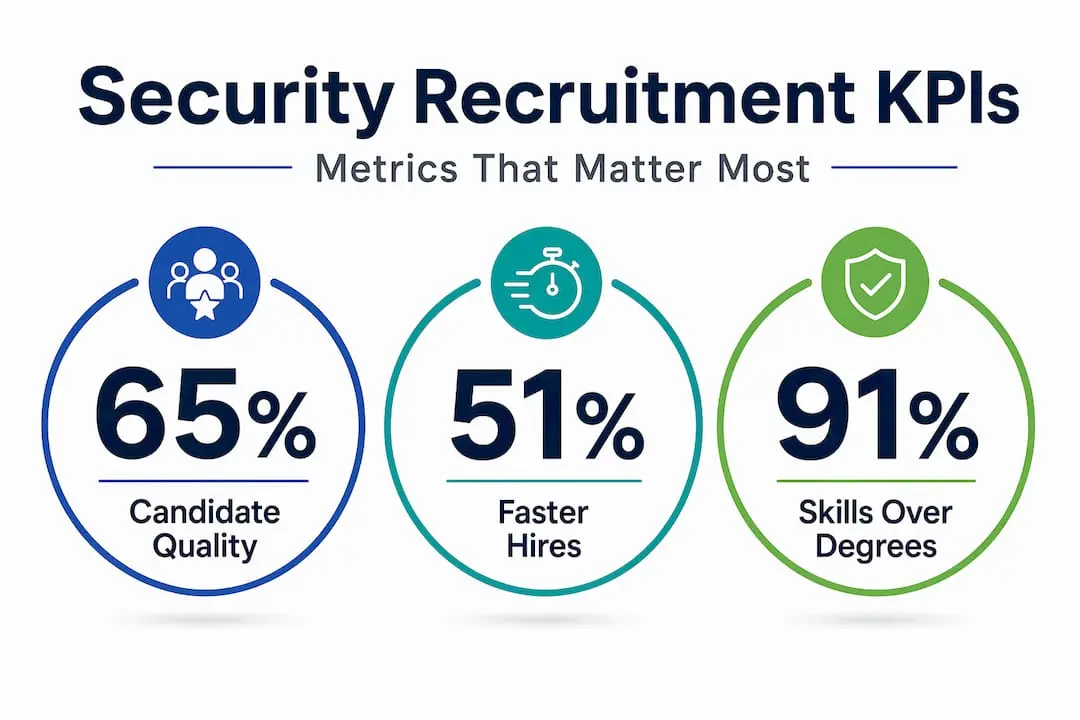
| Skills beat credentials | 91% of organisations prioritising skills over degrees report 65% improved candidate quality. |
| Budget is the new barrier | Budget constraints have overtaken talent shortages as the primary obstacle to security hiring. |
| AI creates a skills gap | Demand for AI security specialists has surged, yet 57% of providers struggle to fill these roles. |
| Junior pipeline is at risk | Automating entry-level tasks without training replacements threatens mid-level talent in three years. |
| Regulation reshapes hiring | Compliance requirements are restructuring security teams, demanding new role types and skill sets. |
Security recruitment trends 2025: the shifting landscape
The biggest misconception many HR teams carry into 2025 is that the problem is still about finding enough people. The real challenge has moved on. Budget replaced talent as the top staffing barrier, and 25% of organisations conducted layoffs in 2024 despite ongoing workforce gaps. You can have open headcount and no money to fill it. That is a fundamentally different problem to solve.
Meanwhile, the skills being demanded have shifted dramatically. The UK security job market in 2025 is recording a 6.2% growth rate, but growth is concentrated in specialist areas. The roles growing fastest are not traditional guarding or generalist security positions. They are AI security specialists, governance, risk, and compliance (GRC) professionals, and cloud security architects.
Here is what is driving the change in the 2025 security job market:
- AI and automation are absorbing entry-level SOC analyst tasks, reducing the volume of junior roles that once fed the mid-level pipeline
- Regulatory pressure from frameworks including NIS2, DORA, and CMMC is directly creating new compliance-oriented roles and forcing team restructures. Regulatory impact on hiring rose from 40% of organisations in 2025 to 95% by 2026
- Skills gaps over headcount gaps: 60% of organisations now cite skills deficits as a bigger challenge than not having enough staff
- AI specialist demand: 57% of cybersecurity providers struggle to recruit AI security specialists, and AI-related skill demand increased 340% since 2025
- Data-driven hiring using structured skills frameworks is replacing degree-based filtering as the primary sorting mechanism
Understanding this context is not optional preparation. It is the precondition for building any sensible recruitment strategy this year.
Preparing your recruitment strategy for 2025
Once you see the environment clearly, the preparation steps become much more straightforward. The changing landscape of security recruitment demands that you audit what you are actually testing for when you screen candidates.
Move from credentials to competencies
91% of organisations that prioritise skills over degrees report a 65% improvement in candidate quality and 51% faster hiring. That is not a marginal gain. Hiring managers who still filter by degree first are cutting themselves off from a large portion of the viable talent pool. Certifications, practical labs, capture-the-flag (CTF) competition results, and bug bounty contributions are increasingly validated through skills assessments as the most reliable indicators of real-world ability.
Rewrite your job descriptions to lead with demonstrated competencies, not qualification lists. Be specific about which skills the role actually requires on day one versus which can be developed on the job.
Build junior pipelines deliberately
AI automating SOC tasks is not a future risk. It is happening now, and the downstream effect is that the mid-level professionals you will need in three years are not being developed today. Apprenticeship programmes, rotational placements, and supervised AI-assisted work models are the emerging answer. If your organisation eliminates junior roles without creating structured pathways to replace that experience, you will pay for it later in a depleted pipeline.

Align with budget realities
Proving ROI on a hire is no longer something only large enterprises need to do. With budget constraints topping the hiring barrier list, every security recruitment decision now needs a business case. Map your hires to specific regulatory requirements, risk reduction metrics, or incident response capacity. Numbers make approval faster.
Pro Tip: Before posting a new role, document the cost of leaving it unfilled. Quantifying risk exposure in financial terms gives budget holders a reason to approve headcount that “we need more people” simply does not provide.
Executing effective security hiring in 2025
Preparation sets the direction. Execution determines whether you actually land the talent you need. Here is a structured approach to recruiting security professionals effectively under current conditions.
Step-by-step hiring workflow
- Define the actual role clearly. Before writing a job description, hold a structured briefing with the CISO or relevant team lead. Confirm whether the role is primarily technical, governance-focused, or hybrid. Misaligned job descriptions are a leading cause of poor hire quality.
- Build skills-based screening criteria. List the five to eight specific competencies the role requires. Weight them by importance. Use these in every stage of evaluation, not just interviews.
- Use AI-enabled screening tools thoughtfully. AI screening can cut time-to-shortlist significantly, but it requires clean, skills-based criteria to function well. Garbage input produces garbage shortlists.
- Diversify your talent sources. Post on specialist platforms, reach out through professional bodies, and actively consider candidates from adjacent fields such as IT infrastructure, data analytics, or military service. Security talent acquisition strategies that unify screening and performance prediction improve retention meaningfully.
- Integrate credential verification early. Do not save background and licence checks for the final stage. Running them in parallel with interviews reduces offer-to-start delays significantly.
- Align hiring managers before interviews. Give every panel member the same scoring criteria. Inconsistent evaluation is where capable candidates fall through the gaps.
Pro Tip: When recruiting for roles with an AI governance or GRC component, ask candidates to walk you through how they would explain a compliance requirement to a non-technical stakeholder. Communication ability in these roles is as important as technical depth.
The table below shows the skill areas commanding the most demand in current security hiring and how to assess them practically:
| Skill area | Assessment method | Why it matters now |
|---|---|---|
| AI security | Practical scenario review | AI-related demand up 340% since 2025 |
| GRC and compliance | Case study with regulatory scenario | Regulatory impact on hiring now near universal |
| Cloud security | Technical lab or environment walkthrough | Cloud infrastructure underpins most modern risk |
| Threat intelligence | CTF results or previous incident reports | Demonstrates applied analytical thinking |
| Security communication | Stakeholder briefing exercise | Governance roles require cross-team credibility |
Avoiding common pitfalls in security recruitment
Even well-prepared teams make avoidable mistakes. The 7 key security job trends in the UK point consistently to the same recurring errors.
The most damaging is eliminating junior roles without replacement pathways. It feels like a cost saving. In three years, it reads as a talent drought. Integrated talent management that aligns screening, credentialing, and training is what separates organisations with strong pipelines from those constantly scrambling to fill mid-level gaps.
Other pitfalls worth flagging:
- Credential inflation in job postings. Demanding five certifications for a role that genuinely needs two actively reduces your applicant pool without improving quality
- Over-relying on AI screening without human review. AI tools are effective at surface-level filtering, but candidate potential and cultural fit still require human judgement. Balancing AI use with human oversight is a practical necessity, not a philosophical position
- Ignoring burnout in your recruitment team. Constant context-switching between AI tools and human evaluation processes drives fatigue. Build in review cycles and limit the number of tools your team operates simultaneously
“The workforce crisis in security is less about not having enough people and more about not developing the right skills for the roles that now exist. Organisations that recognise this distinction will hire better and retain longer.”
Budget conversations also trip up many teams. If a role approval stalls, reframe it around the regulatory or operational consequence of the gap. Compliance-driven hires, in particular, carry a clear legal and financial case that finance teams can understand directly.
Measuring whether your approach is working
Knowing your complete hiring workflow is running correctly requires tracking the right metrics. Many security HR teams monitor time-to-hire and cost-per-hire, but those figures tell you very little about whether you are actually building capability.
The metrics that matter most in 2025 include hire-to-performance conversion (how many new hires reach full effectiveness within their first 90 days), skills validation pass rates across cohorts, and 12-month retention by role type. Layering regulatory compliance onto this, specifically whether new hires meet licence and certification requirements before their start date, adds a critical risk management dimension.
Pro Tip: Run a quarterly review comparing job description requirements against the actual skills your recent hires are using on the job. Role drift is common in fast-moving fields like security, and keeping descriptions current prevents you from screening for the wrong things.
Candidate and hiring manager feedback rounds out the picture. A structured debrief after every hire cycle, win or miss, surfaces process gaps faster than any metric alone.
| Metric | What it reveals |
|---|---|
| Hire-to-performance rate | Whether candidates are well-matched to actual role demands |
| Skills validation pass rate | Quality of the candidate pool you are drawing from |
| 12-month retention by role | Whether onboarding and development meet expectations |
| Regulatory compliance at start date | Risk exposure from unchecked credential gaps |
My take on where security recruitment is really heading
I’ve spent years watching security hiring go through cycles, and what is different about 2025 is the pace of structural change underneath the surface. Hiring managers who treat this year as a slight variation on what came before will fall behind.
What I’ve seen consistently is that organisations doing security recruitment well are not necessarily the ones with the biggest budgets. They are the ones that made a deliberate decision to develop talent rather than simply buy it. Building an apprenticeship pathway, running internal CTF competitions, or creating rotational programmes between IT and security teams costs far less than the premium you pay for a specialist hire in a thin market.
AI genuinely does change the work, but it does not change the fact that someone needs to understand what the AI is doing and why. The future security professional is someone who can operate AI tools, interrogate their outputs, and explain the implications to a board. You cannot screen for that with a certification alone.
The thing I find most underappreciated is the junior pipeline problem. Every time an organisation automates an entry-level task and declares it a cost saving, they are borrowing against their future mid-level bench strength. I’ve seen teams four years later wondering why they cannot find experienced analysts. The answer is always the same. They stopped developing them.
My honest advice is this: hire slightly ahead of your regulatory requirements, develop deliberately at the junior level, and treat skills frameworks as living documents rather than one-off updates. The organisations that do this will not be scrambling when the next compliance deadline arrives.
— Rob
Find your next security hire with Securityjobsboard
If the trends above confirm anything, it is that security hiring in the UK requires a specialist approach. Generic job boards miss the nuance of SIA licensing, sector-specific role requirements, and the regulated nature of security work.

Securityjobsboard connects UK employers directly with qualified, vetted security professionals across every specialisation. Whether you are hiring for guarding, investigations, cybersecurity, or GRC roles, the platform is built specifically for your sector. Employers can browse CV databases, post targeted listings, and communicate with candidates efficiently through a GDPR-compliant system. For teams building out regional capability, the security jobs in Northern Ireland listings are an active and growing market worth exploring. Visit Securityjobsboard to post a role or search the candidate database today.
FAQ
What are the biggest security recruitment trends in 2025?
Budget constraints, skills-based hiring, and demand for AI and GRC specialists are the defining trends. Regulatory frameworks like NIS2 are also restructuring team compositions and creating new role categories across UK organisations.
How should I assess security candidates without using degrees?
Focus on certifications, practical skills assessments, CTF results, and verified work samples. Research shows 65% improved hire quality when organisations prioritise skills over degrees, along with significantly faster hiring cycles.
Why is the junior talent pipeline a concern for 2025 hiring?
AI automation is absorbing entry-level SOC tasks, reducing the junior roles that traditionally develop future mid-level professionals. Without structured apprenticeship or rotational programmes, organisations risk a mid-level talent shortage within three to four years.
What top skills should I prioritise when hiring security professionals in 2025?
AI security, cloud security, GRC and compliance, and threat intelligence are the highest-demand areas. AI-related skill demand has increased 340% since 2025, making it the most urgent specialisation to plan for.
How can I make a business case for a security hire when budgets are constrained?
Quantify the cost and risk of leaving the role unfilled, particularly in relation to regulatory requirements or known threat exposures. Compliance-driven hires carry a legal and financial justification that translates well to finance and executive stakeholders.


