Prove These 6 Skills UK Recruiters Test for SIA Security Guards
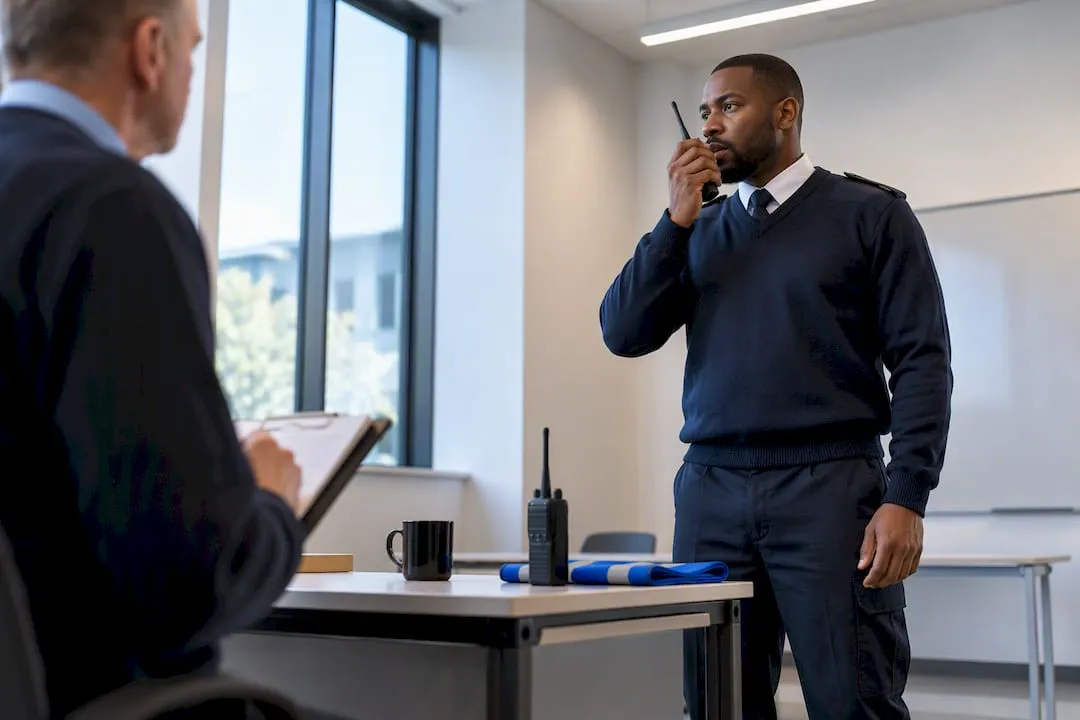
A competent security guard needs six core skill groups: situational awareness, verbal and written communication, conflict management, first aid and physical capability, technical proficiency with CCTV and radios, and professional integrity. For SIA-licensed roles, these skills aren’t optional extras. They’re built into the licence-linked training and reinforced through mandatory first aid and ongoing CPD. The sections below break down what each skill looks like in practice, how employers test for it, and how to prove you’ve got it.
TL;DR:
- Employers check practical evidence of skills like incident reporting, conflict de-escalation, and CCTV operation through scenario questions and assessments.
- Valid first-aid certification is mandatory before beginning SIA training, which must include practical modules on searching and vulnerable person awareness.
- Proven experience, current licences, and specific documented examples carry more weight than vague claims when applying for security roles.
- Ongoing CPD hours and updating knowledge are essential for career progression from operative to supervisor or trainer positions.
- Using dedicated security job platforms with filtered alerts helps match applications to roles that require verified skills and valid qualifications.
Table of Contents
- What are the essential security guard skills employers actually test for?
- SIA training, the first-aid rule and practical assessments
- Turning your training into proof recruiters believe
- Keeping your skills current and moving up
- Hiring priorities from an industry recruiter’s eye
- Find roles where these skills actually matter
- Sources
- FAQ
What are the essential security guard skills employers actually test for?
Recruiters rarely take a CV bullet point at face value. They probe for evidence, often through scenario questions or practical assessments during induction. Here’s what they’re checking for, skill by skill.
-
Situational awareness and observation. This means noticing what’s out of place before it becomes a problem, whether that’s an unattended bag or a repeat visitor acting oddly. Employers test it by asking you to describe a shift and what you’d flag first. Sharpen it by practising a “scan and log” habit on every patrol, noting time, location, and observation even when nothing happens.
-
Verbal communication. Clear, calm instructions defuse situations before they escalate. Interviewers often ask you to talk through how you’d address a member of the public breaching a restricted area. Practise giving instructions in plain language, without jargon, and rehearse tone as much as wording.
-
Written communication and reporting. Incident reports need to be factual, timestamped, and free of speculation. Employers check old incident logs (redacted, obviously) or ask you to draft a mock report on the spot. Keep a personal log of shift notes, written as if a supervisor will read them tomorrow.
-
Conflict de-escalation. This is the ability to lower tension using positioning, tone, and timing rather than force. Assessors watch for candidates who talk about listening first and acting second. Role-play a confrontation with a colleague and time how long it takes you to reach a calm resolution.
-
Incident reporting and record keeping. Distinct from general writing, this is about accuracy under time pressure and knowing what legally needs recording. Employers often test this with a “what would you write down” scenario. Learn the reporting template your target employer uses before the interview if you can find it.
-
Emergency first aid and life saving basics. This covers CPR, bleeding control, and airway management, and it’s assessed practically, not just on paper. Employers expect a current Emergency First Aid at Work certificate as standard.
-
Searching and vulnerability awareness. Knowing how to conduct a lawful, respectful search and spot signs someone may be vulnerable or at risk. This is now assessed practically during refresher training, not just talked through in a classroom.
-
CCTV and technology literacy. Operating control room monitors, understanding camera blind spots, and using radios correctly under pressure. Employers often run a short practical test on the equipment they actually use.
-
Physical fitness and personal safety. You don’t need to be an athlete, but you need the stamina for long shifts and the awareness to protect yourself without escalating a situation. Some employers include a basic mobility or fitness check.
-
Integrity and legal limits. Understanding exactly where your powers end (you’re not a police officer) and acting within the law even under provocation. This tends to surface in interview scenario questions about reasonable force.
-
Problem-solving under pressure. Weighing options quickly when a situation doesn’t fit the training manual, such as a fire alarm during a live incident. Employers value candidates who can explain their decision-making process, not just the outcome.
Pro Tip: Keep an anonymised log of incidents you’ve handled, with dates, actions taken, and outcomes but no names or identifying details. It turns “I have conflict management experience” into a body of evidence you can talk through confidently in an interview.
SIA training, the first-aid rule and practical assessments
Frontline roles such as static guarding, door supervision, and CCTV operation all require the correct SIA licence-linked qualification, and you cannot start that training without a valid first-aid qualification already in hand. That order matters. Turn up to enrol without it and you’ll be turned away.
From October 2024, first-aid content linked to SIA licensing must explicitly cover life-threatening bleeding and keeping airways open, and certificates must remain valid for at least 12 months at the point of licence application. Treat first aid as an operational skill you refresh, not a box you tick once and forget.
Refresher training now builds in practical modules covering searching, terror-threat awareness, and protecting vulnerable people, with a hands-on searching assessment rather than a written test alone. Course length varies by specialism, from a half-day practical top-up for a security guarding refresher through to considerably longer courses for specialisms like public space surveillance.
Before booking any course, check:
- The provider is a recognised awarding body listed against SIA specifications.
- Your first-aid certificate will still be valid on the date you apply for your licence.
- The course includes a practical assessment component, not just classroom theory.
Turning your training into proof recruiters believe
Licence-linked qualifications, EFAW first aid, BSIA Learning Hub CPD modules, and on-the-job supervised shifts are your main evidence sources. Translate them into specifics on your CV rather than vague claims:
- “Completed 40 supervised shifts covering static guarding and access control, zero missed incident logs.”
- “Holds current SIA Door Supervisor licence and EFAW certificate, renewed within the last 12 months.”
- “Managed 15+ incident reports across a six-month period, all signed off without amendment.”
For interview scenario questions, use a simple structure: Situation, Task, Action, Result. A worked example for de-escalation: “A visitor became aggressive after being refused entry (Situation). I needed to calm them without involving other staff (Task). I lowered my voice, stepped slightly to the side, and offered an alternative option (Action). They left without incident and I logged it within ten minutes (Result).” Keep a simple training and incident log so this evidence is ready whenever a recruiter asks, and see our guide on presenting your responsibilities on a CV for more phrasing examples.
Keeping your skills current and moving up
CPD means deliberately updating your knowledge after your licence is issued, not letting it lapse until renewal forces your hand. The BSIA Learning Hub and employer-run briefings are solid sources, alongside sector guidance on emerging threats.
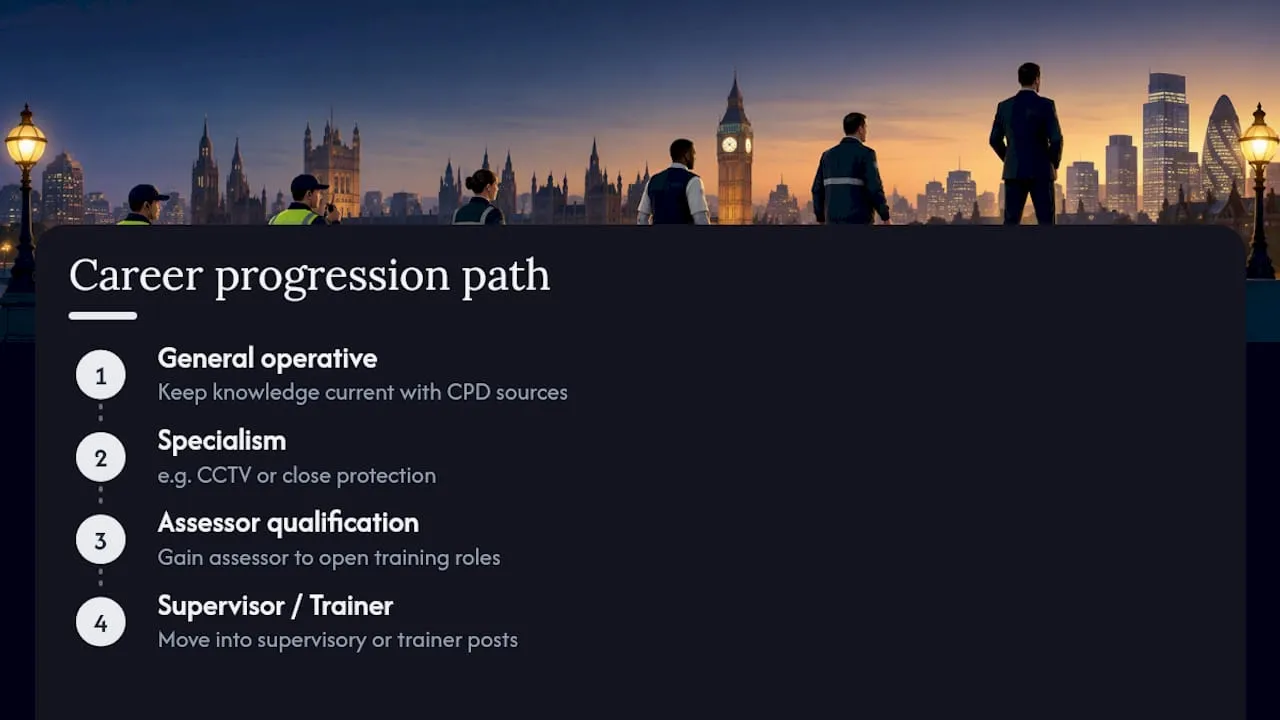
A typical path runs from general operative to a specialism such as CCTV or close protection, then on to supervisor or trainer roles once you’ve picked up an assessor qualification. Our physical security career path guide covers this in more depth. Aim for a handful of CPD hours or modules logged every year, recorded in a simple spreadsheet with dates and certificates attached.
Hiring priorities from an industry recruiter’s eye
Recruiters value verifiable evidence over polished claims: a current first-aid date, the exact licence type, and examples that match the role on offer. Tailor every application to the specific licence and vacancy rather than sending a generic CV, and lead with proof, not adjectives.
— Rob
Find roles where these skills actually matter
Once your licence and evidence are in order, the next step is finding an employer who values them. Specialist security job boards provide an alternative to trawling generic job sites, focusing entirely on the sector so listings assume knowledge of SIA licences and first-aid requirements.

Create a free profile at Securityjobsboard, upload your CV, and set alerts filtered by licence type and specialism, such as door supervision, CCTV, or close protection, so relevant vacancies land in your inbox rather than getting buried in generic search results. Employers browsing the platform post standard listings and featured ads specifically for security roles, which means your skills and certificates are being read by people who actually understand what they’re worth. Set up your profile today and start applying directly to roles that match your licence.
Sources
- Gov
- Knowledge and Skills Specification: Security Guarding Refresher Training (SIA)
- BSIA Learning Hub
FAQ
What are 5 qualities of a good security guard?
Strong candidates combine sharp observation, calm communication under pressure, sound judgement about legal limits, physical readiness including current first aid, and consistent integrity. These qualities show up in how recruiters assess CVs and interview answers rather than in any single test.
What are the 4 P’s in security guard?
Definitions of this vary across the sector and there isn’t one fixed, official version. Some trainers use it to mean prevention, protection, procedure, and professionalism, but it’s not a term you’ll find in SIA specifications.
What are the 5 C’s for security guards?
As with the 4 P’s, this isn’t a standardised industry term, and different trainers apply it differently. It’s safer to focus on the documented skill groups, such as communication, conflict management, and observation, that actually appear in SIA training content.
What are security skills?
Security skills cover the practical and behavioural competencies needed to protect people and property, including observation, reporting, de-escalation, first aid, and technology use like CCTV and radios. For licensed roles in the UK, these skills are shaped directly by SIA training requirements and reinforced through refresher courses.
How do I find security guard jobs that match my skills?
Securityjobsboard lets you create a free profile, upload your CV, and filter vacancies by licence type and specialism at Securityjobsboard. Setting a job alert means matching roles reach you directly instead of relying on manual searches.


