The role of your CV in landing UK security jobs

Your CV is the single document that decides whether a UK security employer invites you to interview or moves on. It is not a formality. Recruiters use it to verify your SIA licence, assess your operational experience, and judge whether you understand the specific demands of the role. Get it wrong and you are screened out before anyone reads your name.
UK security employers require a formal CV to make final interview decisions, even when they have already found you on LinkedIn. Your LinkedIn profile builds visibility; your CV closes the deal. The two must be consistent on job titles, dates, and employers, but the CV carries the legal and operational detail that a social profile cannot.
A strong security CV covers:
- Contact details including phone, email, and location
- Professional profile summarising your experience and sector fit
- Core skills relevant to the specific role
- Work experience with bullet-pointed, outcome-focused entries
- Education and training including any relevant qualifications
- Certifications and licences, with your SIA licence number and expiry date clearly displayed
- Additional information such as first aid training, languages, or driving licence
Recruiters spend only 17–46 seconds on an initial CV scan. Clarity, formatting, and keyword relevance are not optional extras. They are what keep you in the pile.

How to structure your security CV for the UK market
A UK security CV should run to two pages maximum and you can find tips on how to schrijf een ijzersterk cv voor studentenjobs tailored to transport and logistics security roles. One page works well for candidates with under three years of experience; two pages suits those with a broader history across multiple roles or sectors. Anything longer risks losing a recruiter’s attention before they reach your most relevant experience.
The essential sections, in order:
- Contact details at the top: full name, phone number, professional email address, and town or city (no full home address needed)
- Professional profile: three to four sentences summarising your experience, your SIA licence status, and what you bring to the role
- Core skills: a two-column list of six to ten skills directly relevant to the job description
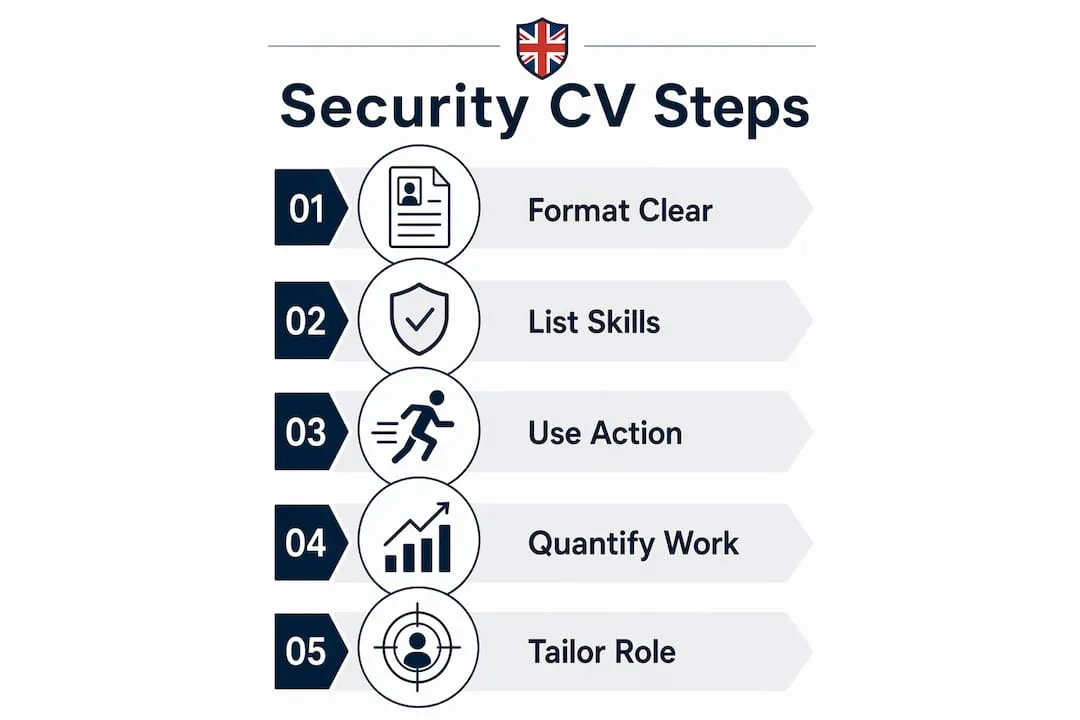
- Work experience: reverse chronological order, with each role broken into bullet points that describe outcomes, not just duties
- Education: secondary school qualifications and any further education, listed briefly
- Licences and certifications: SIA licence type, number, and expiry date; first aid certificates; any sector-specific training
ATS-friendly formatting means clean fonts such as Arial or Calibri at 10–12pt, standard section headings, and no tables, text boxes, or graphics that confuse automated screening software. Keep margins at 2cm and use consistent spacing throughout.
Avoid listing duties as a prose paragraph. “Responsible for patrolling the premises and monitoring CCTV” tells a recruiter nothing they do not already expect. “Conducted hourly patrols across a 40,000 sq ft retail site, reducing security incidents by flagging three access vulnerabilities within the first month” tells them you pay attention and produce results.
Pro Tip: Save your CV as a PDF unless the job advert specifically requests a Word document. PDFs preserve your formatting across every device and operating system.
Key skills and responsibilities to highlight on your security CV
Hiring managers in UK security want proof of operational judgement, not a list of tasks anyone in the role would perform. The skills you choose to feature should reflect what the employer actually needs, backed by evidence from your own experience.
Operational skills worth highlighting:
- Foot and vehicle patrols
- CCTV monitoring and incident logging
- Access control and visitor management
- Alarm response and emergency procedures
- Conflict de-escalation and use of force reporting
- Risk assessment and site vulnerability checks
- Cash or asset escort procedures
Beyond the operational side, hiring managers prioritise candidates with evidence of working in live environments and the ability to respond swiftly under pressure. Communication skills matter too, particularly for roles involving public interaction or multi-agency coordination.
Quantify wherever you can. “Managed access control for a corporate site receiving 200+ daily visitors” is far stronger than “managed access control.” Measured outcomes improve signal density and demonstrate the kind of operational competence that builds recruiter confidence. Even a figure like “responded to an average of four incidents per shift” gives a recruiter a concrete sense of your workload and capability.
Use action verbs to open each bullet: monitored, coordinated, de-escalated, reported, secured, assessed. Passive constructions (“was responsible for”) drain energy from your CV and make achievements sound accidental.
Pro Tip: Match your skills list to the job description word for word where accurate. If the advert says “crowd management” and you have done it, use that exact phrase. ATS systems score keyword matches.
Tailoring your security CV for different roles and sectors
A generic CV sent to every vacancy is one of the most common reasons security candidates get rejected. The SIA licence is a baseline requirement across the industry, but what employers want beyond that varies considerably by sector.
How to adapt your CV by sector:
- Retail security: emphasise customer interaction, theft prevention, and experience with busy public environments; mention any specific retail chains or shopping centres you have worked in
- Corporate and reception security: highlight access control, visitor management systems, professional presentation, and any experience with corporate clients or sensitive environments
- Construction site security: focus on perimeter security, lone working, vehicle access management, and familiarity with site safety protocols such as CSCS awareness
- Event and crowd management: lead with SIA Door Supervisor licence, conflict management training, and experience handling large crowds or high-pressure situations
- CCTV and control room: feature your SIA CCTV licence prominently, along with specific monitoring systems you have operated and any incident reporting procedures you have followed
Rewrite your professional profile for each application. Two or three sentences are enough, but they should mirror the language of the job description. If the advert mentions “lone working” or “key holding,” those phrases belong in your profile if they reflect your experience. Recruiters notice when a CV reads as though it was written for a different job entirely.
Adapting your CV does not mean fabricating experience. It means presenting genuine experience through the lens of what the employer is actually looking for.
Expert advice on security CVs and the mistakes that cost candidates interviews
UK security recruiters see the same errors repeatedly. Knowing what they are is half the battle.
Common mistakes that lead to early rejection:
- Listing job duties without any outcomes or measurable impact
- Using generic language such as “hardworking team player” with no evidence to back it up
- Omitting the SIA licence entirely, or burying it at the bottom of the CV
- Leaving unexplained gaps in employment history
- Sending the same CV to every role without any tailoring
- Including irrelevant personal information such as age, marital status, or a photograph (none of these are required in UK applications)
- Spelling errors and inconsistent formatting, which signal a lack of attention to detail
CV mistakes including generic role descriptions and failure to highlight licences are among the most frequent reasons recruiters lose confidence early in the screening process. A recruiter who cannot find your SIA licence within the first few seconds of reading will often move on rather than search for it.
Career gaps are common in security, particularly for those who have worked short-term contracts or taken time between roles. Address them briefly in your professional profile or in a short note alongside the relevant dates. “Contract work between permanent roles” or “career break for personal reasons” is enough. Leaving a gap unexplained invites assumptions.
Security qualifications beyond the SIA licence add real weight to a CV. First aid at work, conflict management training, CCTV operation certificates, and door supervisor qualifications all signal that you have invested in your professional development. List them with the awarding body and the date of issue.
Pro Tip: Ask a colleague or friend outside the security industry to read your CV. If they cannot understand what you actually did in each role, a recruiter who is scanning quickly will not understand it either.
The National Careers Service outlines the core competencies employers expect from security officers, including the ability to remain calm under pressure, strong attention to detail, and the capacity to work independently. Cross-referencing your CV against that list is a quick way to spot gaps before you apply.
For guidance on whether your role requires a specific SIA licence type, the GOV.UK guidance covers front line, non-front line, and specialist licence categories in detail. Getting this right on your CV matters because employers are legally required to verify it before you start work.
Key takeaways
Your CV is the primary document UK security employers use to decide who gets shortlisted, and it must clearly evidence your SIA licence, operational experience, and sector-relevant skills to pass both ATS screening and recruiter review.
| Point | Details |
|---|---|
| CV leads the hiring process | UK employers rely on the CV, not LinkedIn, to make final interview decisions. |
| Recruiters scan fast | Initial CV reviews last only 17–46 seconds, so clear formatting and keywords are critical. |
| SIA licence must be visible | Display your licence type, number, and expiry date prominently, not buried at the end. |
| Quantify your achievements | Quantifying your achievements with specific, relevant experience carries far more weight than vague duty lists. |
| Tailor every application | Adapting your profile and skills to each sector and job description significantly improves shortlisting rates. |

Ready to put your CV to work? Security roles across the UK are listed on Securityjobsboard, including positions in Northern Ireland, where you can upload your CV and apply directly to employers actively recruiting right now. Securityjobsboard is free for jobseekers and affiliated with the BSIA, so the roles you find there are from employers who take compliance seriously.
FAQ
What should a security guard include on their CV?
A security guard CV should include contact details, a professional profile, core skills, work experience with bullet-pointed outcomes, education, and licences. Your SIA licence type, number, and expiry date must appear clearly, ideally near the top.
How do I address frequent job changes on a security CV?
Briefly note contract or temporary roles as such alongside the dates. A line such as “short-term contract role” removes ambiguity and prevents a recruiter from assuming you were dismissed repeatedly.
Does my SIA licence need to be on my CV?
Yes. Employers are legally required to verify a valid SIA licence before deploying security operatives, so listing it prominently on your CV is both practical and expected.
What are the key responsibilities to list on a security CV?
Focus on patrols, access control, CCTV monitoring, incident response, and conflict de-escalation. Frame each as an outcome rather than a task, using specific figures where possible to show the scale and impact of your work.
How long should a UK security CV be?
One to two pages is the standard for UK security roles. One page suits early-career candidates; two pages is appropriate once you have several roles or specialist qualifications to cover.


