Key Holding in UK Security – Vital Roles Explained

More than 80 percent of British security professionals recognise key holding as a vital career step, yet common myths still hold many back. In the UK, key holding goes far beyond simple key storage, demanding high-level training and strict legal compliance. If you are seeking new job opportunities or want to master the latest industry standards, you will find practical facts here to help advance your career with confidence.
Table of Contents
- Key Holding: Definition And Common Myths
- Types Of Key Holding And Main Distinctions
- How Professional Key Holding Works In Practice
- Regulatory Standards And Legal Obligations
- Core Responsibilities And Liabilities
- Risks, Pitfalls, And Insurance Requirements
Key Takeaways
| Point | Details |
|---|---|
| Understanding Key Holding | Key holding is an active security service that entails professional management of property access and emergency responses, not just key storage. |
| Types of Key Holding Services | Key holding services are categorised into Basic, Security, and Comprehensive, each varying in complexity and compliance requirements. |
| Regulatory Compliance | Key holding providers must adhere to stringent SIA licensing and British Standard BS 7984 to ensure operational accountability and legal protection. |
| Insurance and Risk Management | Adequate insurance coverage and rigorous risk management practices are essential to mitigate potential legal and operational risks in key holding. |
Key holding: Definition and common myths
Key holding is a specialised security service within the United Kingdom where professional security firms securely manage and respond to property access and emergency situations. Far more complex than simply storing keys, this service represents a critical component of modern business and property protection strategies.
At its core, key holding involves a professional security company maintaining secure access protocols for commercial and residential properties. Trained security personnel hold duplicate keys off-site, enabling rapid response to alarm activations, potential break-ins, or other security incidents without risking the safety of property owners or their staff.
Many misunderstandings exist about key holding services. Some individuals mistakenly believe it is a passive role involving mere key storage, when in reality, it is an active and dynamic security function. Key holders are licensed professionals who follow strict British security standards, including BS 7984-1, which outlines comprehensive protocols for incident management, emergency response, and property protection.
Key holding services typically include:
- Immediate alarm response
- Property access management
- Incident documentation
- Communication with law enforcement
- Risk assessment and reporting
Pro tip: When selecting a key holding service, always verify their licensing, insurance coverage, and response time guarantees to ensure comprehensive property protection.
Types of key holding and main distinctions
Key holding services in the United Kingdom are categorised into distinct types, each with specific operational parameters and security industry regulatory requirements. These categories are primarily defined by their scope of responsibility, level of professional licensing, and specific security functions.
The primary distinctions in key holding services can be broadly divided into three main categories:
- Basic Key Holding
- Focuses on storing and safeguarding property keys
- Limited scope of emergency response
- Minimal security intervention required
- Security Key Holding
- Advanced professional service
- Includes alarm activation response
- Comprehensive emergency management
- Requires higher-level SIA licensing
- Comprehensive Security Key Holding
- Full-service security management
- Includes access control systems monitoring
- Scheduled property lock and unlock duties
- Detailed incident reporting and risk assessment
Each category of key holding service demands different levels of professional certification and skill. The Security Industry Authority (SIA) plays a crucial role in regulating these services, ensuring that key holders are appropriately trained, vetted, and licensed to perform their specific security functions.
Here’s a quick comparison of key holding service categories and their operational impact:
| Category | Service Complexity | Typical Clients | Business Impact |
|---|---|---|---|
| Basic Key Holding | Low | Small offices, homes | Minimal intervention |
| Security Key Holding | Moderate | Larger businesses | Faster alarm response |
| Comprehensive | High | Critical infrastructure | Full incident management |
Pro tip: Always verify a security provider’s specific SIA licensing category to ensure they can deliver the exact level of key holding service your property requires.
How professional key holding works in practice
Professional key holding is a sophisticated security service that operates through a carefully orchestrated process of secure key management and emergency response. The entire workflow is designed to provide comprehensive protection for businesses and properties, ensuring rapid and professional intervention during potential security incidents.
The typical key holding process involves several critical stages:
-
Key Storage and Security
- Secure off-site storage of client keys
- Strict access control protocols
- Encrypted and monitored key management systems
-
Alarm Monitoring and Response
- 24/7 professional alarm monitoring
- Immediate dispatch of licensed security officers
- Rapid assessment of triggered alarms
-
On-Site Intervention
- Thorough property inspection
- Documentation of incident details
- Liaison with emergency services if required
- Securing the premises post-incident
Each key holding service is meticulously tailored to the specific requirements of the client, with professional security teams following stringent British Standard BS 7984 guidelines. This ensures a consistent, reliable, and legally compliant approach to property security that goes beyond simple key management.

Pro tip: Request a detailed incident response protocol from your key holding provider to understand exactly how they will handle different types of security scenarios.
Regulatory standards and legal obligations
Key holding services in the United Kingdom operate under a comprehensive regulatory framework designed to ensure professional security standards and accountability. The primary regulatory body governing these services is the Security Industry Authority (SIA), which establishes stringent requirements for licensing, training, and operational conduct.
The key regulatory requirements for key holding services include:
-
Licensing Requirements
- Mandatory SIA professional licensing
- Comprehensive background checks
- Ongoing professional training certifications
- Regular skills and competency assessments
-
Operational Standards
- Compliance with British Standard BS 7984
- Adherence to Approved Contractor Scheme (ACS) guidelines
- Implementation of robust security protocols
- Maintenance of detailed incident documentation
-
Legal Obligations
- Strict accountability for key management
- Secure storage and access control procedures
- Regular audit trails and documentation
- Compliance with data protection regulations
Beyond SIA regulations, key holding providers must also navigate complex legal landscapes involving property access, emergency response protocols, and potential liability scenarios. This requires a sophisticated understanding of both security best practices and legal frameworks that protect both property owners and security personnel.
A summary of regulatory standards and obligations for UK key holding services:
| Regulatory Aspect | Description | Consequence of Non-Compliance |
|---|---|---|
| SIA Licensing | Required for all key holders | Fines, service prohibition |
| BS 7984 Compliance | Mandatory operational standards | Professional deregistration |
| Data Protection Laws | Secure client information handling | Legal liability, compensation |
Pro tip: Request a comprehensive compliance documentation package from your key holding provider to verify their adherence to current regulatory standards and legal requirements.
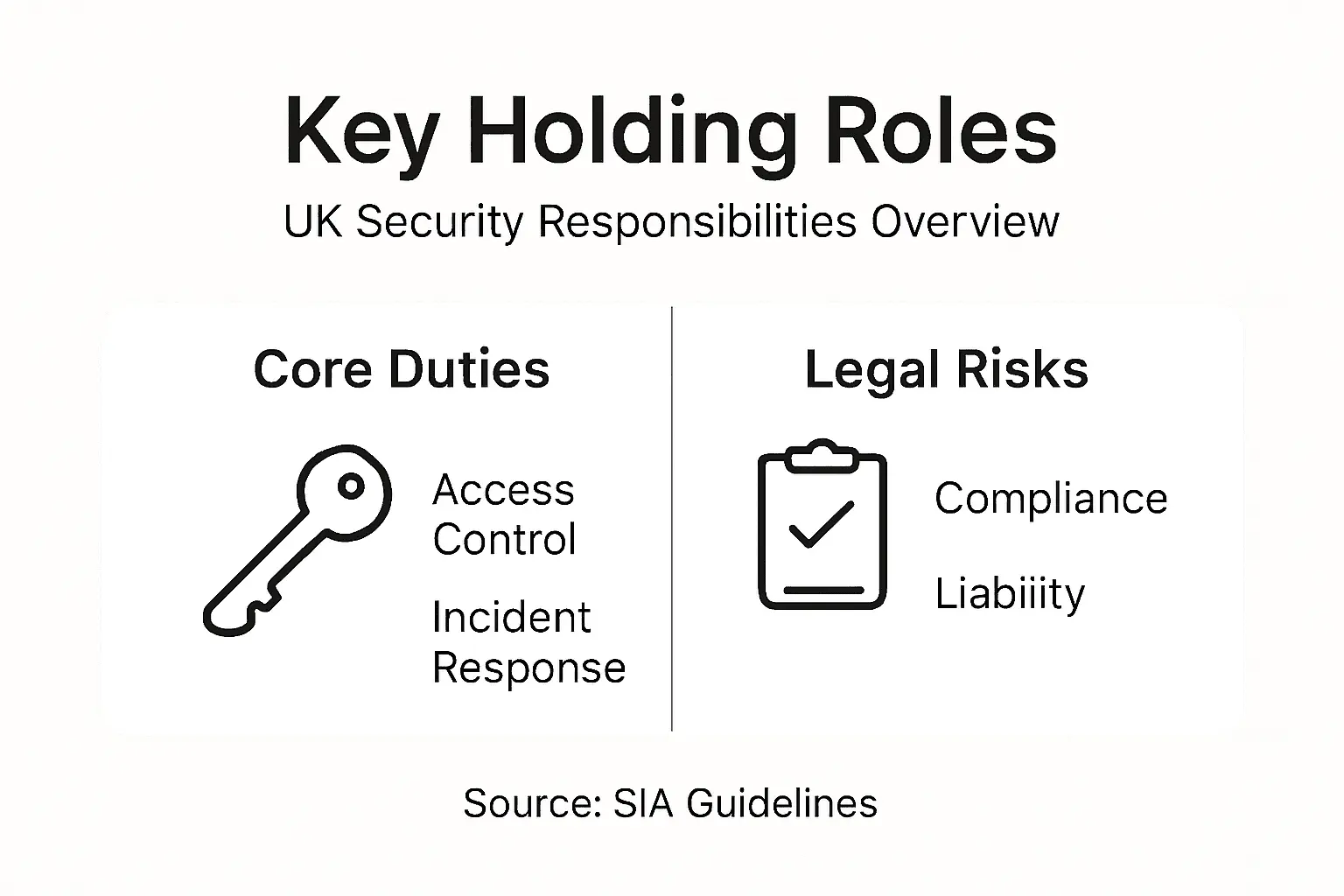
Core responsibilities and liabilities
Key holders in the United Kingdom bear significant responsibilities and potential legal liabilities that extend far beyond simple key management, requiring comprehensive professional protocols. These professionals are entrusted with critical security functions that demand precision, accountability, and unwavering professional conduct.
The core responsibilities of key holders include:
-
Immediate Response Duties
- Investigating alarm activations
- Conducting thorough property inspections
- Assessing potential security breaches
- Coordinating with emergency services
-
Security Management
- Maintaining strict key control logs
- Securing premises after incidents
- Resetting alarm systems
- Documenting and reporting security events
-
Legal and Compliance Obligations
- Preventing unauthorized property access
- Adhering to health and safety regulations
- Maintaining valid SIA licensing
- Protecting client confidentiality
Potential liabilities for key holders can be substantial, encompassing financial penalties, legal prosecution, and professional deregistration for negligence or serious procedural failures. This means every action must be meticulously documented, professionally executed, and aligned with stringent industry standards.
Pro tip: Maintain comprehensive incident logs and always follow established protocols to protect yourself legally and professionally during key holding assignments.
Risks, pitfalls, and insurance requirements
Key holding services in the United Kingdom operate within a complex risk landscape that demands robust insurance and regulatory compliance strategies. The potential financial and legal risks associated with key management require comprehensive protective measures and meticulous professional conduct.
The primary risks for key holding professionals include:
-
Operational Risks
- Unauthorized key access
- Potential property damage
- Security system breaches
- Delayed emergency responses
-
Legal and Financial Risks
- Negligence claims
- Professional liability exposure
- Potential compensation payments
- Regulatory non-compliance penalties
-
Insurance Requirements
- Public liability insurance
- Professional indemnity coverage
- Employer’s liability protection
- Third-party risk mitigation
Insurance policies for key holding services must comprehensively address potential scenarios, from accidental property damage to security breaches. Providers must maintain precise documentation, implement rigorous risk management protocols, and ensure their insurance coverage aligns with evolving industry standards and regulatory expectations.
Pro tip: Conduct annual comprehensive risk assessments and regularly review your insurance policies to ensure complete protection against emerging security challenges.
Secure Your Future in Professional Key Holding Roles Today
Understanding the vital roles and legal responsibilities of key holding in the United Kingdom reveals a clear need for skilled, licensed professionals who can meet stringent standards like those set by the Security Industry Authority and BS 7984. Whether you are starting your career or looking to advance in security key holding services, it is crucial to connect with employers valuing compliance, rapid emergency response, and full incident management.

Discover tailored job opportunities and build your career through Security Jobs Board, the trusted platform designed for the UK security sector. Access specialised vacancies in key holding with verified employers who prioritise professional licensing and operational excellence. Start today by creating your profile and applying for your next role to work confidently within the regulated framework and protect critical infrastructure effectively.
Frequently Asked Questions
What is key holding in UK security?
Key holding is a specialised security service where professional firms manage access and respond to emergencies at properties. It involves trained personnel holding duplicate keys to ensure rapid response to incidents without putting property owners at risk.
What are the different types of key holding services?
Key holding services can be categorised into Basic Key Holding, Security Key Holding, and Comprehensive Security Key Holding, each offering varying levels of emergency response and security management based on the clients’ needs.
What are the legal obligations for key holders?
Key holders must adhere to strict licensing requirements, operational standards, and legal obligations, including secure management of keys, compliance with British Standard BS 7984, and maintaining client confidentiality while preventing unauthorised access.
What are the risks associated with key holding services?
Key holding services face operational risks like unauthorised access and delayed responses, as well as legal and financial risks, including negligence claims. Comprehensive insurance coverage and rigorous security protocols are necessary to mitigate these risks.
Recommended
- Why Choose Security Jobs: Complete Guide UK | Brainiac Media
- Understanding the Role of Security Guards in the UK|BM
- Manned Guarding Explained: Key Roles In UK Security|BM
- Behind the Uniform: Understanding the Role of Security Guards Across the UK|BM
- Understanding Business Travel Safety Tips for Success


