Write 4–8 Measurable Job Duties and Responsibilities for UK Employers

Job duties and responsibilities describe what a role exists to achieve and the specific activities that deliver it, split into a short list of accountabilities rather than a diary of every task. The single best practice for employers is to write between four and eight measurable responsibilities using strong action verbs, ordered by importance or time spent. Get that right and the templates, legal checks, and review habits below will all fall into place.
TL;DR:
- Clear job duties should consist of four to eight measurable responsibilities that focus on outputs rather than daily tasks or processes.
- Responsibilities should be ordered by importance or time spent, each paired with a specific action verb and a result to ensure clarity and defendability.
- Responsibilities must include an estimated percentage of time to reflect seasonal workload shifts and avoid confusing tasks with duties.
- Job descriptions need regular review, at least annually or after organizational changes, with version control to maintain legal defendability.
- Employers should ensure duties are non-discriminatory, gender-neutral, and accurately aligned with role purpose to minimize legal risks.
Table of Contents
- What do job duties and responsibilities actually mean?
- Why do clear duties matter for hiring and performance?
- How do you write duties and responsibilities step by step?
- Copy-ready templates for job duties
- Are your job duties legally fair and consistent?
- When should you review and update job duties?
- What writing job duties actually teaches you
- Where to check the detail yourself
- Sources
- FAQ
What do job duties and responsibilities actually mean?
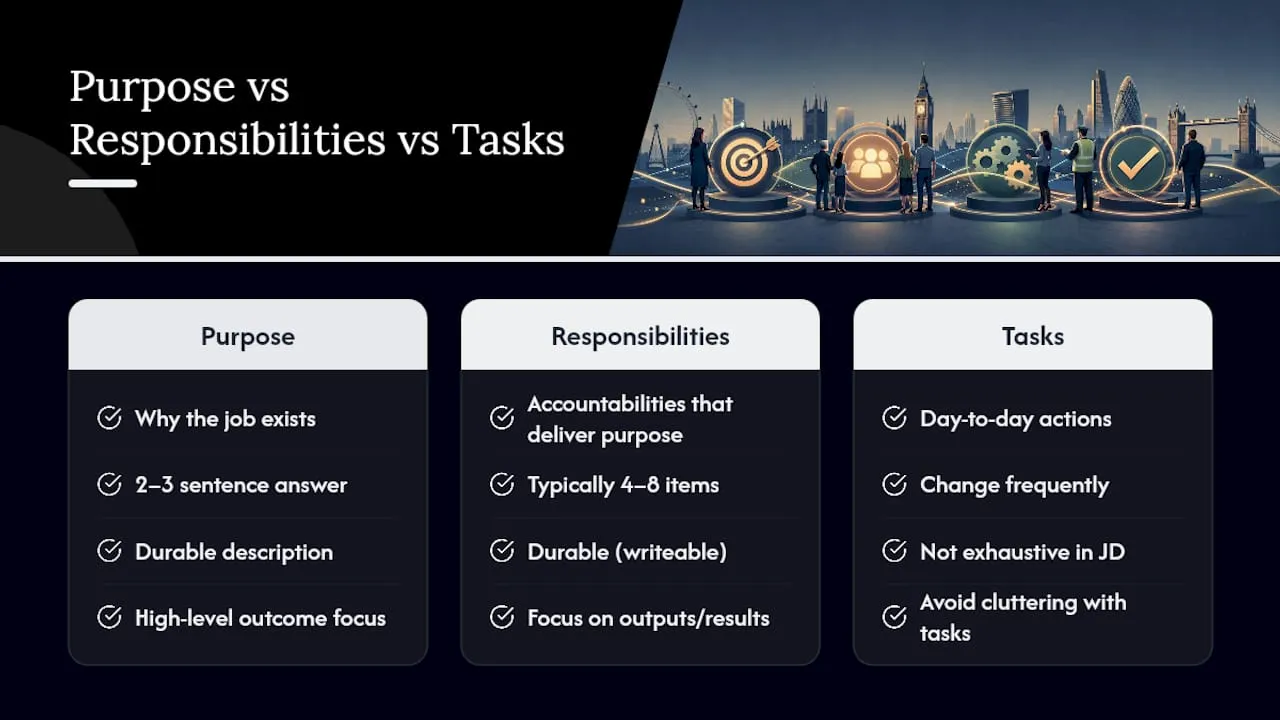
Three terms get muddled constantly: purpose, responsibilities, and tasks. Role purpose is the two or three sentence answer to “why does this job exist?” Responsibilities are the accountabilities that deliver that purpose, typically four to eight of them. Tasks are the day-to-day actions inside each responsibility, and they change too often to list exhaustively.
A responsibility written as “manages site access control” is durable. A task like “checks the visitor log every Tuesday” is not, and cluttering a job description with tasks like this makes it stale within months. Focus instead on outputs: what should be true if the person is doing the job well? For roles with authority over people, budgets, or safety decisions, capture reporting lines and the limits of that authority explicitly, since this becomes evidence later if a decision is ever challenged.
Why do clear duties matter for hiring and performance?
A sharp set of duties does three jobs at once. In recruitment, it lets the wrong candidates rule themselves out before they apply, which cuts down on the sifting time HR teams spend on candidate shortlisting later. In performance management, the job description becomes the benchmark: reviews, probation sign offs, and disciplinary conversations all lean on what was originally agreed.
The legal upside matters just as much. The CIPD’s job design guidance recommends describing measurable outputs and key result areas rather than a task list, because vague duties make it far harder to defend a dismissal or a promotion decision on objective grounds. A responsibility that was never written down cannot be used to justify a decision made later. That gap catches out more employers than any other single documentation failure.
How do you write duties and responsibilities step by step?
Follow this sequence when drafting a new job description or overhauling an old one.
- Write the role purpose first. Two or three sentences describing the outcome the role delivers, not the tasks it performs.
- List every candidate responsibility, then cut to four to eight. University HR guidance and ACAS both settle on roughly this range, usually no more than seven or eight, to keep the description usable rather than exhausting.
- Order by importance or time spent, so the reader sees what matters most first.
- Pair every action verb with a result. Croner’s guidance puts it well: each responsibility needs an action and the reason it matters, not just an activity.
- Add percentage of time where the role has a seasonal rhythm. Estimates should total around 95 to 100%, capturing peaks like year end reporting or Christmas trading rather than an average week.
- Check every line for vagueness. “Supports the team” tells a candidate nothing; “coordinates weekly rota planning for 12 staff” does.
- Add a short flexibility line and flag essential licences. For roles that carry statutory or safety requirements, name the licence and be ready to justify why it is essential.
Here is what that looks like once condensed for a supervisory role:
- Oversees daily site operations and staff deployment (35%)
- Investigates incidents and completes written reports within 24 hours (20%)
- Trains and mentors new starters through their probation period (15%)
- Liaises with the client on service delivery and contract queries (15%)
- Manages rota planning and holiday cover (15%)
Pro Tip: If you can’t attach a percentage or a measurable result to a responsibility, it is probably a task masquerading as a duty. Merge it into a broader responsibility or cut it.
Copy-ready templates for job duties
A short template works for almost any role. Start with the purpose, then list the responsibilities, adding percentage of time only where the workload genuinely shifts across the year.
Micro-template:
- Role purpose (2 to 3 sentences)
- 4 to 6 responsibility statements, each an action verb plus a result
- Optional percentage of time per responsibility
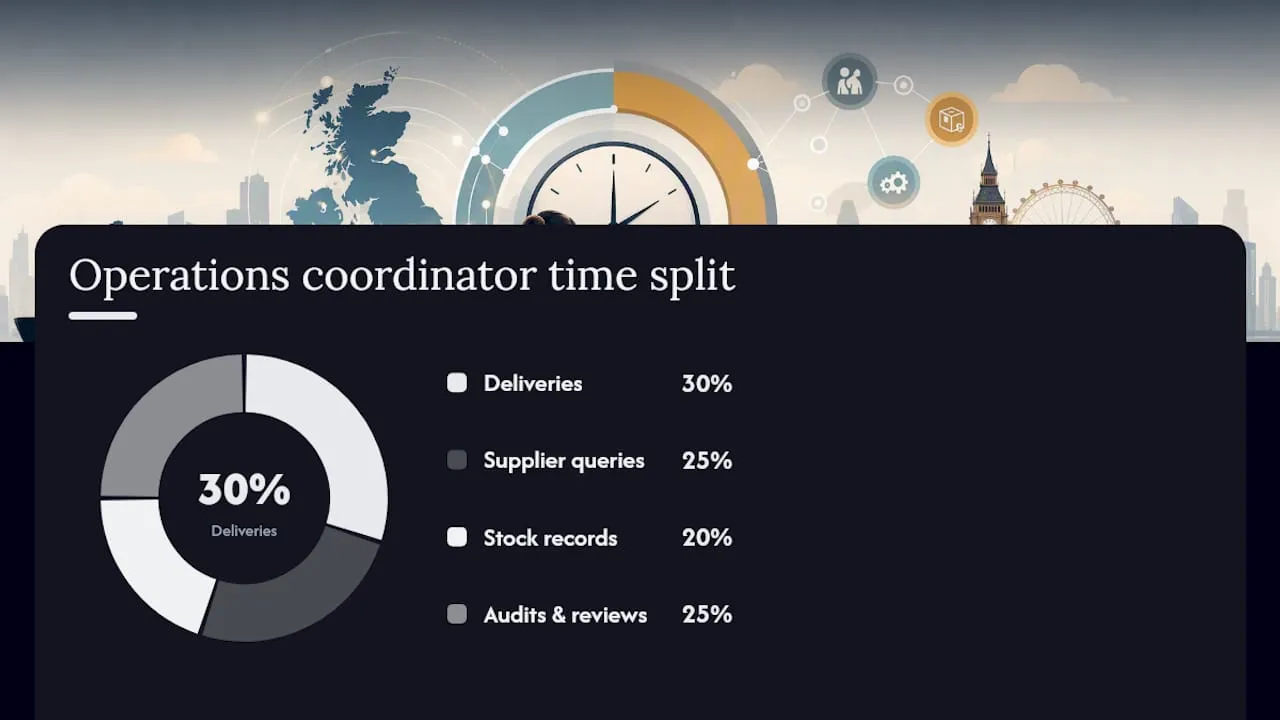
Example 1, operations coordinator:
- Schedules and confirms weekly deliveries across three depots (30%)
- Resolves supplier queries and escalates unresolved issues within 48 hours (25%)
- Maintains stock records and flags discrepancies to the finance team (20%)
- Supports quarterly audits and process reviews (25%)
Example 2, security officer (UK):
- Patrols premises and monitors CCTV to identify and report risks
- Controls access for staff, visitors, and contractors following site protocols
- Responds to alarms and incidents, completing written reports promptly
- Liaises with police and emergency services when required
- Supports fire evacuation drills and health and safety checks
For senior or regulated posts, add SIA licence requirements, first aid certification, or vetting clearances as essential criteria rather than folding them into a responsibility line. Browse more job duties examples for security roles or the fuller guide to writing security job descriptions for sector-specific phrasing.
Are your job duties legally fair and consistent?
Run every draft against this before publishing it:
- Does any requirement disproportionately exclude a protected group without objective justification? The Equality Act’s key principles on indirect discrimination require essential criteria to be justified on genuine business need, not habit.
- Is the wording gender-neutral? Gendered phrasing in adverts measurably narrows who apply.
- Does the job title, hours, and seniority match the employment contract? A position description should support the contract, not contradict it.
- Is there a proportionate flexibility statement rather than an open-ended “other duties as required”?
- For safety-critical or regulated roles, has occupational health or legal advice been sought on the essential physical or licensing requirements?
Most tribunal exposure traces back to a duty that was never written down clearly enough to defend.
When should you review and update job duties?
Review core roles annually and revisit immediately after a restructure, a new system rollout, or a regulatory change affecting the sector. HR or the line manager should own the update, not leave it to drift. Keep a simple record: version date, author, and a one-line change log. That habit alone turns a job description into usable evidence rather than a forgotten PDF, and it keeps the internal role profile consistent with whatever shorter version was used in the original advert.
What writing job duties actually teaches you
The mistake I see most often isn’t laziness, it’s over-description. Someone lists eighteen tasks because they’re afraid of leaving something out, and the result is a document nobody references again, least of all in a performance review. The fix is almost embarrassingly simple: write the four or five things that would justify this person’s salary if you had to explain it to someone outside the business.
The habit worth stealing from tighter HR teams is smaller than a full annual review cycle. Add one line, dated, whenever a duty genuinely changes, rather than waiting for the yearly overhaul. It costs two minutes and saves a rewrite from scratch later.
— Rob
Where to check the detail yourself
For deeper reading beyond this guide, the University of Edinburgh’s job description guidance covers the percentage-of-time method in full. The Equality Act principles page explains indirect discrimination in plain terms, and Sprintlaw’s position description guidance shows how to align descriptions with contracts.
Once your job description is ready, post the vacancy directly to security sector candidates, or explore Standard listings, Featured ads, and multi-role campaign packages if you’re hiring across several sites at once through Securityjobsboard.
Sources
- Guidance for writing Job Descriptions (University HR guidance, 2025)
- Equality law key principles (University equality office)
- How to write an employee position description (Sprintlaw UK)
- Job description templates (ACAS archived guidance)
FAQ
What are examples of duties and responsibilities?
Examples include managing a team’s daily rota, resolving customer complaints within a set timeframe, or patrolling a site and reporting security incidents. Each should combine an action verb with a measurable result, such as “trains new starters through probation” rather than a vague task list.
What are some job duties and responsibilities for a security officer?
Typical duties include patrolling premises, monitoring CCTV, controlling site access for staff and visitors, and responding promptly to alarms or incidents. See the job duties examples for UK security roles for a fuller adaptable list.
What are your typical job duties and responsibilities?
That depends entirely on the role, but a well-written job description should answer it in four to eight clear statements rather than a long task list. The ACAS job description guidance recommends keeping the count to around seven or eight core duties.
What is a list of job responsibilities called?
It’s usually called a job description or position description, sometimes shortened to a duty statement. The fuller internal version, used for performance reviews and tribunal evidence, should stay consistent with the shorter version published in the job advert.


