How to make a job description: guide for hiring managers

TL;DR:
- A well-crafted job description covers ten key fields, including job title, purpose, duties, and qualifications. It should clearly distinguish between essential and desirable criteria to attract suitable candidates. Posting on specialized platforms like Securityjobsboard ensures the description reaches relevant security sector professionals.
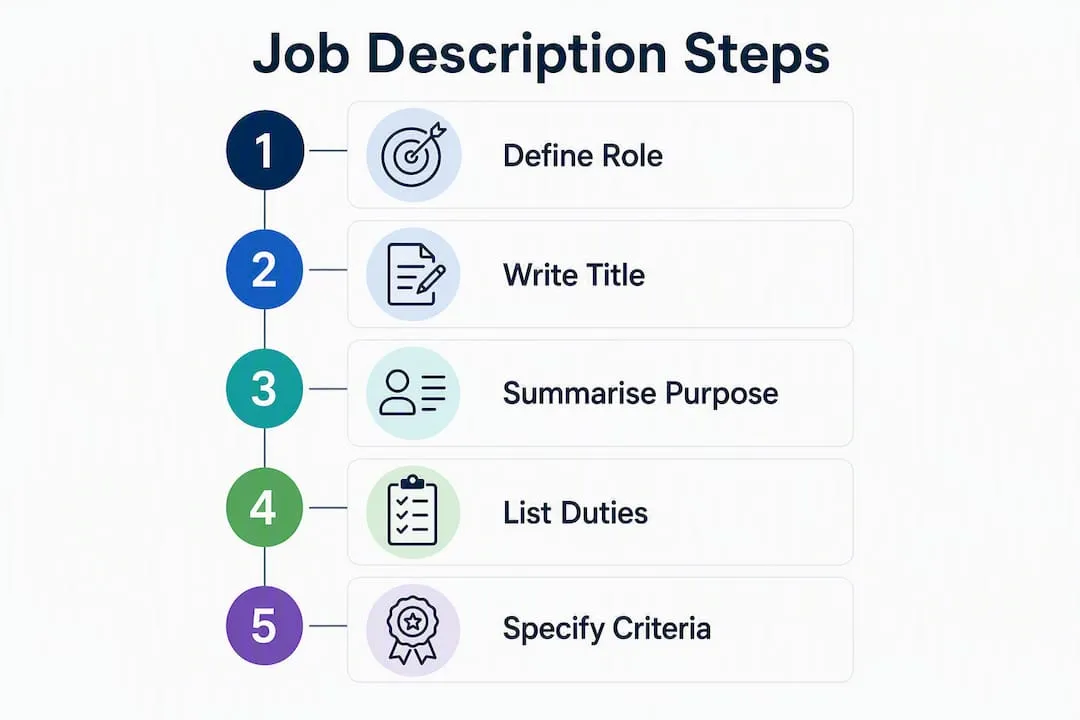
A strong job description covers ten fields: job title, job purpose, duties and responsibilities, reporting line, essential qualifications, desirable skills, working pattern and location, salary or salary band, performance expectations, and application instructions. Copy this checklist into your draft before you write a single word:
- Job title — specific, searchable, free of internal jargon
- Job purpose / summary — one or two sentences stating why the role exists
- Duties and responsibilities — six to ten bullet points, each starting with an action verb
- Reporting line — who the postholder reports to and any direct reports they manage
- Essential qualifications and experience — the absolute minimum to do the job on day one
- Desirable / preferred skills — useful but learnable on the job
- Working pattern, location and travel — hours, shift pattern, remote or on-site, any travel
- Salary or salary band — a stated range, not “competitive”
- Performance expectations — what success looks like in the first three to six months
- Company culture and values — a short, honest description, not a marketing slogan
- Application instructions and equal opportunities statement — how to apply, deadline, and your commitment to fair hiring
Table of Contents
- Who is this job description for, and what should it achieve?
- What goes in each section, and how do you write it?
- Practical writing hints that make a real difference
- Which templates and tools should you use?
- UK compliance and inclusive hiring: what you must check
- From draft to live: the publishing checklist
- Key takeaways
- The part most hiring guides skip
- Post your security role description where it reaches the right candidates
- Useful sources and templates
- FAQ
Who is this job description for, and what should it achieve?
A job description serves three distinct purposes, and knowing which one you are writing for shapes every decision that follows. For recruitment, it is a candidate-facing document that must attract the right people and deter the wrong ones. For accountability, it sets expectations between the postholder and their manager. For role design, it forces the organisation to think clearly about what the job actually requires before advertising.
Ownership typically sits with the hiring manager, who knows the day-to-day demands, but HR should review for legal compliance and consistency, and a subject-matter expert should check technical requirements. For senior or specialist roles, involve the line manager and a peer from the team. Write a new description when a role is genuinely new, when duties have materially changed, or when a previous description was simply a copy of the outgoing postholder’s profile. Acas recommends pairing the job description with a person specification, an application form, and an equality monitoring form — together, these documents reduce discrimination risk and give candidates a complete picture before they apply.
Pro Tip: Resist the temptation to paste in the previous holder’s CV as a template. Analyse the current team’s gaps and express requirements as behaviours or demonstrable competencies instead.
What goes in each section, and how do you write it?
Job title
Make it descriptive and searchable. “Security Officer” will surface in more candidate searches than “Team Guardian” or “Site Protection Specialist.” Avoid internal grade codes unless you also include the plain-English title. If the role has a common industry equivalent, use that.

Job purpose / summary
Thirty to fifty words. State why the role exists and the primary outcome it delivers. Example: “To provide a visible, professional security presence at [Site Name], protecting staff, visitors and assets, and responding to incidents in line with company procedures and SIA licensing requirements.”
Duties and responsibilities
Six to ten bullet points, each opening with a present-tense action verb: monitors, responds, reports, escorts, operates, maintains. Prioritise by importance, not by how often the task occurs. Where possible, quantify: “Monitors CCTV across 24 cameras on a rotating four-hour shift” is more useful than “Monitors CCTV.” Aim for job duties phrasing that a candidate can picture themselves doing.
Essential vs desirable criteria
This split is where most job descriptions go wrong. CIPD advises specifying behaviours and competencies that can be evidenced, and keeping essential criteria to what the role genuinely needs on day one. If a skill can be learned within the first three months, it belongs in the desirable column.
Reporting line
One sentence: “Reports to the Security Operations Manager. No direct reports.” If the role manages a team, state the number and grade.
Working pattern, location and travel
Be specific. “Rotating 12-hour shifts, days and nights, including weekends” tells a candidate far more than “shift work required.” State the primary site, whether remote working is available, and any travel between sites.
Salary or salary band and benefits
Publish a range. CIPD’s sample job advert includes a salary band of a salary band within a typical market range alongside leave entitlement, pension contribution, and flexible working options as a realistic role preview. Candidates who cannot see a salary range often assume the worst, and GOV.UK guidance confirms that presenting salary information increases the diversity of applicants.
| Field | Example wording |
|---|---|
| Salary band | a stated salary band |
| Annual leave | an appropriate annual leave entitlement including bank holidays |
| Pension | a standard employer pension contribution |
| Flexible working | Shift-swap requests considered; part-time applications welcome |
Performance expectations
Describe what good looks like in the first three to six months. “By month three, the postholder will have completed site induction, passed the internal CCTV assessment, and be operating independently on all assigned posts.” This gives candidates a realistic preview and gives managers a basis for probation reviews.

Company culture and values
Two or three sentences, honest rather than aspirational. Avoid phrases like “fast-paced environment” or “family feel” — they mean nothing and can put off candidates who have been burned by them before.
Application instructions and equal opportunities statement
State the closing date, how to apply (online form, email, or via a job board), and whether you accept CVs or require a specific application form. Close with a one-line equal opportunities statement and, where relevant, an invitation to request reasonable adjustments.
Pro Tip: Before finalising essential criteria, ask: “Could a strong candidate learn this within three months?” If yes, move it to desirable. Every unnecessary must-have shrinks your candidate pool.
Practical writing hints that make a real difference
Good structure is half the job. Clear writing is the other half. These editing passes, done in order, catch the most common problems.
Clarity and plain English
- Replace jargon with the plain equivalent: “liaise with” becomes “work with”; “operationalise” becomes “put into practice.”
- Remove internal acronyms or spell them out on first use.
- Aim for sentences under 20 words in the duties section.
- Read the description aloud. If you stumble, rewrite.
Inclusive language
- Avoid gender-coded words. Words like “dominant,” “competitive,” and “ninja” skew male; “supportive,” “collaborative,” and “nurturing” skew female. Neither set belongs in a job description.
- Drop vague cultural-fit language. “Must fit our culture” is both meaningless and a bias risk. CIPD warns that “cultural fit” phrasing can legitimise unconscious bias.
- Separate essential from desirable clearly — a single merged list deters candidates who do not tick every box.
Tone and candidate experience
Use active voice throughout. “The postholder manages access control” reads better than “Access control will be managed by the postholder.” Keep verb tenses consistent: present tense for ongoing duties, future tense for expectations. For online viewing, use a clean font, short paragraphs, and clear headings so the description is readable on a mobile screen.
Candidates increasingly expect transparency about process and timings. Specifying the number of interview stages and any assessment tasks reduces drop-off and improves the overall candidate experience.
Pro Tip: Run your draft through a free gender-decoder tool (such as the one at gender-decoder.katmatfield.com) before publishing. Then ask a colleague outside the team whether any listed skill could realistically be learned on the job. If yes, mark it desirable.
Which templates and tools should you use?
Template sources worth using
Acas provides free, editable job description templates in Word and OpenDocument formats: an outline template covering main headings and duties, and a template with two worked examples (administrative assistant and warehouse assistant). These are designed to reduce discrimination risk and are a reliable starting point for most UK employers.
For security-specific roles, Securityjobsboard’s sector-specific job description guide includes templates and phrasing examples tailored to common UK security posts, from door supervisors to control room operators.
When to use an AI generator
Tools such as Workable’s AI job description generator can produce a usable draft in under two minutes. That speed is genuinely useful when you are writing descriptions for ten roles at once. The catch is that generators frequently introduce biased phrasing, inflate essential criteria, and get localised details wrong — SIA licence requirements, UK pension references, and British shift-pattern conventions are common casualties. Treat any AI output as a first draft, not a finished document.
- Check salary and reporting line — generators often leave these blank or insert placeholder text.
- Proof for inclusive language — run the output through a gender-decoder tool before publishing.
- Verify local legal terms — confirm that references to qualifications, licences, and working hours match UK requirements.
- Bespoke drafts are preferable for senior, specialist, or newly created roles where the generator has no comparable template to draw from.
UK compliance and inclusive hiring: what you must check
Before publishing any job description in the UK, run through this compliance checklist.
Legal requirements
- The job description is a recruitment document, not a contract. Acas and the Employment Rights Act 1996 require a separate written statement of employment particulars — covering pay, hours, and notice — by the first day of employment. Do not confuse the two.
- Include an equal opportunities statement and a contact point for reasonable adjustments.
- Avoid any language that could constitute direct or indirect discrimination under the Equality Act 2010.
Inclusive writing practices
GOV.UK guidance on inclusive job descriptions recommends three specific practices: behaviour-based criteria, flexible working by default, and salary transparency. All three broaden applicant pools. Flexible working by default means stating that flexible arrangements will be considered, even if the role has fixed core hours.
Anonymised sifting — removing names and demographic details before shortlisting — pairs well with a tightly written, criteria-based description. It reduces the risk of unconscious bias at the screening stage.
Pro Tip: Keep your essential criteria list short. GOV.UK guidance is explicit: listing too many must-haves deters high-potential candidates, particularly women and some minority groups. If you have more than six essential criteria, challenge each one.
From draft to live: the publishing checklist
Once the draft is written, these steps take it from a Word document to a live advert that works.
- Internal approval — confirm sign-off from the hiring manager and HR. For regulated roles (SIA-licensed posts, for example), check that licence requirements are correctly stated.
- Salary band confirmation — verify the band with finance or HR before publishing. A salary listed incorrectly creates problems at offer stage.
- Diversity statement and accessibility — confirm the equal opportunities statement is present, the reasonable adjustments contact is named, and the advert is formatted for screen readers.
- Application instructions — check the closing date, application route (form, email, or job board), and that the link or email address works.
- Choose your channels — post internally first if the role may suit an existing employee. For external advertising, niche boards outperform generalist ones for specialist roles. For UK security posts, a specialist security job board reaches a more relevant candidate pool than a generalist platform.
- Set the closing date and interview window — give candidates at least two weeks to apply. Book interview slots before the advert goes live so you can state the expected timeline in the advert itself.
- Shortlisting grid — before applications arrive, build a simple scoring grid: list each essential criterion, score each application 0–2 against it, and total the scores. This keeps shortlisting consistent and defensible.
For a step-by-step publishing workflow tailored to UK security employers, the job posting workflow guide on Securityjobsboard covers the full process from draft to closing.
Key takeaways
A well-written job description separates essential from desirable criteria, states a salary band, describes success in the first three to six months, and uses behaviour-based language throughout.
| Point | Details |
|---|---|
| Write a clear, searchable title | Use the plain-English industry title; avoid internal codes or invented role names. |
| Separate essential from desirable | Keep essential criteria to six or fewer; anything learnable on the job belongs in desirable. |
| State the salary band | Publishing a range increases applicant diversity and reduces wasted time at offer stage. |
| Define early success | Describe what good looks like in months one to three to set expectations from day one. |
| Securityjobsboard for security roles | Post your finished description on Securityjobsboard for GDPR-compliant, BSIA-affiliated reach across UK security candidates. |
The part most hiring guides skip
Most advice on writing job descriptions focuses on structure. Get the headings right, use action verbs, separate essential from desirable. All of that is correct, and none of it is where most descriptions actually fail.
The real problem is that hiring managers write for the person they already have in mind. They list the outgoing postholder’s qualifications, their preferred working style, their sector background. The description becomes a portrait of one specific person rather than a specification for a role. That is how you end up with “must have five years’ experience in a similar role” in a job that genuinely needs someone who can follow a process and stay alert for eight hours.
For security roles specifically, this tendency is pronounced. A patrol officer description that lists “degree-level education preferred” or “experience with enterprise CCTV systems” for a role that requires an SIA Door Supervisor licence and good communication skills is not being thorough. It is being exclusionary by accident.
The fix is to start from the role, not the person. What does this job actually produce? What decisions does the postholder make independently? What would go wrong if they were not there? Answer those questions first, then write the criteria. You will end up with fewer must-haves, more honest desirables, and a description that attracts people who can actually do the job rather than people who look like the last person who did it.
Post your security role description where it reaches the right candidates
Writing a strong job description is only half the work. Where you post it determines who sees it.

Securityjobsboard is the UK’s specialist platform for security sector recruitment, affiliated with the BSIA and built specifically for employers hiring SIA-licensed officers, control room staff, door supervisors, and operations managers. Posting here means your description reaches candidates who are already working in or actively seeking security roles — not a general audience scrolling past irrelevant listings.
The platform is GDPR-compliant, mobile-responsive, and backed by human support rather than automated ticket queues. Flexible pricing means you are not locked into a monthly contract to post a single vacancy. For employers hiring across multiple sites or regions, the CV database lets you search proactively rather than waiting for applications.
Visit Securityjobsboard’s career advice and employer guidance pages to find role-specific templates, posting guidance, and support for your next hire.
Useful sources and templates
Use these resources to check your draft against authoritative UK guidance and download ready-made templates.
- Acas job description templates — free Word and OpenDocument templates, including a worked example for an administrative assistant and a warehouse assistant. Use these as your structural starting point and adapt the headings and duties for your role.
- Acas written statement guidance — clarifies what must appear in the written statement of employment particulars by day one of employment, separate from your recruitment-facing job description.
- GOV.UK inclusive job descriptions — practical guidance on behaviour-based criteria, pay transparency, and flexible working by default. Use this to audit your draft for language that may deter diverse candidates.
- CIPD inclusive recruitment guide — covers behaviour-based and competency criteria, the risks of cultural-fit language, and a sample job advert with salary band and benefits. Use this for the criteria and benefits sections.
- Securityjobsboard sector templates — sector-specific guidance and sample job descriptions for UK security roles, from patrol officers to operations controllers.
Download at least one template and adapt it rather than starting from a blank page. Copying verbatim is a missed opportunity: the template gives you the structure, but the duties, criteria, and culture sections should reflect your specific role and organisation.
FAQ
How do I write a job description from scratch?
Start with the ten core fields: job title, job purpose, duties, reporting line, essential qualifications, desirable skills, working pattern, salary band, performance expectations, and application instructions. Use Acas’s free templates as a structural starting point, then adapt the content to your specific role.
What should a job description include as a minimum?
At minimum, a job description should state the job title, main duties, reporting line, working hours and location, and how to apply. For UK compliance, Acas recommends pairing it with a person specification and an equality monitoring form.
Can I use an AI tool to create a job description?
Yes, tools such as Workable’s generator can produce a usable draft quickly, but always proof the output for biased language, inflated essential criteria, and incorrect UK-specific details such as SIA licence requirements or pension references before publishing.
How do I write a job description for myself in a new role?
Focus on the outcomes the role is expected to deliver rather than tasks you already know how to do. List the decisions you will make independently, the people you will work with, and what success looks like in the first six months. Then separate the skills you bring on day one from those you will develop in post.
Is a job description the same as an employment contract?
No. A job description is a recruitment and accountability document. The written statement of employment particulars — covering pay, hours, notice, and other statutory terms — is a separate legal requirement under the Employment Rights Act 1996 and must be provided by the first day of employment.
This article provides general guidance on writing job descriptions and is not legal advice. For contractual obligations and employment law queries, consult Acas or a qualified employment law professional.


