Candidate shortlisting: a practical guide for UK recruiters

Candidate shortlisting is the formal stage of recruitment where you review all applications and identify those who meet the essential role criteria to be invited to interview. The immediate outcome is a defensible shortlist of typically a small number of candidates typically around four to six, supported by a documented scoring record. Under the Equality Act 2010, rejected applicants can bring uncapped discrimination claims even if never employed, so every shortlisting decision must be evidence-based and consistent. EHRC guidance reinforces this: fairness and objectivity are not optional extras. For UK security employers, Securityjobsboard provides a sector-specific platform built around these compliance requirements.
Table of Contents
- Why candidate shortlisting matters and where it fits in hiring
- What UK law requires at the shortlisting stage
- How to run a shortlisting process step by step
- How to score and rank applications: a scorecard template
- Communicating outcomes and keeping defensible records
- Practical steps to reduce bias in shortlisting
- What technology can do for shortlisting — and where to be cautious
- Shortlisting best practice for UK security-sector hiring
- Key takeaways
- The part most shortlisting guides skip
- Securityjobsboard: built for UK security hiring
- Useful sources
- FAQ
Why candidate shortlisting matters and where it fits in hiring
Shortlisting sits between the application closing date and the interview invitation. Get it right and you interview the best-qualified people; get it wrong and you either waste panel time on unsuitable candidates or expose the organisation to a discrimination claim.
The process flows in a clear sequence:
- Vacancy closes — applications collected and anonymised where possible.
- Longlist sift — binary check against essential criteria; anyone who fails one essential criterion is excluded.
- Shortlisting stage — desirable criteria applied to the remaining pool to produce the final shortlist.
- Interview invitations — shortlisted candidates contacted with full details.
- Hire decision — panel selects from interviewed candidates.
For practical shortlist sizing, University of Bristol HR guidance recommends a small number of candidates typically around four to six as the optimum, with 7 as a sensible upper limit. Beyond that, interview days become unwieldy and panel fatigue sets in. A well-run shortlisting stage also shapes candidate experience: applicants who receive a clear, timely response — even a rejection — are far more likely to reapply or recommend the employer to others.
A note on timing: most shortlisting panels should complete their scoring within a period of several working days of the vacancy closing. Longer delays increase the risk of strong candidates accepting other offers.
What UK law requires at the shortlisting stage
Shortlisting is one of the highest-risk legal stages in the entire recruitment cycle. The Equality Act 2010 prohibits discrimination across nine protected characteristics, and a rejected candidate does not need to have been employed to bring a claim. That makes your scoring records the first line of defence.
EHRC guidance is clear that equality law does not prescribe a single shortlisting method, but it does require the process to be fair and consistent. That gives employers genuine flexibility to choose an approach that suits their volume and context, provided the rationale is documented.
Reasonable adjustments are not limited to interview day. At the shortlisting stage, examples include providing application forms in alternative formats, extending deadlines for online assessments, or accepting supporting evidence in a different medium. Document every adjustment request and the response you gave, and store these in the recruitment file.
On record-keeping, retain the person specification, the completed scoring matrices, panel notes, and any reasonable adjustment correspondence. Under UK GDPR, unsuccessful candidates can submit a subject access request, so records must be held securely and for a defined period set by your organisation’s retention policy. Critically, keep monitoring data (such as equal opportunities forms) entirely separate from the scoring panel. Scorers should never see protected-characteristic information when making their decisions.
How to run a shortlisting process step by step
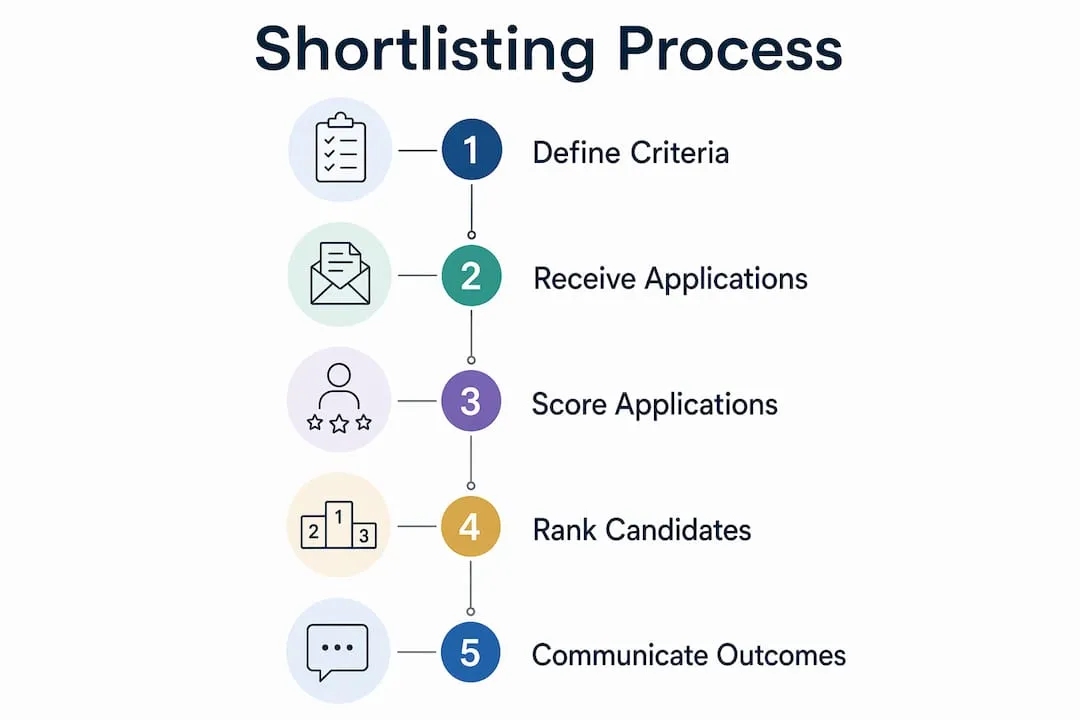
A structured approach removes ambiguity and makes your decisions far easier to defend. Follow these steps in order.
- Finalise the person specification before advertising. Set essential and desirable criteria in advance. The LSE recruitment toolkit recommends no more than ten criteria assessed at application stage; beyond that, both candidates and panels struggle.
- Agree the shortlist size and cut-off rules. Decide before you open applications how many candidates you will invite and confirm that all essential criteria must be met as a minimum threshold.
- Assign the panel. Use at least two independent scorers. Brief them on the criteria, the scoring scale, and the process before they see any applications.
- Run the first sift. Apply essential criteria only, using a binary met/not met check. Any application that fails a single essential criterion is excluded at this stage.
- Apply desirable criteria. Score the remaining applications against desirable criteria using a weighted scale. Where the pool is still large, a two-stage approach — sift for essentials, then score desirables — is recognised best practice for high-volume vacancies.
- Rank and confirm the shortlist. The highest-scoring candidates who meet all essentials form the shortlist. Identify two or three reserve candidates in case of withdrawals.
- Sign off and communicate. A named decision-maker (usually the hiring manager or HR lead) formally approves the shortlist before any invitations go out.
Pro Tip: Set your cut-off rules in writing before scoring begins. Documenting that “all essential criteria must be met” is far more defensible than trying to justify a subjective exception after the fact.
How to score and rank applications: a scorecard template
A shortlisting scorecard turns a subjective review into a structured assessment. The LSE recruitment toolkit recommends binary scoring for essential criteria (1 = met, 0 = not met) and weighted scoring for desirable criteria, with panel members scoring independently before comparing results.

| Criterion | E / D | Weight | Candidate A | Candidate B |
|---|---|---|---|---|
| Holds valid SIA licence | E | — | 1 | 0 |
| Minimum 2 years’ security experience | E | — | 1 | 1 |
| First aid certificate | D | 2 | 2 | 1 |
| CCTV operation experience | D | 1 | 1 | 1 |
| Customer-facing communication skills | D | 2 | 1 | 2 |
| Essential criteria met? | Yes | No | ||
| Desirable total | 4 | 4 | ||
| Proceed to interview? | Yes | No |
E = Essential, D = Desirable. Desirable scores are weighted (score × weight).
In this worked example, Candidate B fails the SIA licence essential criterion and is excluded regardless of their desirable score. Candidate A meets all essentials and proceeds. Where two candidates tie on desirable scores, a pre-agreed tie-break rule (for example, the criterion with the highest weighting) determines the outcome.
Pro Tip: Record the rationale for any tie-break decision in the panel notes at the time. A note written three weeks later, after a candidate has complained, carries far less weight.
Communicating outcomes and keeping defensible records
How you communicate shortlisting decisions shapes your employer reputation as much as the decision itself.

For successful candidates, the interview invitation should include the date, time, format (in-person, video, or telephone), location or link, the names of the panel, and an explicit offer to discuss reasonable adjustments. Giving candidates this information early reduces last-minute withdrawals and signals a well-run process.
For unsuccessful applicants, a brief, professional rejection that thanks them for their application and confirms the vacancy has been filled at this stage is sufficient. Avoid specific feedback at this point unless your policy supports it; detailed written feedback on shortlisting decisions can be used in a later claim if the wording is imprecise.
Pro Tip: Keep a recruitment file for every vacancy that contains: the job description and person specification, the completed scoring matrices, panel notes, the final shortlist decision, any reasonable adjustment requests and responses, and the interview invitations sent. Store it securely and set a retention date aligned to your GDPR policy.
On data access requests: under UK GDPR, a rejected candidate can request their personal data, including the scores and notes recorded about them. Accurate, contemporaneous records protect you; vague or missing notes do not.
Practical steps to reduce bias in shortlisting
Bias in shortlisting is rarely deliberate, but its legal and reputational consequences are the same regardless of intent. The most effective mitigation is structural, not motivational.
- Blind screening: remove names, addresses, and other identifying information from applications before scoring. This reduces the influence of name-based or postcode-based assumptions.
- Binary essential checks: applying a strict met/not met test for essentials leaves no room for a scorer to “feel” that a candidate is worth bending the rules for.
- Separate monitoring data: equal opportunities forms must never reach the scoring panel. Route them to HR for aggregate reporting only.
- Calibration sessions: before scoring the full pool, run a short session where all panel members score two or three anonymised sample applications independently, then compare and discuss. This surfaces differing interpretations of criteria before they affect real decisions.
- Nominate a final arbiter: agree in advance who resolves disagreements. Document any disagreement and the resolution in the panel notes.
- Avoid ‘culture fit’ language: recruitment discrimination guidance consistently identifies subjective culture-fit decisions as a major source of discrimination risk. Every rejection must be traceable to a specific, role-related criterion.
Pro Tip: Run your calibration session on anonymised applications from a previous, closed vacancy rather than invented examples. Real applications surface the edge cases that matter.
What technology can do for shortlisting — and where to be cautious
Technology can speed up shortlisting and strengthen your audit trail, but it introduces its own risks if used without oversight.
| Approach | Key benefit | Key caution |
|---|---|---|
| Manual scoring (paper or spreadsheet) | Full panel control; simple audit trail | Prone to inconsistency across scorers; slow at volume |
| ATS-assisted shortlisting (e.g. PeopleHR, Personio) | Consistent scoring interface; exportable reports; built-in audit trail | Requires correct criteria setup; garbage-in, garbage-out |
| AI-assisted screening | Fast initial sift at high volume | Opaque decision-making; potential for automated bias; accessibility risks |
HR toolkits recommend that any system used for shortlisting must support exportable reports, a clear audit trail, and the ability to record reasons for decisions. When evaluating an ATS or AI tool, check specifically for: a reasonable-adjustment workflow, accessible candidate-facing interfaces, and data export functionality for GDPR compliance.
AI screening tools deserve particular caution. They can filter at speed, but if the training data reflects historical hiring patterns, they may replicate existing biases. Any automated step must be documented, and a human reviewer must be able to override and record the reason. Do not treat an AI output as a decision; treat it as a first-pass indicator that a human then verifies.
Shortlisting best practice for UK security-sector hiring
Security roles carry specific pre-employment checks that map directly onto essential criteria: a valid SIA licence, right to work in the UK, relevant sector training (such as door supervisor or CCTV operator qualifications), and in some roles a basic or enhanced DBS check. These are not optional extras; they are legally required for the role to be performed lawfully. That means they belong on the person specification as essential criteria and must be verified at the shortlisting stage, not left to post-offer checks.
For security recruiters, the practical implications are straightforward. Flag mandatory licence and right-to-work checks on the person specification so applicants know what evidence to supply. Pre-verify licence numbers where possible before committing panel time to a full shortlist review. Hold two or three reserve candidates, because licence lapses and last-minute withdrawals are more common in this sector than in most. For a detailed look at screening security candidates, including how to structure pre-screen checks, Securityjobsboard’s hiring guides cover the sector-specific detail. The step-by-step hiring process for security firms sets out how shortlisting fits into the wider workflow.
Key takeaways
Effective candidate shortlisting requires predefined essential criteria, a documented scoring matrix, and a clear audit trail to satisfy both the Equality Act 2010 and the practical demands of a fair, efficient process.
| Point | Details |
|---|---|
| Define essentials first | Set essential and desirable criteria before advertising; never adjust them mid-process. |
| Use a scoring matrix | Score every application against the same criteria; binary for essentials, weighted for desirables. |
| Consider reasonable adjustments early | Proactively offer adjustments at shortlisting, not just at interview, and document every request. |
| Keep a full recruitment file | Retain scoring matrices, panel notes and decision records securely, with a GDPR-aligned retention date. |
| Aim for four to six candidates on the shortlist | The optimum shortlist is four to six candidates; hold reserves in case of withdrawals. |
| Securityjobsboard | Supports UK security employers with sector-specific job posting, applicant management and GDPR-aware processes at securityjobsboard.co.uk. |
The part most shortlisting guides skip
Most guidance on shortlisting focuses on process compliance, and rightly so. But the single biggest failure point is not a missing form or an unlocked spreadsheet. It is the moment a panel member says “I just don’t think they’d fit in here” and the rest of the panel nods along.
Three things prevent that. First, calibrate your scorers before they touch a single real application. Fifteen minutes on two anonymised CVs from a closed vacancy will surface every disagreement about what “demonstrable experience” actually means. Second, insist on binary essential checks with no exceptions. The moment you allow a panel member to argue that a candidate “almost” meets an essential criterion, you have opened a door that is very hard to close legally. Third, always prepare reserve candidates. A shortlist of six with no reserves is one withdrawal away from a panel day that cannot proceed.
A documented shortlist has, on more than one occasion, been the difference between a straightforward recruitment outcome and a protracted dispute. Not because the records were perfect, but because they existed, were consistent, and showed that the same criteria were applied to every applicant in the same way. That is all a tribunal needs to see.
Securityjobsboard: built for UK security hiring
Posting a security vacancy and managing the applicant flow is where many employers lose time before shortlisting even begins. Securityjobsboard is a UK-based platform built specifically for the security sector, connecting employers with candidates who already hold the licences and sector experience your person specification requires. You get a searchable CV database, direct candidate communication, and a GDPR-aware process, without the overhead of a generalist job board that was never designed for SIA-licensed roles.

Whether you are recruiting door supervisors in Manchester or CCTV operators in Belfast, Securityjobsboard gives you a targeted applicant pool from day one. For regional hiring, the Northern Ireland security jobs page is a practical starting point. Post your vacancy at securityjobsboard.co.uk and reach candidates who are already looking for exactly the role you need to fill.
Useful sources
The following primary and authoritative sources underpin the guidance in this article. Bookmark them if you are building or reviewing your shortlisting policy.
- Equality Act 2010 (legislation.gov.uk) — the primary legislation governing fair treatment at every stage of recruitment.
- EHRC: What equality law means for you as an employer — recruitment — practical employer guidance on reasonable adjustments and consistent process.
- LSE Recruitment Toolkit: A Guide to Shortlisting — detailed guidance on scoring matrices, calibration and audit trails.
- University of Bristol HR: Shortlisting guidance — recommended shortlist sizes, two-stage sift approach and person-specification-first methodology.
- Equality Commission NI: Shortlisting, interviewing and selection — covers reasonable adjustments at shortlisting with practical examples.
- LSE Recruitment Toolkit: Writing Job Descriptions and Person Specifications — guidance on setting no more than ten application-stage criteria and structuring essential vs desirable.
FAQ
What is candidate shortlisting in recruitment?
Candidate shortlisting is the formal process of reviewing all applications to identify those who meet the essential role criteria and should be invited to interview. The outcome is a ranked, documented shortlist, typically of four to six candidates.
How many candidates should be on a shortlist?
The optimum shortlist is four to six candidates, with 7 as a practical upper limit. Always identify two or three reserves in case of withdrawals before the interview stage.
What criteria should you use when shortlisting?
Criteria must come from the person specification and be divided into essential (must be met to be considered) and desirable (used to differentiate between candidates who meet all essentials). Criteria must be objective, role-related, and set before applications open.
Does the Equality Act 2010 apply to shortlisting?
Yes. Under the Equality Act 2010, rejected candidates can bring uncapped discrimination claims even if never employed. Shortlisting decisions must be evidence-based, consistent, and documented, with reasonable adjustments considered proactively for disabled applicants.
How do you reduce bias when shortlisting candidates?
Use blind screening to remove identifying information, apply binary essential checks with no exceptions, keep monitoring data separate from scorers, and run a calibration session before the panel scores the full applicant pool.


