Get Hired in UK Security: 3 STAR Templates and SIA Checks

To pass a security interview you must prove SIA eligibility and show three short, job-focused examples that demonstrate de-escalation, situational awareness and reliability. Employers want to see a licence-linked qualification, a calm communication style and evidence you show up on time, every time. Get those three things straight and the rest of the conversation looks after itself.
TL;DR:
- Reliable licensing and a calm communication style are essential, supported by concrete examples demonstrating de-escalation, situational awareness, and punctuality.
- Preparing STAR responses for scenarios involving conflict resolution, emergencies, and customer service increases the likelihood of showcasing relevant competencies.
- Dress professionally, organize key documents, and have targeted questions ready to demonstrate seriousness and understanding of site-specific security demands.
- Confirm your SIA qualification status online beforehand, and be transparent about any in-progress training or license renewals during the interview.
- Employers value clear, relevant experiences and soft skills such as professionalism and calmness more than flashy answers or vague claims.
Table of Contents
- Common security interview questions to expect and what interviewers are really testing
- How to use STAR in security interviews plus three ready-to-fill templates
- Practical interview execution: appearance, documents, and questions to ask recruiters
- SIA eligibility and licence-linked training: what to check and what to say in interviews
- Conflict management and communication: phrases and behaviours that demonstrate de-escalation skill
- Interview day checklist and a 30 to 60 minute practice routine
- Five short sample answers you can adapt for security interviews
- Different types of security roles and how the interview focus shifts
- Preparing questions to ask about the role and the site’s security policies
- Common mistakes to avoid during security interviews
- Physical fitness and medical considerations for security roles
- What hiring managers value: an employer’s perspective
- Get your CV and licence details in front of employers today
- Sources
- FAQ
Common security interview questions to expect and what interviewers are really testing
Security interviews follow a fairly predictable pattern because employers are checking for the same handful of traits: reliability, composure under pressure, and the judgement to know when to act and when to hold back. Knowing the motive behind each question lets you aim your answer at what actually matters, rather than guessing.
The questions that come up almost every time include:
- Tell me about yourself and your experience.
- Why do you want to work in security?
- What are your main strengths for this role?
- How would you handle an aggressive or intoxicated member of the public?
- Describe a time you dealt with an emergency or unexpected incident.
- How do you stay alert during long or quiet shifts?
- What does good customer service look like in a security role?
Each of these is testing something specific, and knowing what sits behind the question helps you shape a sharper answer:
- Tell me about yourself: tests communication and relevance. Keep it to 60 seconds, cover your background, licence status and why this role fits.
- Why security: tests motivation and staying power. Mention what draws you to the work, not just that you need a job.
- Strengths: tests self-awareness. Pick one strength tied directly to security work, such as observation or calm under pressure, and back it with a short example.
- Handling aggression: tests conflict management. Interviewers want a de-escalation approach, not a story about physical intervention.
- Emergency example: tests judgement and procedure-following. They want to hear that you followed protocol and reported correctly, not that you improvised.
- Staying alert: tests reliability on quiet or repetitive shifts. Mention rounds, checks, or a personal routine that keeps you sharp.
- Customer service scenarios: tests tone and professionalism, especially for retail, event or reception-facing roles.
Two short prompts are worth preparing an answer to for each question above: what specifically did you do, and what was the outcome for the site, the client or the public. Interviewers remember concrete detail far more than general claims about being “a people person” or “good under pressure.” A guard who says “I noticed a fire exit blocked by pallets during my hourly walk and had it cleared within ten minutes” beats a guard who says they are “very safety-conscious” every time.
Tailor your answers to the role type where you can. A static guard interview will lean harder on the alertness and reliability questions, while an event security interview will lean on crowd behaviour and customer service. Keep a mental note of which two or three questions matter most for the specific job advert and be ready with your sharpest example for those.
How to use STAR in security interviews plus three ready-to-fill templates
STAR (Situation, Task, Action, Result) works well in security interviews because it forces you to show what actually happened rather than what you would theoretically do. For this sector, adapt it slightly: the Result should always point to safety, legality or a calm outcome, not to how tough the situation was.
Three templates you can fill in with your own detail:
- De-escalation: Situation, a visitor or member of the public became agitated. Task, keep the situation calm and safe without escalating. Action, you used a steady tone, active listening and gave them space and choices. Result, the situation was resolved without incident and handed over or logged correctly.
- Emergency response: Situation, an alarm, fire or medical incident occurred. Task, follow site procedure and protect people first. Action, you assessed the scene, radioed control, and directed people to safety. Result, the incident was contained and reported within policy.
- Customer service and responsibility: Situation, a visitor needed help or made a complaint. Task, resolve it while staying professional. Action, you listened, explained the site rule clearly, and offered an alternative. Result, the visitor left satisfied and no incident report was needed.
Pro Tip: Never claim you used force beyond policy, made an arrest, or restrained someone unless that is genuinely your role and legally accurate. Describe outcomes such as “safe handover to police” rather than anything that sounds like you exceeded your authority.
Keep each STAR answer to around 60 to 90 seconds. Longer than that and interviewers start to lose the thread of what you actually did.
Practical interview execution: appearance, documents, and questions to ask recruiters
First impressions matter more in security than in most sectors, because presentation is part of the job. Dress a level smarter than the uniform you would wear on shift: a clean shirt, dark trousers and polished shoes signal that you take standards seriously.
Bring your documents in one folder, ready to hand over without fumbling:
- Photo ID and proof of right to work.
- Your SIA licence or proof of a licence-linked qualification if the licence itself is still pending.
- CV copies and any references or certificates relevant to the role.
- A note of your availability for shifts, including nights and weekends if relevant.
If your licence application is in progress rather than complete, say so plainly and explain the stage you are at. Some employers will pay the fee or apply on your behalf, so it is worth asking directly whether that support is available, as Gov confirms this is common practice.
Ask two or three questions that show genuine interest: what does a typical shift pattern look like, what training or refresher support is offered, and how does the site handle incident reporting. These questions tell the interviewer you are thinking about the job seriously, not just trying to get through the meeting.
SIA eligibility and licence-linked training: what to check and what to say in interviews
Before you interview, confirm your own eligibility rather than assuming it. Under gov.uk’s SIA licence guidance, you must be 18 or older, pass identity and criminal record checks, and hold a licence-linked qualification before you apply. Employers see a lot of candidates who skip this step and then stumble in the interview when asked about licence status.
Check these before you sit down with an employer:
- Confirm your qualification appears under “My licences” or “My qualifications” in your SIA online account, not just on a course certificate.
- Check which licence-linked training covers your intended role, since door supervision, CCTV and close protection have different course content.
- If your qualification is due to expire or you need a refresher, say so directly and name the date you plan to renew.
- If the employer is known to sponsor licence fees, raise it as a question rather than an assumption.
If your qualification is very recent, say so with confidence rather than apologising for lacking experience — and consider how to préparer son stage de points efficacement en France to maintain your licence status and compliance. If it is still in progress, be specific about your expected completion date. Our SIA licence guide breaks down the pathway stage by stage if you want a fuller checklist before your next interview.
Conflict management and communication: phrases and behaviours that demonstrate de-escalation skill
De-escalation is one of the most heavily weighted competencies in a security interview, and it is also the easiest to demonstrate badly. The College of Policing’s conflict management guidance points to situational awareness, active listening, a controlled tone and paraphrasing as the core techniques, alongside scenario-based training.
In practice, that means avoiding commands that start with “don’t” and instead offering outcome-focused language, such as “let’s step over here so we can sort this out” rather than “stop shouting.” Paraphrasing what someone has said back to them, calmly, shows you are listening rather than just waiting to respond.
- Mention that you scan the environment for exits, crowd density or early warning signs before a situation escalates.
- Use a specific phrase you would use on shift, such as “I hear you’re frustrated, let’s find a way to sort this.”
- Describe the outcome in terms of reduced tension or a safe handover, not in terms of “winning” the confrontation.
BSIA members represent around 70% of the UK private security industry, and sector guidance consistently pairs technical skills like patrolling and access control with soft skills like communication and professionalism. That combination is exactly what interviewers are listening for when they ask a conflict question.
Interview day checklist and a 30 to 60 minute practice routine
A short, focused run-through the evening before beats hours of vague worrying.
- Pack documents, ID, licence proof, CV copies and referee contacts the night before.
- Plan your travel route with a buffer of at least fifteen minutes.
- Rehearse your three STAR stories out loud, once each.
- Practise the 60-second “tell me about yourself” until it flows without notes.
- Prepare five questions to ask the interviewer and read them back to yourself once.
Pro Tip: If nerves tend to catch you before interviews, do a slow four-count breath in and out twice before you walk in, and have one piece of small talk ready, such as a comment on the site or the weather, to settle the first thirty seconds.
Five short sample answers you can adapt for security interviews
These are templates rather than scripts. Swap in your own detail and adjust length depending on how much time the interviewer gives you.
- Tell me about yourself: “I’ve worked in customer-facing roles for two years and recently completed my SIA licence-linked training in door supervision. I’m looking for a role where I can put that training to use and build a longer-term career in security.” This tests communication and relevance, and should stay under 60 seconds.
- Why security: “I like the structure and responsibility of the job. I’ve always been the person in a group who notices when something’s off, and I want a role where that instinct is actually part of the job.” This tests motivation, so keep it personal and specific.
- Handling aggression: “In my last role, a customer became loud and confrontational over a refused entry. I kept my tone level, gave them space, and explained the site policy calmly rather than repeating the refusal. They calmed down and left without further issue.” This tests conflict management, and the outcome line matters more than the description of the aggression itself.
- Emergency example: “During a shift, a fire alarm went off unexpectedly. I followed the evacuation procedure, checked my assigned zone, and radioed control to confirm the area was clear before reporting back.” This tests procedure-following, so name the steps in order.
- Customer service: “A visitor was lost and frustrated trying to find a delivery entrance. I walked them most of the way, explained the site layout, and made sure they knew who to contact if it happened again.” This tests tone and helpfulness, and a small gesture like walking someone partway often lands better than just giving directions.
When you adapt these, mention the specific site type if you know it (retail, event, corporate reception) and drop in your licence type where relevant, since interviewers often ask directly whether your qualification covers the role advertised.
Different types of security roles and how the interview focus shifts
A static guard interview at a warehouse or corporate site will focus heavily on reliability, patrol routines and staying alert during quiet stretches, since the job is largely about consistency rather than constant activity. Expect questions about how you handle repetitive shifts and lone working.
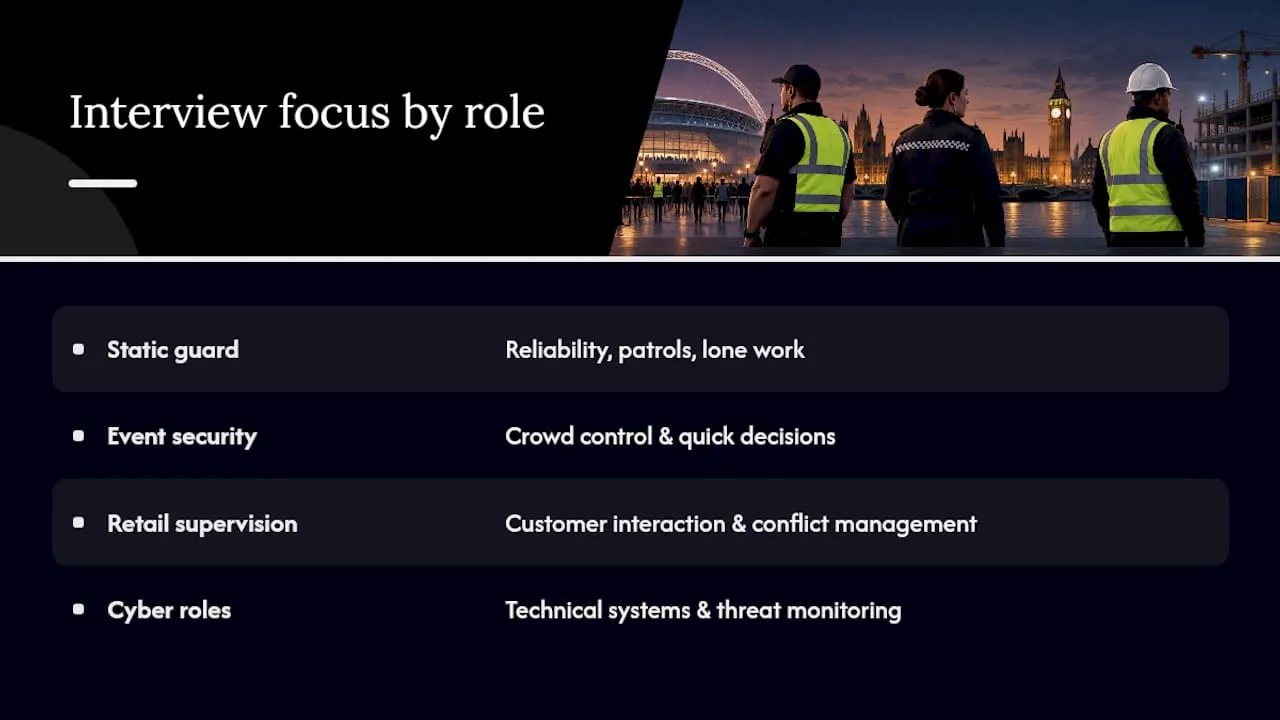
Event security interviews shift the focus towards crowd behaviour, quick decision-making and customer service, because you are managing large numbers of people in short, high-intensity bursts. Interviewers here often probe how you would handle a queue dispute or a crowd surge near an entrance.
Retail and door supervision roles sit somewhere between the two, with heavier weight on customer interaction, conflict management and clear communication with store or venue staff.
Cybersecurity-adjacent roles, where they appear on a security jobs board, are a different discipline entirely and typically test technical knowledge of systems and threat monitoring rather than physical presence, so tailor your preparation accordingly if you are applying across both physical and digital security postings. Check which roles require an SIA licence before applying, since not every security-titled role needs one.
Preparing questions to ask about the role and the site’s security policies
Asking good questions at the end of an interview does two things: it shows genuine interest, and it gives you real information to decide whether the job suits you.
Useful questions include asking what a typical shift pattern looks like, what training or refresher courses are provided once you start, and how incidents are logged and escalated on site. You might also ask whether the employer supports licence renewal costs or ongoing CPD, since some do and some do not.
Avoid questions that are only about pay and holiday in the first exchange. Save those for when an offer is on the table, and lead instead with questions that show you are thinking about the actual work: site risks, team structure and how support works during a difficult shift.
Common mistakes to avoid during security interviews
The most frequent mistake is turning up without proof of licence status, or being vague about where the application currently stands. Interviewers notice immediately when a candidate cannot answer a direct question about their SIA qualification.
A second common mistake is answering the aggression question with a story about physical intervention rather than de-escalation, which can raise concerns about judgement rather than reassure the interviewer.
Vague answers are another trap. “I’m good under pressure” without an example carries far less weight than a specific, thirty-second story with a clear outcome. Turning up late, dressing too casually, or failing to research the company at all are smaller mistakes that still cost candidates offers, particularly when competing against someone who has clearly prepared.
Physical fitness and medical considerations for security roles
Some security roles, particularly static guarding, event security and mobile patrol, involve long periods of standing, walking rounds, and occasional physical demands such as responding quickly to an incident. Employers do not usually require a formal fitness test, but they will often ask directly whether you can manage extended shifts, night work or outdoor conditions.
If you have a condition that affects mobility, stamina or shift flexibility, it is worth raising it honestly during the interview rather than after you start, so the employer can confirm whether the specific role suits your circumstances. Being upfront here tends to be viewed as a sign of reliability rather than a weakness.
What hiring managers value: an employer’s perspective
Employers consistently prioritise reliability, correctly presented licence paperwork and clear, calm communication over flashy answers. BSIA affiliation is treated as a baseline industry standard, not a bonus, so candidates who present licence and training detail clearly stand out immediately. Candidates can surface this information early by letting them attach licence status directly to a profile, so employers see it before the interview even starts.
— Rob
Get your CV and licence details in front of employers today
Preparation gets you through the door, but employers still need to find you. Security Jobs Board lets you create a free profile, upload your CV and attach your licence details directly, then set job alerts so relevant roles reach you first.

Quick-apply features mean you can respond to a new listing the same day it goes live, with your SIA status already visible to the employer. Set up your profile at Securityjobsboard and start applying with your paperwork already sorted.
Sources
Confirm licence eligibility directly with gov.uk’s SIA application guidance and check course requirements on the SIA training pages. Read industry expectations from the BSIA and conflict-management technique from the College of Policing. For a step-by-step licence walkthrough, see our security guard licence guide.
FAQ
What are the 5 C’s of security guards?
Different training providers describe the “5 C’s” slightly differently, so there is no single official version. A common set covers communication, conscientiousness, consistency, control and courtesy, all of which line up with the reliability and de-escalation skills employers test for in interviews.
What are the 5 C’s of interviewing?
This framing varies by source and is not a fixed industry standard, so treat any version with caution. In a security context, the closest useful equivalent is preparing clear communication, concrete examples, calm delivery, correct documentation and confidence in your licence status.
What are some tips for a security interview?
Bring proof of your SIA licence or qualification status, prepare three short STAR examples covering de-escalation, an emergency and customer service, and dress smartly. Research the employer’s site type beforehand so you can tailor your answers to static, event or retail security work.
What are the 4 P’s in security guard?
This is another framework that varies between training providers rather than a fixed official standard, so definitions differ. Candidates are better served focusing on the concrete skills employers actually test in interviews: reliability, observation, communication and correct licensing.
Do I need my SIA licence before I apply for security jobs?
You do not always need the licence fully issued before applying, but your qualification should appear on your SIA online account, as required under gov.uk guidance. Some employers will support the application or cover the fee, so it is worth asking during the interview.


