Shortlist applicants: an auditable process for UK security roles

Shortlist applicants by scoring every candidate against the essential and desirable criteria in your person specification, using at least two independent scorers and a simple matrix with a pre-set pass threshold. Record a written reason for every rejection, keep diversity monitoring data separate from the scoring sheet, and notify shortlisted candidates promptly. Do this and your process stays fast, fair, and defensible if ever challenged.
TL;DR:
- Shortlisting should be a multi-step, carefully planned process with at least two independent reviewers to reduce bias and ensure fairness.
- Use a clear scoring matrix aligned with the job’s essential and desirable criteria, setting thresholds before reviewing applications to maintain consistency.
- Keep detailed records of scores, reasons for rejection, and decision rationale to defend choices and comply with legal standards.
- Automate only objective criteria through ATS filters, and always supervise or review AI decisions to prevent unintentional discrimination.
- Limit shortlisted candidates to 3 to 8 based on capacity and job complexity, and notify candidates promptly with specific reasons for rejection or success.
Table of Contents
- How do you shortlist applicants step by step?
- How do you build a shortlisting scorecard that holds up?
- How do you avoid discrimination and bias when shortlisting?
- Can you use an ATS to shortlist without introducing bias?
- How many applicants should you shortlist?
- How should you record and communicate shortlisting decisions?
- Practical notes from Security Jobs Board
- What actually matters when you shortlist applicants
- Ready to hire faster in UK security recruitment?
- Sources
- FAQ
How do you shortlist applicants step by step?
Shortlisting works best as a sequence, not a single sitting. Rushing it produces inconsistent scores and, worse, decisions nobody can explain three months later if a rejected candidate asks why.
Here’s the workflow that holds up under scrutiny and doesn’t burn a week of everyone’s time.
- Prepare before you open a single CV. Confirm the job description and person specification are current, agree how many candidates you actually need to shortlist, and book time in the diaries of everyone scoring. If the role has changed since the advert went live, fix the criteria now rather than mid sift.
- Run an initial sift to build a longlist. Skim every application against the essential criteria only. Anyone who plainly fails to meet a must have requirement (a licence, a minimum year of experience, right to work) drops out here. This stage is fast by design: you’re filtering, not judging.
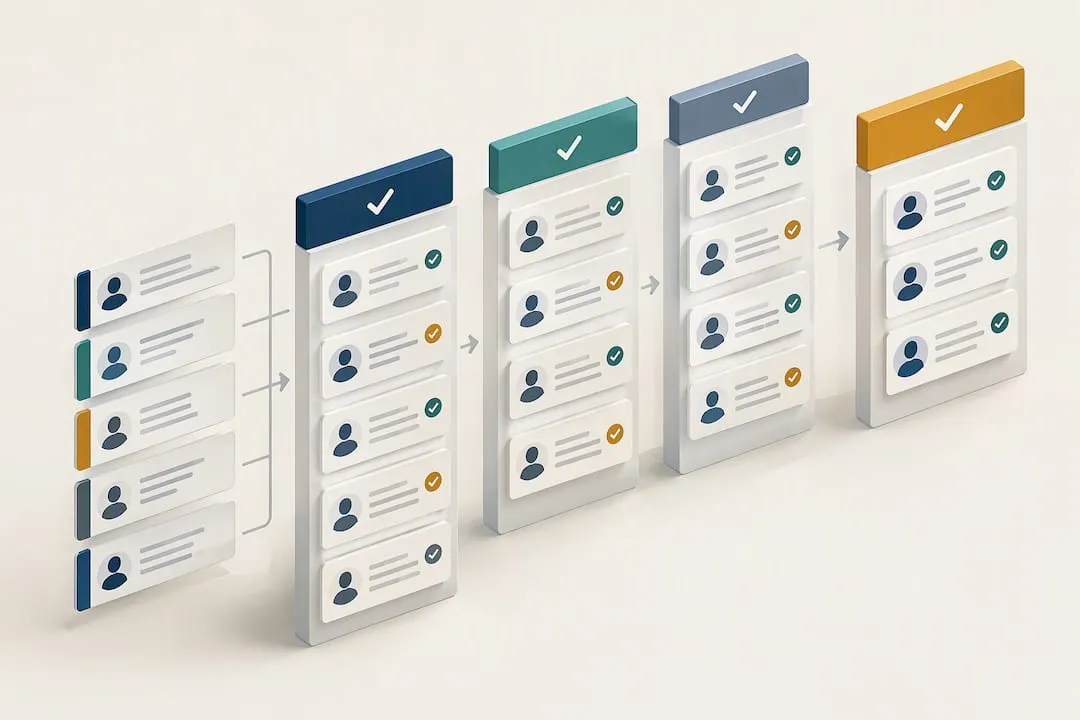
- Score in detail, independently. Each remaining candidate gets scored against every criterion by more than one person, without discussing scores with each other first. Running the shortlisting stage with at least two independent reviewers who score before any group discussion cuts down on conformity bias, where one loud opinion in the room drags everyone else’s marks with it.
- Compare scores and resolve disagreements. Bring the independent scores together, flag any large gaps, and talk through the evidence rather than the gut feeling. Set a tie break rule in advance, such as defaulting to the higher scored criterion being the essential one, so you’re not inventing rules on the spot.
- Finalise the list and book interviews. Confirm your final shortlist against the threshold you set, lock in interview slots, and hold one or two reserve candidates in case someone withdraws. Reserves save you re-running the whole sift a week later.
A few things make this run smoother in practice:
- Give scorers the person specification and matrix at the same time as the CVs, not after.
- Cap detailed scoring sessions at around 90 minutes before fatigue starts flattening everyone’s judgement.
- If a role is drawing an unusually strong field, don’t just extend the shortlist. Add a short longlist stage instead, as covered below.
- Keep a running note of decisions as you go. Reconstructing your reasoning after the fact is where audit trails fall apart.
The LSE recruitment toolkit’s guide to shortlisting sets out this essential first, desirable second logic clearly: only candidates meeting every essential criterion should progress, and desirable criteria exist purely to narrow down a pool that’s still too large after that filter. Skip that order and you’ll end up shortlisting on personality fit or a nicely formatted CV rather than the requirements that actually matter for the job.
For security sector roles specifically, this is where a practical shortlisting guide for UK recruiters and detailed CV screening walkthrough earn their keep, since licence checks and SIA compliance add a layer most general hiring guides don’t cover.
How do you build a shortlisting scorecard that holds up?
A shortlisting matrix is nothing more than a table: candidates down the side, criteria across the top, numbers in the middle. What makes it defensible is consistency, not complexity.
Map every essential and desirable criterion from the person specification to its own column, and give each candidate a unique ID rather than just a name, which keeps the sheet usable if you later need to anonymise it. Use a simple rubric everyone agrees before scoring starts: 2 for fully meets, 1 for partially meets, and 0 for does not meet is the standard version, and it’s hard to improve on. Set your minimum threshold before you see a single application, not after you’ve seen how the field performs.
| Field | What it captures |
|---|---|
| Candidate ID | Anonymous reference, not name |
| Essential criteria (per column) | Score 0, 1, or 2 against each |
| Desirable criteria (per column) | Score 0, 1, or 2 against each |
| Total score | Sum across all criteria |
| Shortlisted Y/N | Against agreed threshold |
| Reason for no | Short, job related note |
Partial evidence needs a judgement call, and the rule of thumb is: score what’s demonstrated, not what’s implied. A candidate who lists “customer facing experience” without detail on conflict handling gets a 1, not a 2, even if you suspect they’d be fine at interview. Transferable skills count when the person specification allows for them explicitly (many security roles accept forces or emergency services background against a “dealing with high pressure situations” criterion), but only score them where the spec actually invites that substitution.
Pro Tip: Keep the matrix as a live working document during the sift, not something you fill in retrospectively from memory. Scores written an hour after reading a CV are noticeably less accurate than scores written while reading it.
How do you avoid discrimination and bias when shortlisting?
The Equality Act 2010 applies at every stage of recruitment, including shortlisting, and a rejected applicant can bring a claim even though they were never actually employed. That risk sits at the shortlisting stage as much as anywhere, because it’s where the largest number of candidates get filtered on the thinnest amount of information: a CV and a covering letter.
Consistent, job related criteria are your main defence. If two candidates with equivalent experience get different scores against the same criterion, and one happens to share a protected characteristic pattern, you’ve built yourself a problem. The fix isn’t complicated, it’s procedural discipline:
- Strip names, addresses, and photos before the initial sift where your process allows it (blind shortlisting).
- Keep diversity monitoring information on a completely separate sheet from the scoring matrix.
- Use at least two independent scorers for every application that reaches detailed review.
- Declare conflicts of interest before scoring starts, not after someone spots a familiar surname.
- Write a specific, job related reason for every rejection and keep it on file securely.
Blind shortlisting and structured, skill based screening measurably reduce unconscious bias in CV review, and government guidance treats it as one of the most reliable single interventions available to employers. Structured scoring with consistent weighting across candidates is echoed by employment law guidance on recruitment discrimination, which frames documented, criteria based decisions as the main defence if a claim ever surfaces.
One more obligation worth flagging: under the guaranteed interview scheme many employers run voluntarily, disabled candidates who meet the essential criteria may be entitled to an interview even where they weren’t top scoring against desirable criteria, and reasonable adjustments should be offered at the shortlisting and interview stages alike.
Can you use an ATS to shortlist without introducing bias?
Yes, but only if you configure it carefully and never let it make the final call unsupervised. Automated filters are useful for essential, objective criteria that don’t require judgement: a valid SIA licence, a minimum number of years’ experience, a specific qualification. Test any filter on a sample of applications before switching it live, because a poorly worded rule can silently exclude qualified candidates without anyone noticing until the shortlist looks thin.
Removing identifiable data during initial automated filtering reduces the risk of indirect discrimination creeping into a system nobody’s actively watching. A sound workflow looks like this:
- Automated pre-screen against essential criteria only, never against subjective or desirable ones.
- Manual second check on anything the system flags as borderline rather than an automatic reject.
- Export the scoring matrix so decisions remain reviewable outside the software itself.
- Review filter outcomes periodically to check they’re not skewing towards or against particular applicant groups.
A two pass approach, automated filter first and human detailed scoring second, is the sensible middle ground for high volume roles, and it’s the model most functioning ATS workflows are built around. Our applicant tracking system guide for UK security employers covers configuration in more depth if you’re setting one up for the first time.
How many applicants should you shortlist?
There’s no universal number, but practical guidance for typical roles suggests around 3 to 8 candidates per interview day, adjusted for your actual interview capacity, the seniority of the role, and how strong the applicant pool turned out to be.
A few factors push that number up or down:
- Senior or specialist roles usually justify a tighter shortlist since interviews run longer and involve more panel members.
- High volume, lower skilled roles often need a slightly wider shortlist to account for no shows and withdrawals.
- Past conversion rates matter: if you know only half your shortlisted candidates typically accept an offer, shortlist accordingly.
- If a role attracts an unusually deep field, add a longlist stage first rather than interviewing everyone who clears the threshold, and publish expected interview dates so candidates aren’t left guessing.
- If nobody meets your essential criteria, that’s a signal to revisit the advert and person specification, not to quietly lower the bar.
How should you record and communicate shortlisting decisions?
Minimum records worth keeping: candidate ID, scores against each criterion, total score, the shortlisted Y/N decision, a short reason for rejection, and the names of everyone who scored plus the date. Consistent documentation of this kind is what actually defends a decision if it’s ever challenged.
- Notify shortlisted candidates as soon as the panel confirms the list, with interview date, format, and what to bring.
- Keep non-shortlist emails short: a concise, job related reason if you give one, without detailed comparative feedback that could expose the process to challenge.
- If a candidate asks for feedback, have a standard response ready rather than improvising one under pressure.
- Escalate internally to HR or a hiring lead before responding to anything that reads like a complaint, not after.
Pro Tip: Send non-shortlist emails within the same week as shortlisted invitations, not two weeks later. Candidates who hear nothing assume the worst and often stop trusting your brand for future roles.
Practical notes from Security Jobs Board
Sector focus changes what “meets essential criteria” actually looks like on paper. A CV that reads well generically can still miss a live SIA licence or a specific site experience type, and general recruitment advice rarely flags that. Employers using the platform are matched against candidates with compliance markers relevant to security work, which narrows the pool before scoring even starts.
The application flows are GDPR compliant and mobile responsive, which helps reduce administrative time. Candidates applying from a phone on a break complete cleaner, more consistent applications when the form itself is short and structured, which means less time spent chasing missing information before you can even begin your matrix.
What actually matters when you shortlist applicants
Most shortlisting advice focuses on the scoring mechanics and skips the bit that actually causes disputes: inconsistency between scorers who were never given the same brief. A well designed matrix is worthless if one reviewer interprets “strong communication skills” generously and another interprets it strictly, and nobody calibrated beforehand.
The conventional advice oversells software and undersells the five minutes it takes to align scorers before they open a single CV. An ATS filter or a well built spreadsheet enforces consistency in the mechanics, but the judgement calls, what counts as “partially meets,” still sit with people. Get that calibration wrong and even a legally sound process produces shortlists that don’t actually reflect the strongest candidates.
If you take one thing from this guide, prioritise the pre-scoring conversation over the scoring sheet itself. Agree what evidence satisfies each criterion, agree the threshold, and only then start reading applications. Everything else, the matrix format, the number shortlisted, the ATS configuration, is secondary to that shared understanding.
— Rob
Ready to hire faster in UK security recruitment?
Security Jobs Board gives employers a shorter route to applicants who already meet the criteria that matter in this sector, rather than sifting a general jobs board for candidates who happen to mention “security” somewhere on their CV. Because listings sit inside a dedicated security marketplace, the applications landing in your inbox tend to already carry the licences and experience your person specification demands, which cuts down the initial sift considerably.

Before posting, make sure your job description and person specification separate essential from desirable criteria clearly. That single step does more for shortlist quality than any amount of software configuration. Employers can post a job or explore a CV access plan to start receiving relevant applications, or review standard listings, featured ads, and multi-role campaign packages if you’re hiring across several roles at once. Get your vacancy live today and start building a shortlist worth interviewing.
Sources
For the legal framework behind shortlisting decisions, the Legislation is the primary text, alongside government guidance on reducing unconscious bias in CV screening. For practical toolkits, the LSE guide to shortlisting and NCVO’s shortlisting and interviewing guidance are both practitioner-tested, and DavidsonMorris’s employer guide to recruitment discrimination covers the legal risk side in more depth.
- A guide to shortlisting (LSE recruitment toolkit)
- Gov
- Recruitment discrimination: employer guide (DavidsonMorris)
- Shortlisting and interviewing for the role (NCVO)
- Selection and assessment factsheet (CIPD)
FAQ
What is the process of shortlisting candidates?
Shortlisting means comparing every applicant against the essential and desirable criteria in the person specification, scoring them independently using a matrix, then selecting those above an agreed threshold for interview. The LSE recruitment toolkit sets out essential criteria first, desirable second, as the correct order to apply them.
What does it mean to shortlist an applicant?
Shortlisting an applicant means they’ve been assessed against your role’s criteria and judged strong enough to progress to interview, rather than being rejected at the paper sift stage. It’s a formal decision point, not a loose shortlist of “candidates you liked.”
How do I write an email to shortlisted candidates?
Keep it clear and practical: confirm the interview date, time, format, and location or platform, and mention roughly how long it will take and who’s on the panel. Send it promptly after the panel confirms the shortlist so candidates aren’t left waiting or accepting another offer elsewhere.
How do I ask if I’ve been shortlisted?
A short, polite email to the recruiter or hiring contact asking for an update on your application status is standard practice, usually sent a week or two after the closing date. Most employers, including those hiring through Security Jobs Board, notify shortlisted candidates directly, so a follow up is only needed if you haven’t heard anything within the stated timeframe.
How many candidates should typically be shortlisted per role?
Around 3 to 8 candidates per interview day is a common practical range, though the right number depends on interview capacity, role seniority, and how strong the applicant pool is, according to NCVO’s shortlisting guidance. If nobody meets your essential criteria, that’s a sign to revisit the advert rather than shortlist anyway.


