Up to Two Weeks: Counter a UK Salary Offer With Scripts & Checklist

Thank the employer for the offer, ask for a short window to consider it, then come back with a specific figure or range backed by evidence, whether that is comparable job adverts, sector data, or a competing offer. State it clearly on a call or in writing, and give the employer a clear next step. That single sequence protects your position without souring the relationship before you have even started.
TL;DR:
- Research comparable salaries from multiple sources, including job ads, sector guides, and your experience, to set a realistic and credible counteroffer range.
- Request up to two weeks to consider an offer in writing, and verify all details against the original job description before resigning from current employment.
- Begin salary negotiations by expressing gratitude, stating your interest, then directly proposing a figure supported by solid evidence and justifications.
- Avoid emotional language, ultimatums, or exaggerating competing offers, and consider the full compensation package beyond the base salary.
- Prepare for possible rejection or pushback by having a clear walk-away point and alternative negotiations, such as flexible work or signing bonuses.
Table of Contents
- Quick checklist: the first things to do when you receive a salary offer
- Research and prepare your numbers: how to set a credible counteroffer range
- Timing, logistics and legal safety checks
- How to structure the counteroffer conversation and exact wording to use
- Common mistakes candidates make (and simple corrections)
- Editable scripts and email templates for real situations
- Author and site credentials plus supporting UK guidance
- Preparing mentally and emotionally for possible rejection or pushback
- Strategies for handling counteroffers from your current employer
- Negotiating in the security sector: what candidates often miss
- How Security Jobs Board can support your next move
- Sources
- FAQ
Quick checklist: the first things to do when you receive a salary offer
Before you say anything about numbers, get the basics in order. This is where candidates either protect their leverage or accidentally give it away.
- Confirm the offer is in writing, including salary, hours, and any conditions attached to it.
- Note the deadline the employer has given you and write it down somewhere you will not lose it.
- Ask for time to decide. Newcastle University Careers notes that requesting up to two weeks is generally acceptable, though an employer is free to say no.
- Pull together the original job advert, the full job description, and any benefits information so you can compare like with like.
- Decide your bottom line, your target figure, and the number you would be delighted with, before you speak to anyone.
Doing this in the first hour or two after the offer arrives matters more than people expect. Once you have replied with enthusiasm and asked for time, the pressure to respond instantly disappears, and you can think clearly instead of reacting.
Pro Tip: Reply to the offer email within a few hours, even if only to say thank you and confirm you will respond by a set date. Silence reads as disinterest.
Research and prepare your numbers: how to set a credible counteroffer range
A counteroffer only works if the number behind it is credible. Surrey Careers recommends researching comparable salaries, setting a realistic range, and justifying it with your own experience and current market rates rather than guesswork.
Build your range from more than one source:
- Job adverts for similar roles at comparable employers, ideally in your region and sector.
- Sector-specific salary guides, such as the security sector salary ranges guide, for role-specific benchmarks.
- Internal pay bands where you can find them, for example through recruiters or industry contacts.
- Your own track record: years of experience, relevant certifications, licences, and specific achievements you can point to.
Once you have that evidence, set three figures rather than one. Your minimum acceptable salary is the point below which you would rather decline. Your target is the number you genuinely expect to land on if the negotiation goes well. Your ideal is the top of a defensible range, the figure you would be pleasantly surprised to get. Working with three points rather than a single demand gives you room to move without looking like you plucked a number from nowhere.
A tight, evidence-backed range lands better than a single extreme figure. Surrey Careers notes that presenting a narrow, justified range builds credibility, while opening with one high number risks pricing yourself out of the role altogether.
If you have a competing offer, it changes the conversation, but only if you use it honestly. Naming a genuine competing offer gives the employer a real benchmark to respond to, and most hiring managers respect that. Inventing or exaggerating one is a different matter entirely: if it ever comes to light, whether through a reference check or a shared industry contact, it damages your credibility permanently. Security is a sector where reputations travel between employers quickly, so this is not a risk worth taking for a few thousand pounds.
Timing, logistics and legal safety checks
Before any figure is discussed, get the logistics right. Newcastle University Careers suggests that asking for up to two weeks to decide is a reasonable request, although the employer may need an answer sooner depending on their own recruitment timeline.
- Ask for the offer in writing if it has not already been sent, including salary, working hours, benefits, and the proposed start date.
- Check the written offer against the original advert and job description for any mismatches.
- Note whether the offer is conditional (on references, background checks, or right-to-work confirmation) or unconditional.
- Keep a simple written record of every deadline given and every reply you send, even a one-line email confirming a phone conversation.
The most important safety check applies specifically in the UK. Gov explains that an unconditional job offer and your acceptance of it create a legally binding contract, but a conditional offer can still fall through if the conditions are not met. Do not hand in your notice at a current job until the new offer is confirmed as unconditional in writing. It sounds obvious until you are excited about a new role and the paperwork is slower than expected.
How to structure the counteroffer conversation and exact wording to use
Whether you are on a call, on video, or writing an email, the shape of the conversation is the same. Get the structure right and the actual words matter less than you think.
- Open with gratitude and enthusiasm. Thank them for the offer and confirm you are genuinely keen on the role before raising anything about pay. For example: “Thank you for the offer, I’m genuinely excited about the team and the role.”
- State the issue concisely. Move straight to the point rather than building up to it. For example: “Having looked at similar roles in the sector, I was hoping we could discuss the salary before I confirm.”
- Make a specific ask. Name a figure or a tight range, then give two or three short justifications: comparable adverts, your years of experience, a relevant licence or certification, or a competing offer if you genuinely have one.
- Offer trade-offs if the base figure is fixed. If the employer signals the salary band cannot move, propose alternatives: an early salary review at three or six months, flexible or hybrid working, funded training, or a signing bonus.
- Close by inviting discussion. Ask what flexibility exists and propose a clear next step, such as a follow-up call by a set date.
A script for the phone or video call might run: “Thanks again for the offer, I’m really keen to join the team. Based on similar roles I’ve seen advertised and my [number] years in [specific area], I was hoping we could look at something closer to [figure]. Is there flexibility on that, or on the wider package?”
For a written counter, keep it shorter and more direct: “Thank you for sending the offer through. I’d like to discuss the salary before confirming. Based on comparable roles and my experience with [specific skill or certification], I was hoping for [figure]. I’d welcome the chance to talk this through, either by phone or email, whichever suits.”
Cambridge Careers Service advises weighing the full package, not just the base figure, and deciding in advance the point at which you would walk away. That walk-away point should sit behind every version of this conversation, even when you never mention it out loud.
Pro Tip: Practise saying your target figure aloud before the call. Candidates who rehearse the number tend to sound calmer and more matter-of-fact when they actually say it.
Common mistakes candidates make (and simple corrections)
Harvard PON flags a set of recurring errors in counteroffer conversations, most of which are easy to avoid once you know to look for them.
- Avoid ultimatums and emotional language such as “I need this or I walk”. State your position calmly and let the numbers do the persuading.
- Never invent or exaggerate a competing offer. If it unravels later, it costs you far more than the raise was worth.
- Don’t fixate on base salary alone. Pension contributions, holiday allowance, shift patterns, and training budgets all have real value and are often more flexible than the headline figure.
- Watch for fixed pay scales in large organisations, common in public-sector and enterprise security contracts, where the band genuinely cannot move regardless of how well you negotiate.
- Don’t hand in your notice at a current job until the new offer is unconditional and confirmed in writing, as GOV.UK sets out.
Most of these mistakes come from treating the negotiation as a confrontation rather than a conversation between two parties who both want the hire to happen. The employer has already decided they want you. Your job now is simply to make sure the terms reflect that.
Editable scripts and email templates for real situations
Keep these short and adapt the bracketed details to your own situation before sending.
- Asking for time to consider: “Thank you for the offer, I’m delighted. Before I confirm, could I take until [date] to review the details? I want to make sure I give this the attention it deserves.”
- Opening a phone or video call: “Thanks for the call, I’ve had a chance to review the offer and I’m keen to move forward. Based on [market data / my experience / a specific licence], I was hoping we could discuss a figure closer to [amount].”
- Written counteroffer email: “Thank you for sending the formal offer. Having reviewed comparable roles and considering my [years of experience / certification], I’d like to propose a salary of [figure]. I’m very keen to join the team and would welcome a conversation on this.”
After any call, send a short follow-up email restating what was discussed and agreed. The Open University recommends checking the written offer against the advert and confirming hours, benefits, and start date in writing before you resign anywhere else.
- Restate the figure or range discussed within a day of any verbal conversation.
- Confirm any agreed next step, such as “I understand we’ll speak again on Thursday”.
- Keep every email in one folder so you have a clear record if a dispute ever arises later.
This documentation habit feels unnecessary until the one time a verbal promise does not match what lands in the final contract.
Author and site credentials plus supporting UK guidance
This guidance draws on published advice from university careers services, including Cambridge and Surrey, alongside GOV.UK employment guidance and analysis from Harvard’s Program on Negotiation. Security Jobs Board is a UK-focused job board built specifically for the security industry, with an affiliation to the BSIA that underpins the sector guidance published across the site. Rob writes on hiring and negotiation for the security sector as part of that ongoing career-advice coverage.
Preparing mentally and emotionally for possible rejection or pushback
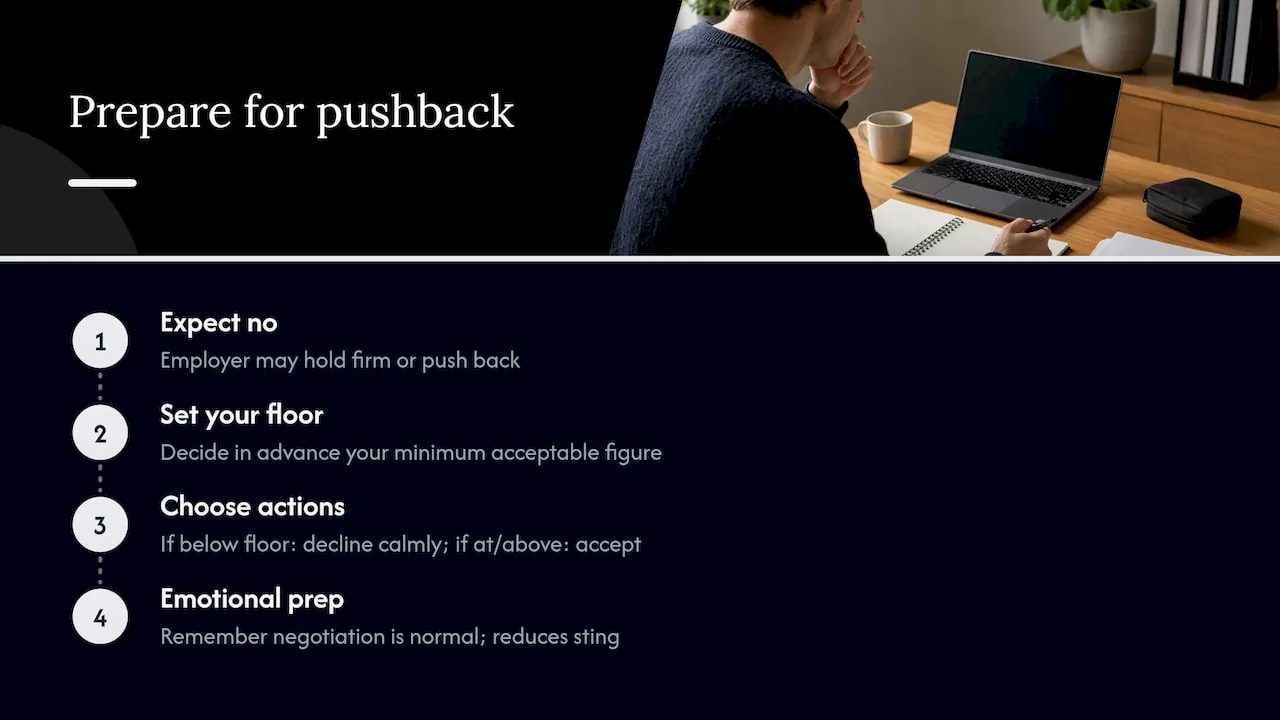
Not every counter succeeds, and it helps to expect that going in. An employer might hold firm on the figure, or push back with reasons tied to budget or internal fairness across the team. Neither outcome means you did anything wrong.
Decide beforehand what you will do if the answer is simply no. If your minimum acceptable figure was genuinely your floor, be prepared to decline the role, calmly and without drama. If the offer still clears that floor, even without movement, you can accept without it feeling like a loss, because you already knew that outcome was possible when you set your range.
The emotional part is often harder than the practical part. Asking for more money can feel uncomfortable, particularly early in a career or after a long stretch out of work. Remind yourself that a reasonable, evidence-based ask rarely damages how an employer sees you. Cambridge Careers Service frames this as a normal, expected part of accepting a role, not an act of defiance. Going in with a clear walk-away point set in advance takes most of the sting out of a pushback, because you already know what your next move is before the answer comes back.
Strategies for handling counteroffers from your current employer
Countering a new job offer sometimes triggers a different kind of counteroffer: your current employer, hearing you are leaving, offers to match or beat the new figure to keep you. This puts you in an unusual position, and it is worth thinking it through before it happens rather than in the moment.
Ask yourself why the improved offer only appeared once you were leaving. If the role, workload, or progression prospects were genuinely fine before, and only the pay was the issue, a counteroffer from your current employer might solve the actual problem. If the frustration ran deeper than money, a bigger pay cheque rarely fixes it for long.
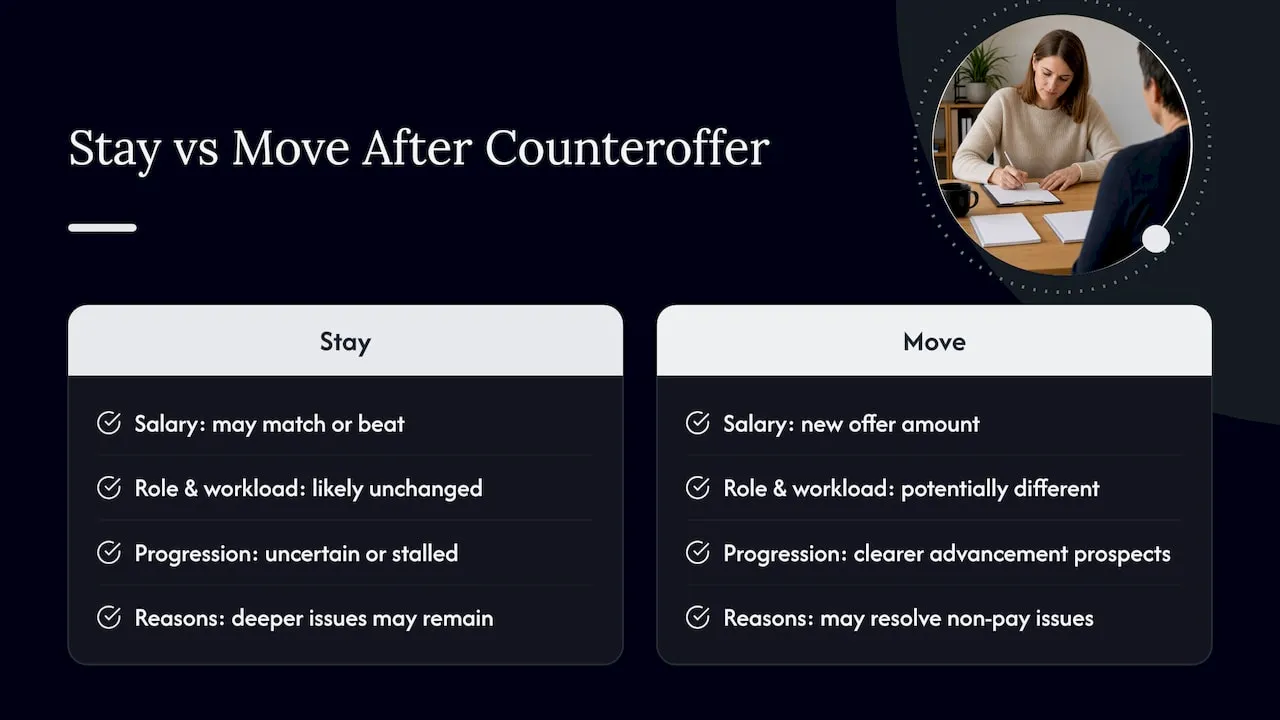
Manchester Careers Service notes that your leverage in any negotiation is highest right after an offer, when the employer’s desire to secure you is strongest, which is exactly the position your current employer is now reacting to. Weigh the new role’s genuine appeal, not just its salary, against staying somewhere that only moved once you had one foot out the door.
Negotiating in the security sector: what candidates often miss
Security recruitment tends to run on structured pay scales more than people expect, particularly in enterprise contracts and public-sector work, which limits how far base salary alone can move. Candidates who do best usually widen the conversation rather than push harder on one number.
Licences, SIA badges, and specific vetting clearances carry real weight in this sector and are worth naming explicitly when you counter, because they shorten an employer’s time to hire. Shift flexibility is another lever that often gets missed: employers running 24-hour operations frequently have more room to negotiate patterns and unsociable-hours pay than they do the headline salary.
— Rob
How Security Jobs Board can support your next move
Setting a credible counteroffer starts with knowing what security roles actually pay across the UK, not guessing. Our security sector salary ranges guide gives you role-specific benchmarks to check your figure against before you send a single email, and our negotiation advice for security roles covers what tends to work in this sector specifically.

Create a free profile at Security Jobs Board, set job alerts for roles matching your target salary band, and browse current vacancies to benchmark what employers are actually advertising right now.
Sources
- How to negotiate your starting salary | Surrey Careers
- Negotiating job offers | Careers Service
- Handling job offers | Newcastle University Careers
- Gov
- How to counter a job offer: avoid common mistakes | Harvard PON
FAQ
How do you politely counter offer salary?
Thank the employer for the offer, state clearly that you would like to discuss the salary before confirming, then name a specific figure or tight range backed by evidence such as comparable job adverts or your own experience. Surrey Careers recommends keeping the tone collaborative rather than confrontational throughout.
How much should you counter offer salary?
There is no fixed formula, so set a minimum acceptable figure, a target, and an ideal figure based on comparable adverts, sector salary guides, and your own experience and certifications. A narrow, evidence-backed range is more persuasive than a single extreme number, according to Surrey Careers.
Is it normal to counter a salary offer?
Yes, countering an offer is a standard, expected part of accepting a new role, and Cambridge Careers Service treats it as routine practice rather than something unusual. Employers generally expect some negotiation, particularly once an offer has been made.
What should you not say when negotiating salary?
Avoid ultimatums, emotional pressure, and any mention of a competing offer you do not genuinely have, since Harvard PON identifies these as common missteps that damage credibility. It is also worth not fixating solely on base pay when benefits, review timing, and flexibility are all part of the same conversation.


