Negotiating Security Job Offers for Better Outcomes

Securing the right offer in the UK security sector is more complex than ever as the industry’s value has risen to £13.2 billion in revenue with more than 2,100 businesses now competing for top professionals. With five or more years of experience under your belt, understanding your market worth is vital for meaningful negotiation rather than guesswork. This guide helps you pinpoint your value, set clear priorities, and approach your next offer with hard evidence and confidence.
Table of Contents
- Step 1: Assess Your Security Sector Market Value
- Step 2: Clarify Your Priorities And Non-Negotiables
- Step 3: Research The Employer And Offer Benchmarks
- Step 4: Present Your Negotiation Case Confidently
- Step 5: Review Responses And Secure Agreement
Quick Summary
| Key Takeaway | Explanation |
|---|---|
| 1. Assess Your Market Value | Understand your worth by evaluating your skills and experience in the growing security sector. |
| 2. Define Non-negotiables | Prioritise aspects you won’t compromise on before entering negotiations to maintain focus. |
| 3. Research Employer and Market Benchmarks | Gather salary data and company insights to negotiate confidently and accurately. |
| 4. Present Your Case Confidently | Use data-driven arguments to communicate your value during negotiations without appearing aggressive. |
| 5. Review Offers Thoroughly | Always check written agreements for accuracy to avoid misunderstandings after negotiations conclude. |
Step 1: Assess your security sector market value
Knowing your worth in the security job market isn’t about guesswork. It’s about understanding the concrete value you bring to employers and backing that understanding with data. This step helps you identify your true market position so you can negotiate from a place of confidence rather than assumption.
Start by examining your specific skill set and experience level. The UK security sector is experiencing significant growth, with the sector valued at over £13.2 billion and employers constantly seeking experienced professionals. Your value depends on several factors: years in the sector, specialised certifications you hold, sector experience (whether you’ve worked in corporate security, physical security, cybersecurity, or risk management), and any leadership responsibilities you’ve undertaken. A professional with 5+ years handling complex security operations commanding £50,000 annually occupies a different market position than someone protecting a single site.
Next, measure your impact using business metrics. Security professionals often underestimate their value because they focus on what they do rather than what they achieve. Key performance indicators aligned to governance and business objectives help communicate your value effectively. Consider tracking metrics like incident response times, security audit pass rates, staff training completion rates, compliance certification maintenance, or cost savings from implemented security improvements. Did you reduce security incidents by 40% in your previous role? Did you successfully maintain ISO 27001 certification whilst cutting operational costs? These numbers matter far more than vague claims about being “reliable” or “dedicated.” Research comparable roles in your region using specialist security job boards and industry salary data to understand what employers pay for your level of expertise and responsibility.
Document your achievements with specificity. Rather than listing “improved security protocols,” write down exactly what changed and why it mattered. If you implemented a new access control system that reduced unauthorised entry attempts by 65%, that’s a quantifiable achievement. If you trained 200+ staff members on security awareness, saving the company from potential data breaches, note that impact. Employers understand business impact far better than they understand effort.
Here’s a concise overview of key business metrics security professionals can track to demonstrate their impact:
| Metric | What It Measures | Typical Business Benefit |
|---|---|---|
| Incident response time | Speed of addressing security issues | Minimises business disruption |
| Security audit pass rate | Compliance with standards | Maintains client and stakeholder trust |
| Training completion rate | Staff participation in training | Reduces risk of human error |
| Compliance certification held | Ongoing regulatory adherence | Avoids legal/contractual penalties |
| Cost savings from improvements | Financial impact of security changes | Increases operational efficiency |
| Reduction in incidents | Fewer breaches or losses | Protects assets and reputation |
Professional tip Gather concrete numbers from your previous employers now, including incident statistics, audit results, and any cost savings you contributed to, as these form your strongest negotiation foundation.
Step 2: Clarify your priorities and non-negotiables
Before you sit down to negotiate, you need absolute clarity on what matters most to you and what you simply will not compromise on. Without this foundation, you’ll find yourself making reactive decisions in the moment rather than staying true to your actual needs. This step ensures you walk into negotiations with a clear roadmap.
Start by listing everything that matters in a new role. This sounds straightforward, but many security professionals skip this crucial groundwork and later regret accepting offers that don’t align with their goals. Think beyond just salary. Understanding what aspects are flexible and which are not helps you focus your negotiation efforts where they’ll have the most impact. Consider location and commute time. Are you willing to relocate, or do you need a role within a specific distance from home? Think about working hours and shift patterns. Some security roles demand nights and weekends, whilst others follow standard office schedules. Career development matters enormously at your experience level. Does the role offer progression toward management, specialist certifications, or exposure to emerging security technologies? What about flexibility, remote work options, or training budgets? Consider the team dynamics and company culture you’ve observed during interviews. Benefits matter too, from pension contributions and health insurance to professional memberships and conference attendance.
Now separate your list into two categories. Your non-negotiables are the absolute deal-breakers. If a role doesn’t meet these criteria, you walk away, regardless of salary. For many experienced security professionals, this might include location flexibility, a minimum salary threshold that reflects your market value, or specific technical experience. Your priorities are important but potentially flexible. These are elements you’d prefer but could negotiate around if other aspects compensate. Perhaps you want a management role, but you’d accept a senior individual contributor position with a higher salary and clear development pathway. Seeking advice from peers can help set realistic expectations about what’s negotiable in the current market. Talk to colleagues in similar roles. Ask what they’ve successfully negotiated and what employers refused to budge on. This intelligence directly informs your strategy.
Write down your rankings. Put your three most critical non-negotiables at the top. Then list your top five priorities in order of importance. This written list becomes your reference point during negotiations. When an employer makes a counteroffer, you’ll pull out this document and quickly assess whether the package aligns with your goals. Without this clarity, you’ll waste energy negotiating elements that don’t actually matter to you whilst overlooking things that do.
Professional tip Write down your bottom line number for salary and identify two other non-negotiables before any formal negotiation begins, then refer back to this list to avoid getting swayed by pressure in the moment.
Step 3: Research the employer and offer benchmarks
You cannot negotiate effectively without knowing what’s realistic in your market. Research transforms you from someone hoping for a decent offer into someone who knows exactly what they should be earning and what the employer can actually afford. This step gives you the competitive intelligence you need to negotiate with confidence.
Begin by researching salary benchmarks for your specific role and experience level. Security sector compensation varies significantly based on specialisation, location, and employer size. If you’re moving into a cybersecurity role, for instance, typical starting salaries range from £37,281 rising to over £50,000 with experience in established organisations. Government agencies, financial institutions, and large corporates often pay differently than smaller private security firms. Use multiple sources to build a clear picture. Check job boards like https://www.securityjobsboard.co.uk for current postings in similar roles and note what’s being advertised. Look at LinkedIn salary data, Glassdoor reviews, and industry reports. Join professional networks where you can discuss compensation openly with peers. Talking to colleagues who’ve recently negotiated offers in your sector provides invaluable insight into what’s actually achievable, not just what’s theoretical.
Now research the specific employer. Understanding their financial position, growth trajectory, and reputation tells you how much flexibility they likely have. Review their annual reports if they’re publicly traded. Check news articles about recent funding rounds, expansion plans, or contract wins. Read employee reviews on Glassdoor and Indeed to understand company culture and whether they’re known for generous benefits or tight purse strings. Professional groups like the Information Security Forum provide insights into employer practices and compensation trends across the UK security sector. If you know people who work there, ask them discreetly what they’re paid and what benefits the company offers. Look at the job posting itself for clues. Did they post a salary range? Higher ranges suggest budget availability. Are they advertising fast-track promotion or development programmes? That suggests investment in talent. Is it a new role or a replacement? New budgets might have more flexibility than backfilling an existing position.
Compile this research into a simple reference document. Write down the salary range for your role in your region, note what benefits are standard across the sector, and list what you’ve learned about your specific employer. This becomes your negotiation anchor. When they make an offer, you immediately know whether it’s below market, competitive, or generous. Armed with this data, you negotiate from reality rather than emotion.
Professional tip Create a spreadsheet comparing 3-5 similar roles in your region, noting salary, benefits, and company size, so you have concrete comparisons ready when discussing compensation.
Step 4: Present your negotiation case confidently
This is where preparation meets execution. You’ve assessed your market value, clarified what matters to you, and researched the employer. Now you need to present your case in a way that’s compelling without being aggressive, factual without being cold, and confident without coming across as entitled. The way you communicate your negotiation request matters as much as what you’re asking for.

Start by scheduling a conversation rather than negotiating via email. A phone call or video meeting allows you to read tone, respond to concerns in real time, and build rapport. When you connect, open with appreciation for the offer. This isn’t performative. You genuinely should be pleased they’ve made you an offer. Then pivot to your case. Demonstrating knowledge of the role, industry benchmarks, and why your skills justify requested adjustments builds credibility. Walk through your specific points with evidence. Instead of saying “I think the salary is too low,” say “Based on my research of comparable roles in London with my level of experience, the market range is £52,000 to £58,000. My previous role involved managing a team of five security operatives and implementing a new access control system that reduced incidents by 40 percent. Given these responsibilities and outcomes, I’d like to discuss bringing the salary to £55,000.” Notice what you’re doing here. You’re not demanding. You’re presenting data, explaining your value, and making a reasonable request. This approach works because it focuses on objective criteria rather than personal need.
Address the employer’s perspective actively. Collaborative communication and cognitive empathy enhance your confidence and help achieve mutually beneficial agreements. Ask questions like “What flexibility exists around the salary figure?” or “Are there other benefits we could discuss if the base salary can’t move?” This signals that you’re interested in finding solutions together, not locked into one demand. Sometimes employers can’t increase salary but can offer additional holiday, professional development budgets, or flexible working arrangements. Listen carefully to what they say about constraints. If they explain the salary is fixed because it’s a government contract, that’s real information. If they simply say “that’s our budget,” there’s often more room to negotiate. Stay positive throughout. You’re building a working relationship with these people, and they’re assessing whether you’ll be pleasant to work with. Maintain a respectful, professional tone even if their response disappoints you.
Professional tip Practise your negotiation conversation aloud before the actual call, so you sound natural and confident rather than reading from notes, which undermines your credibility.
Step 5: Review responses and secure agreement
Negotiation doesn’t end when you make your ask. The employer responds, counteroffers arrive, and new terms emerge. This step is about carefully evaluating what comes back, ensuring you’re satisfied with the outcome, and moving toward a formal agreement that protects both you and your new employer. Getting this right prevents misunderstandings and sets you up for success in your new role.
When the employer responds to your negotiation request, take time to process their answer before accepting or rejecting anything. Don’t agree immediately, even if you’re thrilled with the outcome. A simple “Thank you for considering my request. Let me review the details and get back to you by tomorrow” buys you breathing room to think clearly. Read their response carefully. Did they agree to your full request? Did they counter with a lower figure and offer something else in exchange? Did they say the salary is fixed but offer additional benefits like extra holiday or a professional development budget? Each response requires different thinking. If they’ve met your requirements, you’re likely ready to move forward. If they’ve partially met them or offered alternatives, assess whether the overall package still aligns with your priorities from Step 2. Sometimes a lower salary paired with genuine flexibility or development opportunities becomes more valuable than a higher base salary with rigid working conditions.
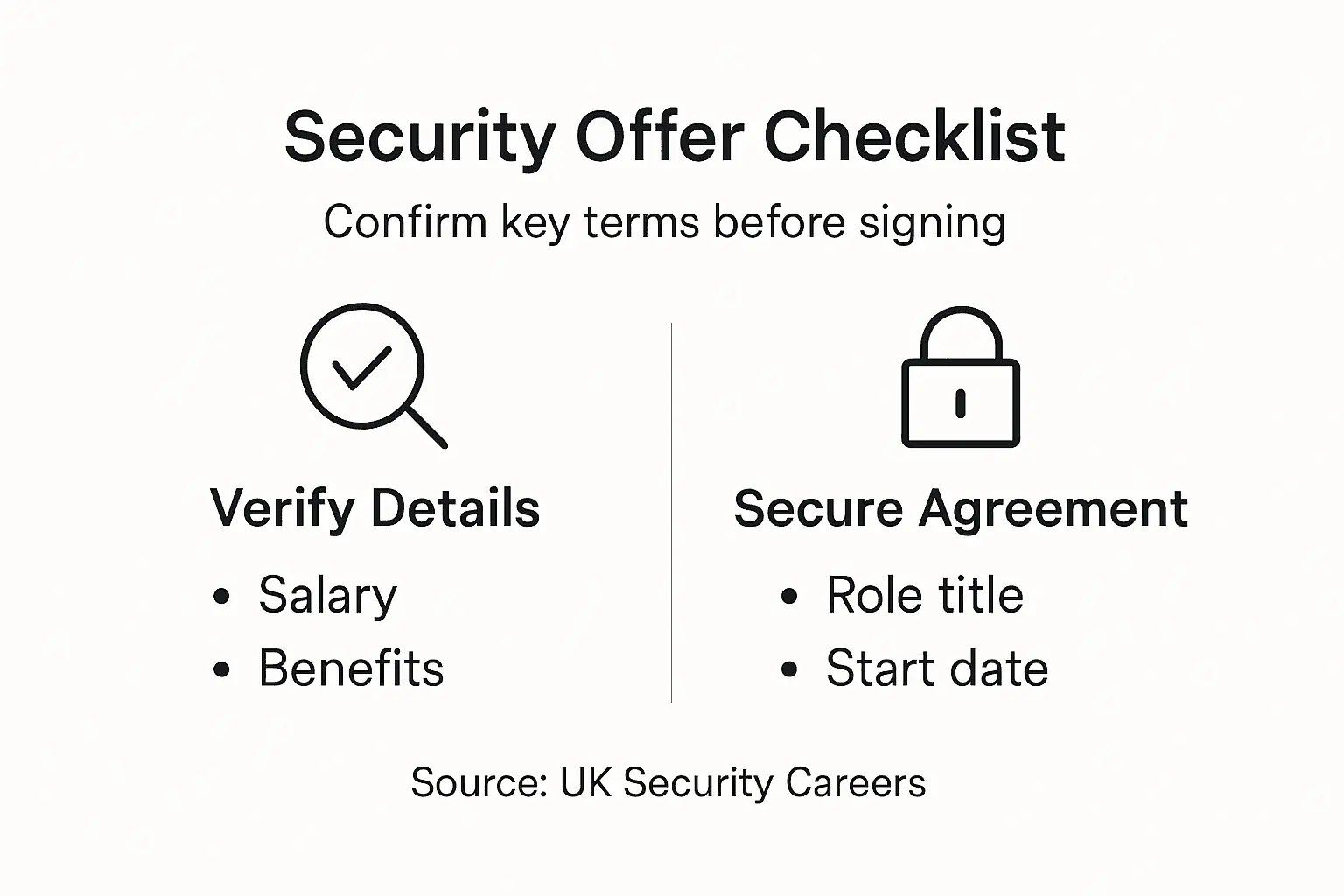
Once you’ve reached agreement on the key points, ensure all agreement details are outlined in a formal written offer. Verbal agreements are how misunderstandings happen. You remember discussing a start date of 1st September and flexible working on Tuesdays. Six weeks later, the employer sends a contract saying you start 15th September with no flexibility. A written offer prevents this entirely. When you receive the formal contract, review all contractual terms thoroughly before signing to avoid misunderstandings. Read every section carefully. Check that salary, start date, job title, reporting line, probation period, benefits, and any negotiated arrangements are exactly as you agreed. If something doesn’t match your conversation, flag it immediately. Don’t assume you can sort it out after signing. The contract is the legal document that governs your employment, and corrections become complicated once both parties have signed.
Once you’ve confirmed everything is accurate, sign and return the contract promptly. This shows professionalism and commitment. Then pause. Take a moment to recognise that you’ve successfully negotiated a better position than the initial offer. You’ve advocated for yourself effectively, which is exactly the mindset you’ll need in your new role.
The following table summarises typical components of a formal job offer and what to check before signing:
| Offer Component | What to Verify | Why It Matters |
|---|---|---|
| Salary | Amount, frequency, structure | Ensures pay matches negotiated terms |
| Start date | Exact date agreed | Prevents onboarding confusion |
| Benefits | Health, pension, extras | Validates total compensation package |
| Working arrangements | Flexibility, remote options | Confirms any agreed adjustments |
| Reporting line | Direct supervisor listed | Establishes clear responsibilities |
| Probation period | Length and terms accurate | Clarifies job security expectations |
Professional tip Request the formal written offer within 24 hours of reaching verbal agreement, then allow yourself two business days to review before responding, ensuring nothing gets lost in the transition from conversation to contract.
Secure Your Ideal Security Role with Confidence
Negotiating a job offer in the UK security sector requires clarity, preparation, and the right market insights to achieve better outcomes. If you find yourself needing robust data on salary benchmarks, role expectations, or industry standards, the journey starts with knowing where to look and how to present your case confidently. Many security professionals struggle with assessing their market value accurately and identifying real negotiation priorities. You require a tailored platform that understands these challenges and offers solutions that empower you to take control of your career path.

Explore The Security Jobs Board, a specialised UK security industry platform designed to connect you directly with employers who value your expertise. Create your profile, upload your CV, and access comprehensive listings that reflect the true market landscape you researched during your negotiations. Benefit from features like job alerts and fast applications so you never miss a role that matches your career goals and compensation expectations. Ready to approach your next offer with confidence and clarity Visit The Security Jobs Board today and take the first step towards negotiating your next role on your terms.
Frequently Asked Questions
How can I assess my market value in the security job sector?
Knowing your market value involves analysing your skills, experience, and the current demand within the security sector. Evaluate metrics like your years of experience, levels of responsibility, and specific certifications. Gather data on salaries for similar roles in your area to establish a clear benchmark.
What should I include in my list of non-negotiables before negotiating a job offer?
Your non-negotiables are the deal-breakers that must be met in your new role, which could include minimum salary, job location, or specific responsibilities. Create a ranked list where your top three non-negotiables are clearly identified, ensuring you enter negotiations prepared to walk away if these aren’t met.
What research should I do on a potential employer before negotiating?
Research the employer’s financial health, professional reputation, and employee reviews to understand their compensation practices. Compile information about salary benchmarks for your role, typical benefits, and company culture, as this knowledge empowers you to negotiate effectively.
How should I present my negotiation case during discussions?
Present your case confidently by opening with appreciation for the offer and then logically detailing why your skills and market data support your request for a salary increase. Use specific examples of your contributions to past employers to justify your ask, helping to create a persuasive argument.
What steps should I take after receiving a counteroffer from an employer?
After receiving a counteroffer, take time to assess it without rushing to agree. Reflect on whether the salary and benefits align with your priorities from earlier steps; you may need to negotiate further for either better terms or additional benefits to meet your needs.
How can I ensure that terms are accurately represented in my formal job offer?
Before signing the formal job offer, carefully review all components such as salary, benefits, and working arrangements to ensure they match your verbal agreement. If any discrepancies arise, address them with the employer immediately to avoid misunderstandings in the future.


