How to Choose the Right Security Job for Your Career

Nearly 40 percent of security professionals say they feel unprepared for changes in the job market. The sheer variety of roles and requirements can make choosing your next step feel confusing, especially with new skills and certifications appearing every year. This guide breaks down each stage of the security job search, offering practical steps to match your abilities with the right opportunities and helping you confidently pursue a career path that fits your unique strengths.
Table of Contents
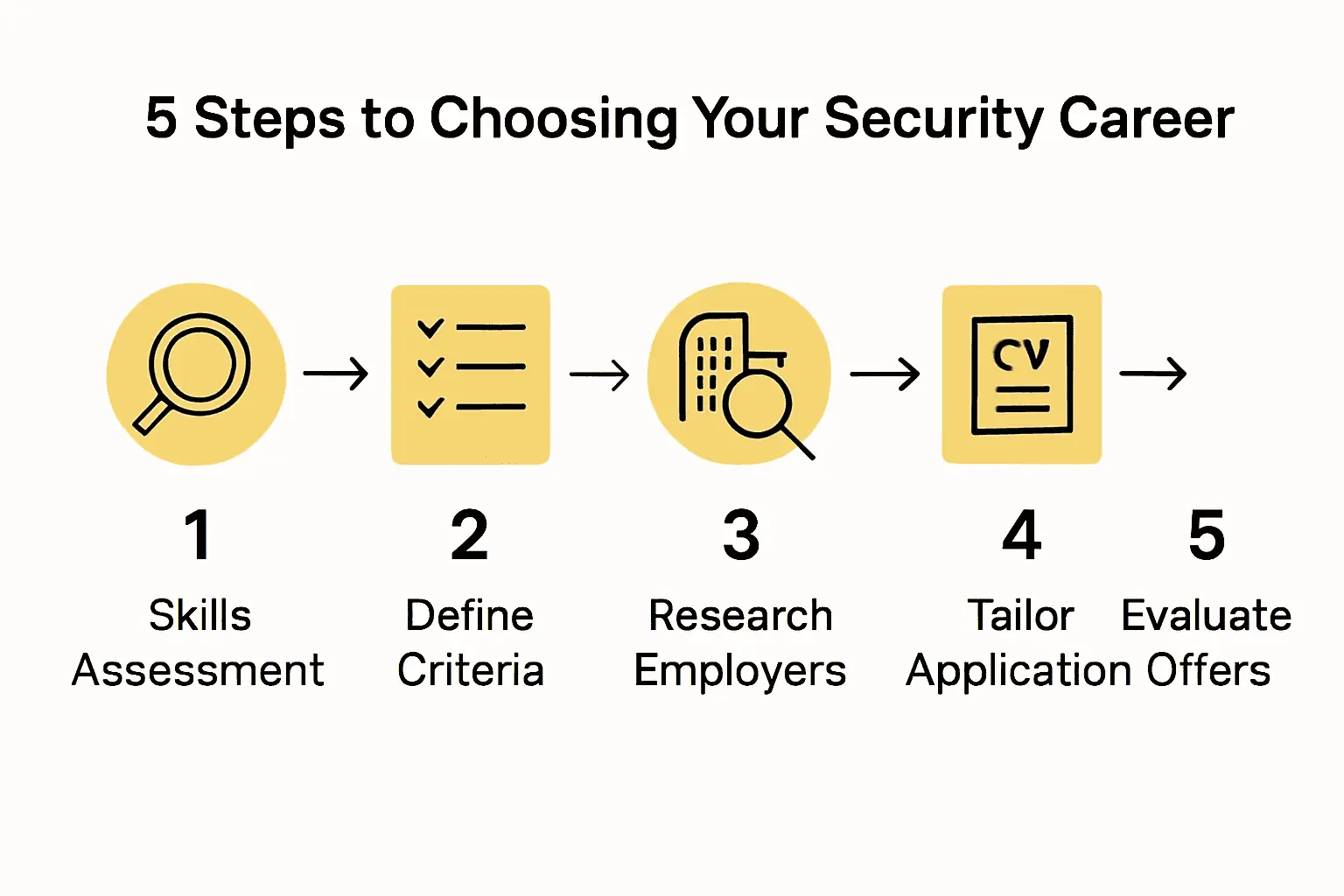
- Step 1: Assess Your Security Skills And Qualifications
- Step 2: Define Your Ideal Security Job Criteria
- Step 3: Research Security Employers And Industry Trends
- Step 4: Tailor Your Applications To Relevant Roles
- Step 5: Evaluate Offers And Confirm The Best Fit
Quick Summary
| Key Point | Explanation |
|---|---|
| 1. Conduct an honest self-assessment | Review your skills and qualifications to determine suitable security roles for your profile. |
| 2. Define clear job criteria | Outline your ideal job attributes, including work environment, salary, and career progression for effective job searching. |
| 3. Research employers and trends | Understand the job market and emerging trends by utilizing networking platforms and industry publications to identify opportunities. |
| 4. Tailor applications for specific roles | Customize your CV and cover letter for each position, emphasizing relevant skills and experiences to increase interview chances. |
| 5. Evaluate job offers thoroughly | Assess offers based on career growth and alignment with your professional goals, not just salary, to ensure a suitable fit. |
Step 1: Assess Your Security Skills and Qualifications
Choosing the right security job requires a strategic self-assessment of your professional capabilities and potential career pathways. In this crucial first step, you’ll conduct a comprehensive review of your existing skills, qualifications, and professional aspirations to identify the most suitable security roles for your unique profile.
According to the Security Institute, professional security management qualifications are structured across multiple levels from Level 3 to Level 7, providing a clear framework for skill development. Begin by performing an honest audit of your current competencies. Review your educational background, professional certifications, technical skills, and practical experience. Consider creating a detailed skills matrix that categorises your capabilities into key areas such as physical security, cybersecurity, risk management, surveillance technologies, and investigative techniques.
The UK Government Security Profession emphasises linking individual skills directly to professional development opportunities. Take time to map your existing skills against job requirements in different security domains. This strategic approach will help you understand potential skill gaps and identify targeted training or certification programmes that can enhance your marketability.
Pro Tip: Be brutally honest during your self-assessment. Recognising areas for improvement is not a weakness but a powerful strategy for professional growth.
Once you have completed your skills inventory, you will be well positioned to explore security job opportunities that align with your current capabilities and future career aspirations.

Step 2: Define Your Ideal Security Job Criteria
Identifying your ideal security job requires a strategic approach that aligns your professional aspirations with the right career opportunities. In this critical step, you will develop a comprehensive blueprint of your career expectations and professional goals.
According to the Security Institute, professional security management roles range from Level 3 to Level 7, offering diverse career pathways. Begin by creating a detailed criteria framework that encompasses key elements such as work environment, salary expectations, career progression opportunities, required skills, and personal interests. Consider factors like shift patterns, organisational culture, geographical location, specialisation areas physical security, cybersecurity, risk management and potential for professional development.
The UK Government Security Profession emphasises the importance of linking individual career objectives with structured skill development. When defining your ideal job criteria, reflect on your long-term career vision. What specialist areas intrigue you? Where do you see yourself in five to ten years? What specific professional achievements do you want to accomplish?
Pro Tip: Be realistic yet ambitious. Your ideal job criteria should stretch your capabilities while remaining achievable.
By methodically defining your job criteria, you create a powerful roadmap that will guide your targeted job search and professional growth in the security sector.
Step 3: Research Security Employers and Industry Trends
Researching potential employers and understanding current industry trends is crucial for making an informed career decision in the security sector. This step will help you develop a comprehensive view of the job market and identify the most promising opportunities for your professional growth.
According to JSaRC, the security sector is experiencing significant skills gaps, which presents unique opportunities for motivated professionals. Start by conducting thorough research using multiple channels: professional networking platforms, industry publications, security forums, and recruitment websites specialising in security roles. Pay close attention to emerging trends such as cybersecurity, digital forensics, risk management, and technological innovations that are reshaping the security landscape.
The Security Institute recommends aligning your research with professional development pathways. Explore job postings across different security specialisations, analyse the skills and qualifications employers consistently seek, and identify potential skill gaps in your current profile. Look beyond immediate job opportunities and consider long term career trajectories that match your professional aspirations.
Pro Tip: Attend industry conferences, webinars, and networking events to gain insider insights and make valuable professional connections.
By methodically researching employers and industry trends, you will position yourself strategically in the competitive security job market.
Step 4: Tailor Your Applications to Relevant Roles
Effectively targeting your job applications requires a strategic approach that highlights your most relevant skills and experiences for specific security roles. This step is about transforming your professional profile into a compelling narrative that speaks directly to potential employers.
According to the UK Government Security Profession, successful security professionals understand how to link their individual skills to specific job requirements. Begin by meticulously analysing each job description and identifying key competencies and technical skills. Create a personalised application strategy that demonstrates how your specific skills precisely match the employers requirements. This means customising your CV and cover letter for each application, using similar language and keywords found in the job posting.
The Security Institute recommends developing a flexible professional profile that can be easily adapted across different security specialisations. Focus on highlighting transferable skills such as risk assessment, communication, problem solving, and technological proficiency. Quantify your achievements wherever possible use specific metrics that showcase your impact in previous roles rather than relying on generic job descriptions.
Pro Tip: Always have a master CV with all your achievements, then create targeted versions that emphasise the most relevant experiences for each specific role.
By carefully tailoring your applications, you significantly increase your chances of securing interviews and ultimately landing your ideal security position.
Step 5: Evaluate Offers and Confirm the Best Fit
Reaching the final stage of your job search requires careful consideration and strategic decision making. This step is about thoroughly assessing job offers to ensure they align with your professional goals and personal aspirations.
According to the Security Institute, professional development is not just about accepting the first offer but finding a role that supports your long-term career progression. Develop a comprehensive evaluation framework that goes beyond salary considerations. Assess each offer across multiple dimensions including career growth potential, training opportunities, organisational culture, work environment, professional development pathways, and alignment with your personal skills and career objectives.
The UK Government Security Profession emphasises the importance of linking individual skills to broader professional development strategies. Create a detailed scoring system that objectively compares job offers. Consider factors such as mentorship programmes, opportunities for additional qualifications, potential for specialisation, technological resources available, and the potential for future advancement within the organisation.
Pro Tip: Do not rush your decision. Request time to review offers thoroughly and do not hesitate to ask potential employers detailed questions about career progression and professional development opportunities.
By methodically evaluating each offer against your predefined career criteria, you will make an informed decision that sets the foundation for a successful and fulfilling security career.
Find the Perfect Security Role That Matches Your Career Goals
Navigating the security job market can be overwhelming, especially when you are trying to align your unique skills and ambitions with the right role. The article highlights challenges such as identifying skill gaps, tailoring applications, and evaluating offers to ensure long-term growth and job satisfaction. If you feel unsure about where to begin or how to find opportunities that truly fit your profile, know that you are not alone. It is essential to have a dedicated platform designed to connect you quickly with employers who value your expertise and professional aspirations.

Take control of your career today by exploring the latest security vacancies on Security Jobs Board. Our easy-to-use platform allows you to create a profile, upload your CV, and receive tailored job alerts directly aligned with your skills and interests. Whether you are focused on physical security, cybersecurity, risk management or any other specialisation mentioned in the article, find trusted employers committed to your professional development. Don’t wait to take the next step towards a fulfilling security career. Visit https://www.securityjobsboard.co.uk now and discover roles that offer the growth and recognition you deserve.
Frequently Asked Questions
How do I assess my security skills and qualifications?
To assess your security skills and qualifications, conduct a thorough review of your education, certifications, technical skills, and work experience. Create a skills matrix categorizing your capabilities in key areas like cybersecurity or risk management, and identify any skill gaps you need to address.
What criteria should I define for my ideal security job?
Define your ideal security job by outlining key elements like work environment, salary expectations, career progression opportunities, and areas of interest. Consider factors such as shift patterns and the potential for professional development to create a well-rounded job criteria framework.
How can I research security employers and industry trends?
Research security employers and industry trends by using professional networking platforms, industry publications, and security forums. Focus on identifying emerging trends like cybersecurity and technological innovations to position yourself effectively in the job market.
What should I include in my job application to make it stand out?
To make your job application stand out, tailor your CV and cover letter to highlight the most relevant skills and experiences specified in the job description. Use specific metrics to quantify achievements in previous roles, demonstrating how you can meet employer needs.
How do I evaluate job offers to find the best fit for my career?
Evaluate job offers by creating a scoring system that examines factors such as career growth potential, organisational culture, and professional development opportunities. Take your time to review each offer thoroughly to ensure alignment with your long-term career objectives.
What steps can I take to improve my security job prospects?
Improve your security job prospects by actively seeking additional training and certifications that align with your career goals. Set a timeline for this development, aiming to complete relevant courses or obtain qualifications within the next 6–12 months.


