How to apply for a security job: your 2026 guide

TL;DR:
- Applying for a security job in the UK requires a valid SIA licence, thorough background checks, and ATS-optimized CVs. Success depends on tailoring applications, preparing for vetting timelines, and demonstrating practical skills in interviews. Building industry relationships and continuously updating relevant certifications enhance chances of securing employment.
Applying for a security job means meeting strict vetting standards, tailoring your application to pass automated screening systems, and demonstrating practical skills that go beyond paper qualifications. The security job application process in the UK is more structured than most industries. Candidates must hold a valid Security Industry Authority (SIA) licence for most frontline roles, pass background checks that can cover up to 10 years of history, and present a CV built for Applicant Tracking Systems (ATS). Get these three things right and you move from the rejection pile to the interview shortlist.
How to apply for a security job: what you need before you start
The SIA licence is the non-negotiable starting point for most UK security roles. Without it, applications for door supervision, CCTV operation, or close protection work will not progress. You obtain an SIA licence by completing an approved training course and passing the relevant unit qualifications, then applying directly to the Security Industry Authority.
Beyond the licence, background checks are thorough. Security vetting in the UK typically covers a checkable history of 7–10 years, including employment records, financial checks, and criminal record disclosures. Gaps in your history will be questioned, so prepare clear explanations in advance.
Experience matters, but it does not have to be direct security experience. Bridge roles in IT support or help desk positions build familiarity with infrastructure and user behaviour, making candidates more competitive for technical security positions. For physical security roles, customer-facing work, military service, or emergency services experience all translate well.
Key prerequisites to have in place before submitting any application:
- Valid SIA licence (or proof of enrolment in approved training)
- A clean, documented employment history covering at least 5 years
- Relevant certifications such as CCTV operation, first aid, or conflict management
- Two professional references who can speak to your reliability and conduct
- A clear understanding of the types of security checks your target employer uses
Pro Tip: Keep a master document listing every job, date, and certification you have ever held. Security applications often ask for month-level accuracy on employment dates, and having this ready prevents errors that can delay your vetting.
What should your CV and cover letter look like?
A CV that fails an ATS scan never reaches a human recruiter. Recruiters recommend a 60% match threshold as the minimum before applying, and they expect keyword-rich CVs that mirror the language in the job description. Read each job advert carefully and reflect its exact phrasing back in your CV, particularly for skills, qualifications, and role-specific duties.
Building an ATS-ready CV
Your CV structure should be clean and simple. Avoid tables, graphics, and unusual fonts, as ATS software often cannot read them. Use standard section headings: Personal Profile, Work Experience, Qualifications, and Skills. List your SIA licence number prominently in your Personal Profile section.
Tailor your CV for every application. A generic CV sent to 50 employers produces far fewer results than a targeted CV sent to 10. Tailoring your CV to the job description means adjusting your personal profile, reordering your skills, and emphasising the experience most relevant to that specific role.
Common CV mistakes to avoid:
- Listing duties without outcomes (say what you achieved, not just what you did)
- Including a photo (not standard practice in UK applications)
- Using a generic personal profile that does not mention the specific role
- Leaving unexplained gaps in employment history
- Submitting a CV longer than two pages for most commercial security roles
Writing a focused cover letter
Your cover letter should be one page, no longer. Open with a direct statement of which role you are applying for and why you are qualified. Address the employer’s stated objectives, which you find in the job advert, and connect your experience to those objectives in two or three specific examples. Close with a clear call to action, asking for an interview.
Pro Tip: Location clues in job adverts often reveal which client site or agency is involved. Use that information to research the employer’s priorities and reference them in your cover letter. Candidates who show they have done their homework stand out immediately.
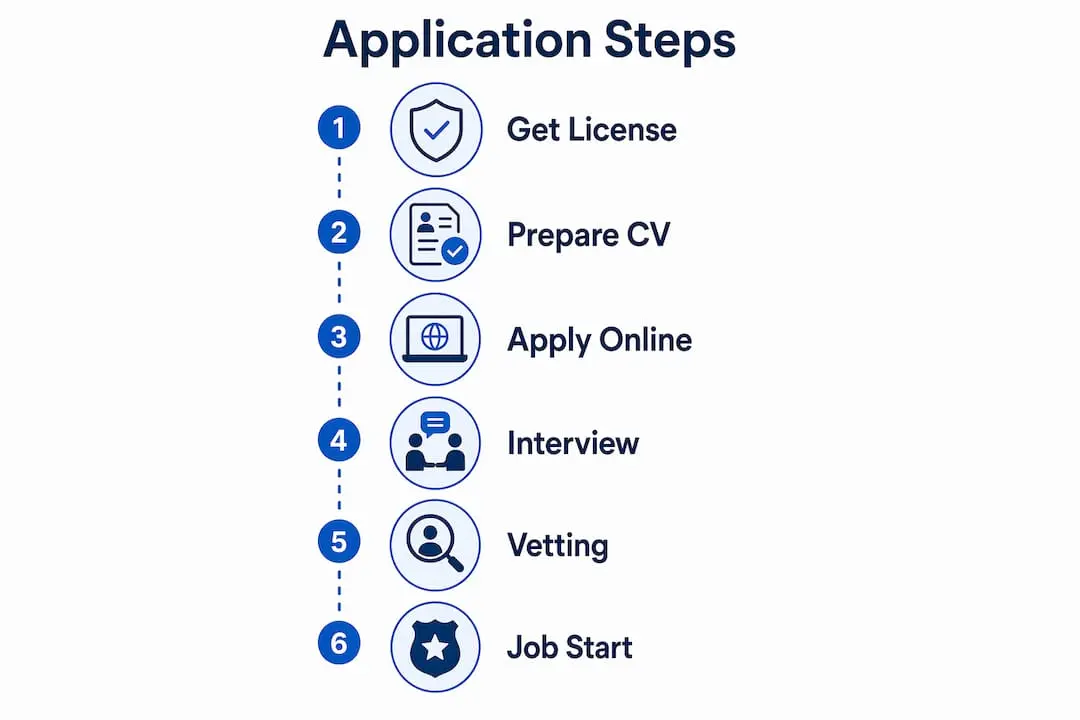
What does the security job application process look like step by step?
The typical security hiring process follows a predictable sequence. Knowing each stage helps you prepare the right materials at the right time and avoid being caught off guard.
-
Online application. Submit your CV and cover letter through a recruitment portal or specialist job board. Securityjobsboard allows candidates to create a profile, upload their CV, and apply quickly to relevant vacancies, all free of charge.
-
ATS screening. Your application is filtered automatically before a recruiter sees it. Keyword matching determines whether you progress. This is why CV tailoring is not optional.
-
Phone or video screening. A recruiter contacts shortlisted candidates for a 15–30 minute call. Expect questions about your SIA licence status, availability, and salary expectations. Have your master document open during this call.
-
Formal interview. This may be one or two rounds depending on the employer. Larger contracts and government-adjacent roles often include a second interview with the client.
-
Vetting and background checks. This stage begins after a conditional offer. For standard commercial roles, vetting takes days to weeks. For high-security roles, the process can last 3–9 months. Plan your finances accordingly if you are moving from another job.
-
Offer confirmation and onboarding. Once vetting clears, you receive a formal offer letter. Read it carefully before signing, paying attention to shift patterns, pay rates, and notice periods.
Meaningful networking before you reach stage one significantly improves your chances. Recruiters actively look for candidates who engage with the industry through LinkedIn, professional bodies, and referrals. Cold mass applications are the least effective route into security employment.
How do you prepare for security job interview questions?
Security interviews test more than your knowledge. They assess your judgement, communication, and ability to stay calm under pressure. Most employers use a mix of behavioural and scenario-based questions.
Behavioural questions follow the STAR format: Situation, Task, Action, Result. Prepare three to five examples from your work history that demonstrate reliability, conflict resolution, and decision-making under pressure. Write them out in advance and practise saying them aloud.
Common security job interview questions include:
- “Describe a time you dealt with an aggressive or difficult person.”
- “What would you do if you witnessed a colleague acting dishonestly?”
- “How do you prioritise tasks when multiple incidents occur simultaneously?”
- “Walk me through how you would conduct a site patrol.”
- “What does your SIA licence cover and when does it expire?”
Employers prioritise security thinking and practical problem-solving over paper qualifications alone. Candidates who can describe real scenarios, explain their reasoning, and demonstrate situational awareness consistently outperform those who simply list their certifications.
For roles involving CCTV or access control, expect a practical element. You may be asked to demonstrate how you would log an incident, operate a control panel, or review footage. Practise these tasks before the interview if you have access to the relevant equipment.
Pro Tip: Dress professionally even for roles that involve a uniform. First impressions in security interviews carry significant weight because employers are assessing whether they would trust you to represent their client.
Key takeaways
A successful security job application combines a valid SIA licence, a keyword-tailored CV, thorough vetting preparation, and confident interview performance.
| Point | Details |
|---|---|
| SIA licence first | Obtain or enrol in SIA-approved training before submitting any frontline security application. |
| Tailor every CV | Mirror the job advert’s language to pass ATS screening and reach a human recruiter. |
| Prepare for vetting | Background checks cover 7–10 years; document your full employment history accurately. |
| Apply at 60% match | Apply when you meet roughly 60% of the requirements and address gaps in your cover letter. |
| Practise STAR answers | Prepare real examples of conflict resolution and decision-making before every interview. |
What I have learned from watching candidates succeed and fail
The single biggest mistake I see candidates make is treating the security application process like any other job search. They send the same CV to 30 employers, wait, and wonder why nothing comes back. Security hiring is relationship-driven. Recruiters in this sector talk to each other, and a strong referral from a trusted contact moves you past the ATS entirely.
The second mistake is underestimating vetting timelines. Candidates accept a conditional offer and hand in their notice the same week. Then they discover the background check process takes longer than expected and find themselves in a difficult position financially. Always keep your current role until you have a confirmed start date in writing.
The candidates I have seen succeed share one trait: they treat the application as a project. They research the employer, tailor every document, practise their interview answers, and follow up politely after each stage. They also invest in continuous learning, whether that is a first aid renewal, a conflict management refresher, or simply staying active in security forums and professional groups. That visible commitment to the profession makes a genuine difference when a recruiter is choosing between two equally qualified candidates.
Patience is not a weakness in this process. It is a requirement.
— Rob
Security jobs in Northern Ireland: find your next role on Securityjobsboard
Securityjobsboard is a UK-wide platform affiliated with the BSIA, built specifically for security industry candidates and employers. It is free to use, GDPR-compliant, and mobile-friendly, so you can apply from anywhere.

If you are based in Northern Ireland or looking to work there, Securityjobsboard lists security jobs in Northern Ireland updated regularly across a range of roles, from door supervision to control room operations. Create your free candidate profile, upload your CV, and set job alerts so you hear about new vacancies the moment they are posted. The platform connects you directly with employers who are actively hiring, cutting out the delays that come with generic job boards.
FAQ
What licence do I need to apply for a security job in the UK?
Most frontline security roles in the UK require a valid SIA licence. The specific licence type depends on the role, such as door supervisor, CCTV operator, or close protection officer.
How long does the security job vetting process take?
Standard commercial security vetting takes days to a few weeks. High-security or government-adjacent roles can take 3–9 months after a conditional offer is made.
Should I apply if I only meet some of the job requirements?
Apply when you meet roughly 60% of the stated requirements. Address any gaps directly in your cover letter and tailor your CV to highlight the qualifications you do hold.
What questions come up most often in security job interviews?
Interviewers commonly ask about handling difficult people, responding to simultaneous incidents, and your knowledge of your SIA licence scope. Prepare STAR-format answers for each.
How do I make my CV stand out for security roles?
Mirror the exact language from the job advert, list your SIA licence number prominently, and remove any graphics or tables that ATS software cannot read. Keep it to two pages maximum.


