Find UK graduate security jobs fast with Security Jobs Board

If you’re a graduate weighing up security as a career, the fastest route in is a front-line SIA-licensed role, a SOC analyst graduate scheme, or a corporate in-house trainee post. Check your licence and clearance eligibility first, then build a free profile on Security Jobs Board and set alerts for graduate and apprenticeship vacancies. Most employers train you into the licence rather than expecting you to arrive with one, so a security or non-security degree both work.
TL;DR:
- Most security roles with government or defense linkage require SC clearance, which can take several weeks to process and depends on nationality and residency.
- Employers typically fund SIA license training during onboarding, making prior certification unnecessary for front-line or in-house trainee positions.
- Graduates with any degree can enter front-line security or in-house roles, while cyber and SOC positions often prefer technical backgrounds with strong analytical skills.
- Applying to multiple roles simultaneously and tailoring CVs for different security pathways improves chances of securing a position amid competitive recruitment.
- Creating a complete profile on Security Jobs Board with license and clearance details increases visibility and chances of employer contact within the first month.
Table of Contents
- What graduate jobs in recruitment for security actually look like
- Qualifications, licences and clearances you need to check first
- Skills that get graduates hired into security roles
- How to apply, step by step
- Finding graduate roles on Security Jobs Board
- A recruiter’s advice for graduates starting in security
- Set up your profile and start applying today
- Sources
- FAQ
What graduate jobs in recruitment for security actually look like
Graduate jobs in recruitment terms usually means agency-side hiring roles, but for security specifically, the phrase covers a distinct set of entry positions inside the sector itself: front-line officer roles, cyber operations, and structured graduate schemes run by employers and government bodies. Each suits a different type of graduate.
- Front-line security officer or mobile patrol apprentice. Any degree works here. Employers value customer service experience and reliability more than subject knowledge, and most fund your SIA licence training as part of onboarding.
- SOC analyst / graduate cyber security roles. These typically want a computing, engineering, or cyber-related degree, though some accept strong analytical graduates from any discipline. Expect on-the-job training and, for many roles, a requirement to obtain HMG SC clearance.
- In-house corporate security trainee. Found in retail, finance, and aviation employers, these roles blend physical security tasks with stakeholder liaison across a business. A Business Security Trainee listing at Invesco shows the graduate-level salary and scope typical of this route.
- Security management trainee or graduate scheme. Structured, multi-year programmes with rotations, mentoring, and a route to supervisory roles. The DE&S Security Graduate Scheme is the clearest public example, offering two years of development and an advertised starting salary of £28,800.
Airport and transport security teams are worth a look too. Heathrow’s security careers pages show how customer-facing operational roles build the same skills as corporate posts, often with faster hiring cycles. Apprentice and entry salaries vary by employer and region, so treat any single figure as indicative rather than fixed.
Qualifications, licences and clearances you need to check first
Most front-line roles legally require an SIA licence, and the National Careers Service confirms that approved training courses and apprenticeships are the standard route in. You rarely need to fund this yourself. Many employers, including apprenticeship schemes like the NAD Group Security Apprenticeship, build licence training directly into the first weeks of employment.
The vast majority of UK front-line security posts sit within roles the National Careers Service classifies as SIA-licensable, which is why checking licence status before you apply saves wasted effort on unsuitable vacancies.
For graduates aiming at supervisory or management tracks, the benchmark qualification is the Security First Line Manager apprenticeship (ST0330), which typically runs around 18 months and covers risk assessment, incident management, and people leadership. Front-line competence is usually demonstrated through the BIIAB Level 2 Award for Security Officers, an Ofqual-regulated qualification employers accept as proof you meet licence-to-practise standards.
Government and defence-adjacent roles add another layer:
- BPSS (Baseline Personnel Security Standard) is the minimum check for most public sector roles.
- SC (Security Check) clearance is common for defence, intelligence-adjacent, or sensitive government contracts, and eligibility often depends on nationality and UK residency history.
- Clearance processing can add several weeks to a hiring timeline, so graduate programme guidance from Babcock International recommends checking eligibility before you invest time in an application.
Apprenticeships generally run 18 to 30 months, graduate schemes run one to two years, and licence-linked training itself is usually completed in days rather than weeks.
Skills that get graduates hired into security roles
Employers running graduate schemes told recruiters they weight demonstrable transferable skills above direct experience, according to the DE&S graduate scheme’s own guidance. That’s good news if your degree has nothing to do with security. What matters is how you evidence the following:
- Risk assessment — describe a time you spotted a problem before it escalated, even in a part-time job or student society.
- Report writing — mention any coursework, dissertation, or committee minutes where clarity and accuracy mattered.
- Stakeholder management — a group project, a part-time retail role, or event organising all count if you liaised between competing interests.
- Situational awareness and attention to detail — retail, hospitality, and campus security roles all build this naturally.
- Teamwork under pressure — sports, volunteering, or shift work translate well here.
For CVs, be specific rather than generic: “Managed till discrepancies and flagged suspicious activity to store management weekly” beats “good attention to detail” every time.
Short courses help too. The Security Institute runs foundational modules on risk and management, and basic cyber awareness courses strengthen SOC analyst applications even without a computing degree.
Pro Tip: Keep one version of your CV for front-line and management-track applications, and a second, technically weighted version for SOC or cyber roles. Recruiters skim for keywords in the first ten seconds.
How to apply, step by step
Follow this sequence for each vacancy rather than mass-applying with one generic CV.
- Check eligibility first. Confirm right to work, minimum age (usually 18 for SIA licences), and whether the role needs SC or BPSS clearance. If it does, check nationality and residency criteria immediately rather than after you’ve written a cover letter.
- Prepare documents early. DBS checks, proof of address history, and identification take time to gather. Start this before you find the perfect vacancy, not after.
- Tailor your application. Name the specific skills from the job description and match them to concrete examples, not general claims.
- Expect an assessment stage. Many graduate schemes and larger apprenticeships use assessment centres involving group exercises, written tasks, and a competency-based interview.
- Understand onboarding before you accept. Ask who funds SIA licence training, how long probation runs, and whether clearance vetting happens before or after your start date.
Most employers cover licence costs as part of onboarding, but it’s worth confirming this explicitly during the offer stage rather than assuming.
Finding graduate roles on Security Jobs Board
Once you know which roles fit, the search itself should take minutes, not hours. Create a free profile on Security Jobs Board, upload your CV, and set job alerts using keywords like “graduate”, “apprentice”, “SIA”, and “SOC analyst” so relevant vacancies land in your inbox rather than you trawling listings daily.
- Enable quick-apply where it’s offered, so you can respond to time-sensitive graduate scheme deadlines fast.
- Fill in every profile field, particularly licence status and clearance eligibility. Employers searching the CV database filter on exactly these terms, and a complete profile surfaces higher in their search results.
- Check region-specific listings, including the Northern Ireland security jobs page, since demand varies noticeably by region and city.
A significant proportion of graduate security applicants who complete a full profile, including licence and clearance status, get contacted by an employer within their first month, which is why the extra ten minutes filling in those fields is worth it.
Security Jobs Board’s BSIA affiliation and GDPR-compliant handling of application data are worth knowing about too, particularly given how much personal and clearance-related information you’ll be submitting across multiple applications. A simple daily routine works well: check new alerts each morning, and spend ten minutes updating your profile keywords each week based on the roles you’re seeing.
A recruiter’s advice for graduates starting in security
Run two applications in parallel rather than picking one route and waiting. Apply to an apprenticeship and a graduate scheme at the same time. They move at different speeds, and having both live means you’re not stuck if one goes quiet for weeks during clearance vetting.
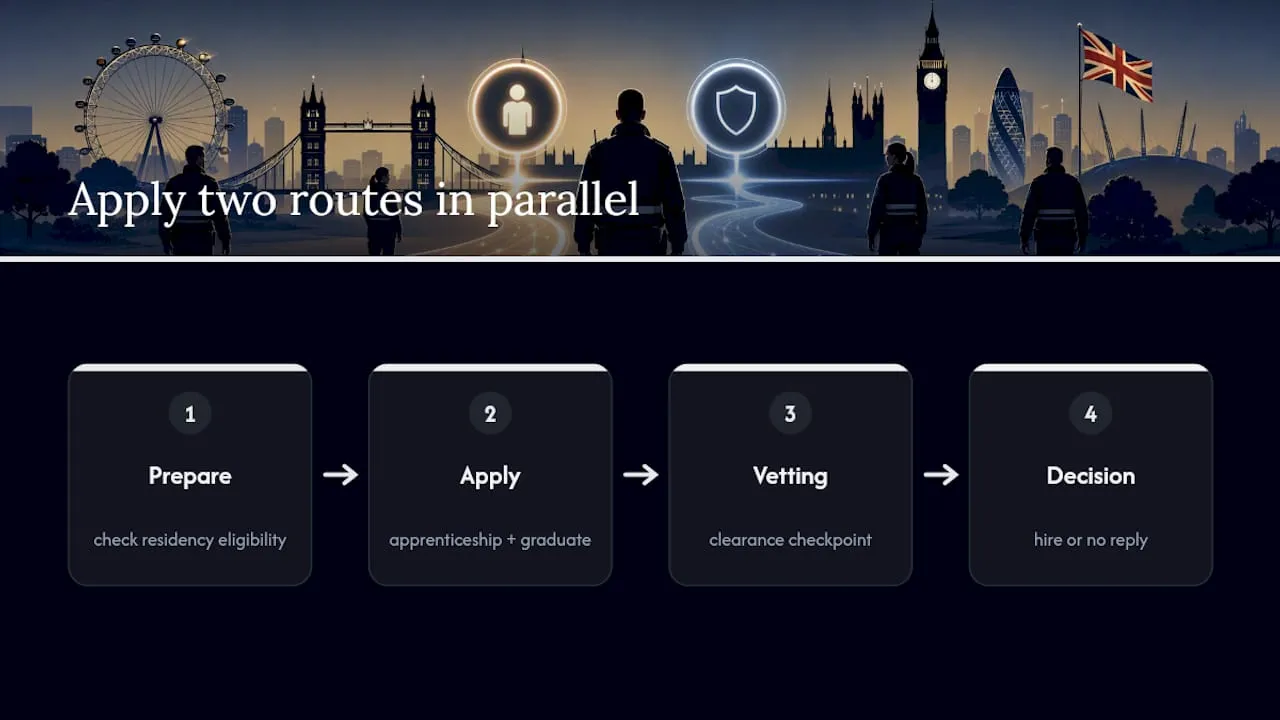
The biggest mistake I see is graduates applying to SC-cleared roles without checking residency eligibility first, then wondering why they never hear back. Read the eligibility criteria before you write a single word of your application, not after.
The second mistake is the generic CV sent to every vacancy. A front-line role and a SOC analyst graduate scheme want almost entirely different evidence from you, and employers can tell within seconds when a CV hasn’t been adapted.
If you want more detail on licence routes specifically, Security Jobs Board’s guide on how to get into homeland security roles breaks down the SIA process further.
— Rob
Set up your profile and start applying today
Security Jobs Board is built specifically for this sector, which matters more than it sounds. Generic graduate job boards bury security vacancies among thousands of unrelated listings; here, every posting is relevant, employers are actively searching the CV database for graduates like you, and the platform’s BSIA affiliation gives hiring teams a reason to trust candidates who apply through it.

Getting started takes three steps: register for a free account, upload your CV with licence and clearance status filled in clearly, and set alerts for “graduate”, “apprentice”, and “SOC analyst” so relevant roles reach you first. If you’re specifically looking regionally, the Northern Ireland security jobs listings are a good place to see live vacancies right now, or browse the full site at Securityjobsboard to see what’s currently open across the UK.
Sources
- Security Graduate Scheme - Defence Equipment & Support
- Security officer (job profile) - National Careers Service
- Security first line manager (ST0330) - Skills England
- BIIAB Level 2 Award for Security Officers (qualifications guide)
FAQ
Do I need an SIA licence before applying for graduate security roles?
No. Most employers, including apprenticeship schemes, provide or fund SIA licence-linked training as part of your onboarding rather than expecting you to hold one already.
What degree do I need for a graduate security job?
Front-line and in-house trainee roles accept any degree, while SOC analyst and cyber security graduate schemes usually prefer computing, engineering, or a related technical background.
How long does a security apprenticeship take?
The Security First Line Manager apprenticeship (ST0330) typically takes around 18 months, while broader security apprenticeships run 18 to 30 months depending on the scheme.
What is SC clearance and do I need it?
SC (Security Check) clearance is required for many defence and government-adjacent roles and depends partly on nationality and UK residency history; check eligibility with the employer before applying.
How do I find graduate security vacancies quickly?
Create a free profile on Security Jobs Board, upload your CV with licence and clearance status included, and set alerts for “graduate”, “apprentice”, and “SOC analyst” to get relevant vacancies sent directly to you.


