DevSecOps career path: your 2026 guide to breaking in

TL;DR:
- The DevSecOps career path involves integrating security into software delivery through development, security, and operations. Success depends on building relevant technical skills, obtaining certifications like Security+, CKS, and CKA, and demonstrating real-world portfolio projects; it typically takes five to nine months to become job-ready. Progression yields higher salaries, especially with experience in cloud platforms, strategic influence, and a strong security-first mindset.
The DevSecOps career path is defined as the progressive integration of development, security, and operations skills to embed continuous security directly into software delivery pipelines. This hybrid discipline has moved from niche specialism to mainstream demand, with organisations like Microsoft, AWS, and Google building entire platform security teams around it. Certifications such as CompTIA Security+, CKS (Certified Kubernetes Security Specialist), and CKA now serve as credibility anchors at every hiring stage. If you are a developer, DevOps engineer, or security analyst wondering how to start a DevSecOps career, the realistic timeline to becoming job-ready sits between five and nine months with focused effort and a strong portfolio.
What skills are required to start a DevSecOps career?
The technical foundation of a DevSecOps role covers four core areas: CI/CD pipeline security, container and Kubernetes security, policy-as-code, and vulnerability scanning using both SAST (Static Application Security Testing) and DAST (Dynamic Application Security Testing) tools. Tools like Trivy, Snyk, Checkov, and Open Policy Agent appear repeatedly in job descriptions from mid-sized SaaS companies through to enterprise financial institutions. You do not need to master all of them on day one, but you must be able to demonstrate working knowledge of at least one toolchain end to end.

Soft skills matter more than most entry-level candidates expect. DevSecOps engineers sit at the intersection of development and security teams, which means translating risk language into engineering priorities and vice versa. Threat modelling, clear written communication, and the ability to run a productive cross-functional conversation are skills that separate candidates who progress from those who stagnate.
The most common entry points into the field are DevOps engineers, software developers, and security analysts. Each brings a different strength and a different gap to close. Becoming job-ready typically takes five to nine months for a committed learner who combines certification study with hands-on project work. That timeline assumes roughly ten to fifteen hours of focused practice per week.
- CI/CD pipeline security: Understand how to integrate security gates into Jenkins, GitHub Actions, or GitLab CI without breaking developer velocity.
- Container security: Learn image scanning, runtime protection, and Kubernetes RBAC policies using tools like Falco and Trivy.
- Policy-as-code: Write and enforce security policies using Open Policy Agent or Kyverno so that compliance becomes automated rather than manual.
- Vulnerability scanning: Run SAST tools like Semgrep and DAST tools like OWASP ZAP against real codebases and document your findings.
- Certifications: CKA builds your Kubernetes foundation, CKS validates your security specialism, and CompTIA Security+ remains the most widely recognised baseline credential across UK and US hiring funnels.
Pro Tip: Build a public GitHub repository that contains a working CI/CD pipeline with integrated security scanning, a policy-as-code library, and signed build artefacts. Recruiters treat this kind of public portfolio as a significant differentiator in 2026.
How does a DevSecOps career progress in roles and salary?
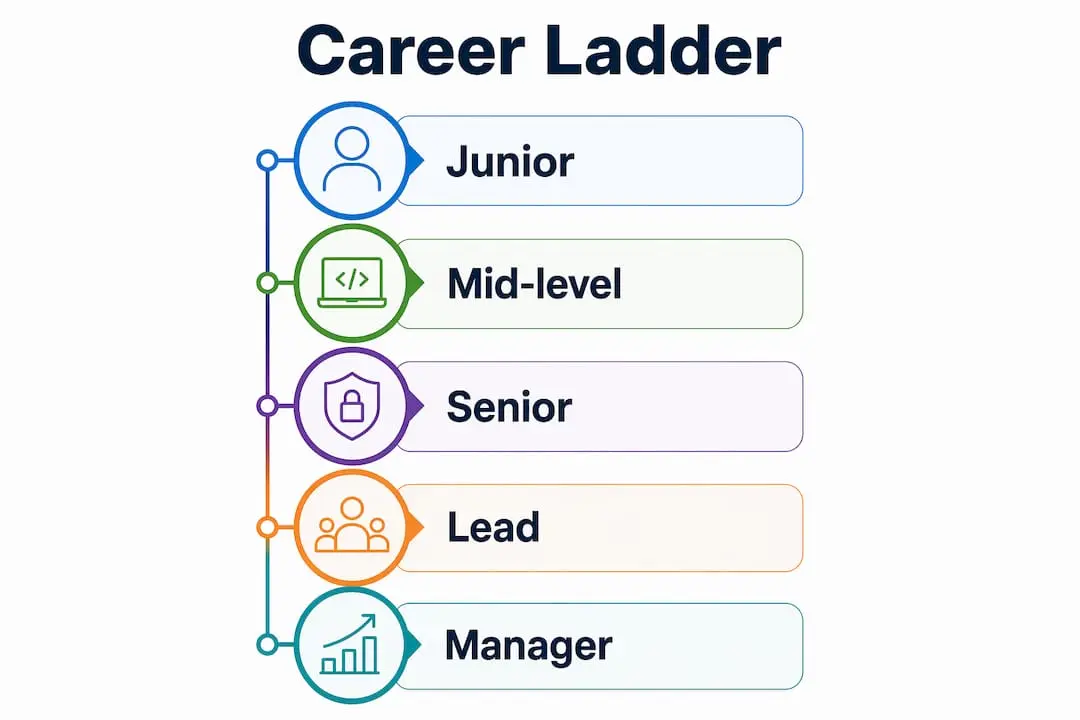
The DevSecOps career path follows a clear seniority ladder, but the responsibilities at each level shift considerably. Junior engineers focus on implementing security tooling within existing pipelines. Mid-level engineers own the security architecture of one or more product teams. Senior engineers define standards across the organisation and mentor others. Principal and staff engineers influence platform strategy, and directors translate security metrics into business impact for executive audiences.
Salary data from the US market in 2026 illustrates the financial trajectory clearly. Junior to mid-level salaries range from $90,000 to $130,000. Senior engineers command $140,000 to $180,000. Staff and director-level roles reach $180,000 to $250,000 and above. These figures reflect a market where demand consistently outpaces supply, particularly for engineers who can operate across cloud platforms like AWS and Azure simultaneously.
| Level | Experience | Salary range (USD) | Key milestone |
|---|---|---|---|
| Junior engineer | 0 to 2 years | $90,000 to $110,000 | First production pipeline with security gates |
| Mid-level engineer | 2 to 4 years | $110,000 to $140,000 | Owns security architecture for a product team |
| Senior engineer | 4 to 7 years | $140,000 to $180,000 | Sets organisation-wide security standards |
| Staff or principal | 7 to 10 years | $180,000 to $220,000 | Drives platform security strategy |
| Director or above | 10 or more years | $220,000 to $250,000+ | Aligns security investment with business outcomes |
Compared to a pure DevOps engineer role, the DevSecOps track commands a 15 to 25 per cent salary premium at equivalent seniority levels, reflecting the added security specialism. Compared to a cybersecurity engineer, the DevSecOps role requires deeper platform and pipeline knowledge, which is why contract-to-hire arrangements are common for new programmes. Hiring managers use a six-month evaluation period to assess not just technical skill but the ability to navigate organisational politics between security and engineering departments.
Pro Tip: When negotiating your first DevSecOps contract, ask specifically whether the role is contract-to-hire or direct hire. Contract-to-hire is standard for new security programmes, and understanding this upfront helps you set realistic expectations for the first six months.
What certification paths support DevSecOps career advancement?
Certifications serve two purposes in a DevSecOps career: they signal credibility to hiring managers who cannot evaluate your skills directly, and they force structured learning that fills gaps you might otherwise skip. The sequence in which you pursue them matters as much as the certifications themselves.
-
CompTIA Security+ is the right starting point for anyone without a formal security background. It covers foundational concepts including network security, cryptography, and threat management. Most UK and US employers list it as a baseline requirement or a strong preference for entry-level roles.
-
CKA (Certified Kubernetes Administrator) follows naturally if you are targeting cloud-native environments, which describes the majority of modern DevSecOps roles. It validates your ability to deploy, manage, and troubleshoot Kubernetes clusters before you layer security on top.
-
CKS (Certified Kubernetes Security Specialist) requires a valid CKA and is the most respected Kubernetes-specific security credential available. It covers cluster hardening, system hardening, supply chain security, and runtime security. Passing CKS advances hiring funnel stages more effectively than almost any other single credential in cloud-native environments.
-
AWS Security Specialty or Azure Security Engineer Associate becomes relevant at mid-level when you are designing security controls across cloud infrastructure. AWS and Azure each have their own threat models, and employers building on a specific platform want evidence you understand it deeply.
-
HashiCorp Terraform Associate is worth adding if your role involves infrastructure-as-code, which it almost certainly will. Policy-as-code and infrastructure-as-code are increasingly treated as one discipline in mature DevSecOps teams.
Beyond certifications, writing detailed technical blog posts about specific challenges you have solved, such as implementing OPA policies in a multi-tenant Kubernetes cluster, significantly boosts recruiter visibility. Recruiters search for candidates by technical keyword, and a well-written post positions you as a practitioner rather than a student. Emerging topics like AI security and LLM threat modelling are already appearing in senior job descriptions, so building awareness of OWASP’s AI Security Top 10 now puts you ahead of the curve.
What are the main entry pipelines into DevSecOps?
Five distinct backgrounds feed into DevSecOps roles, and each one carries a different set of advantages and gaps to close.
-
DevOps or SRE engineers make the most natural transition. They already understand CI/CD pipelines, infrastructure-as-code, and container orchestration. The primary gap is application security knowledge and the security mindset. Most successful transitions come from DevOps or Systems Engineering backgrounds precisely because pipeline mechanics are faster to learn than deep platform security from the other direction.
-
Application security engineers bring strong vulnerability knowledge and secure code review skills. Their gap is typically on the platform and pipeline side. They need to build hands-on experience with Kubernetes, Terraform, and CI/CD tooling before they can operate effectively in a DevSecOps role.
-
Software engineers hold a communication advantage because they speak the same language as the development teams they will be working alongside. However, developers entering DevSecOps must adopt a fundamentally different mental model. Building software means making things work. Security engineering means finding every way a system can break. This shift from builder to breaker is the hardest cognitive adjustment in the entire transition.
-
Security analysts and SOC engineers understand threat intelligence, incident response, and compliance frameworks. Their gap is the engineering depth required to implement controls at the code and pipeline level rather than responding to alerts after the fact.
-
Direct entry candidates with no prior professional experience in any of these areas face the steepest climb but are not excluded. A strong portfolio built through personal projects, Capture the Flag competitions, and bug bounty programmes on platforms like HackerOne or Bugcrowd can substitute for professional experience in early hiring conversations. The security mindset developed through CTFs produces demonstrable artefacts that hiring managers can evaluate directly.
You can explore career transition resources and skills training options to support whichever pathway fits your background.
Key takeaways
A successful DevSecOps career requires combining platform engineering skills with a security-first mindset, validated through certifications like CKS and CompTIA Security+, and demonstrated through a public portfolio of working artefacts.
| Point | Details |
|---|---|
| Timeline to job-ready | Committed learners become job-ready in five to nine months with portfolio and certification work. |
| Portfolio over theory | CI/CD pipelines, policy libraries, and signed artefacts attract significantly more recruiter interest than qualifications alone. |
| Best entry background | DevOps and Systems Engineering backgrounds transition fastest due to existing platform and pipeline knowledge. |
| Certification sequence | Start with Security+, progress to CKA and CKS, then add cloud-specific credentials at mid-level. |
| Leadership track | Senior progression requires translating security metrics into business outcomes, not just hands-on configuration. |
Why I think most DevSecOps career advice misses the point
Most guides tell you to collect certifications and learn the tools. That is necessary but not sufficient, and focusing on it exclusively is how candidates end up with impressive CVs and poor interview performance.
The thing that actually separates candidates who land roles from those who do not is the quality of their portfolio artefacts. Not a list of tools they have used. Not a badge wall on LinkedIn. A working GitHub repository with a real CI/CD pipeline, a policy-as-code library that does something non-trivial, and documented evidence of how they found and fixed a vulnerability. Leadership advancement focuses on strategic influence rather than hands-on configuration, but you cannot influence strategy without first demonstrating you can execute.
There is also a market reality worth acknowledging. Many organisations, particularly those with fewer than thirty engineers, do not yet need a dedicated DevSecOps hire. A senior DevOps engineer with security awareness and quarterly penetration testing covers the majority of their risk at a fraction of the cost. Targeting your job search at organisations with fifty or more engineers, active cloud-native programmes, and existing DevOps teams gives you a far better chance of finding a role that actually uses your skills rather than treating you as an expensive generalist.
Patience matters too. The first role is the hardest to land. The second is considerably easier once you have production experience to discuss. Build the portfolio, write about what you learn, and target organisations where the role is genuinely needed.
— Rob
Find your next DevSecOps role with Securityjobsboard

Securityjobsboard connects aspiring and experienced security professionals with employers across the UK who are actively hiring. If you are building towards a DevSecOps role or ready to make the move now, the platform lists security-specific vacancies tailored to technical and operational skill sets. Northern Ireland in particular has a growing cluster of technology and security employers worth exploring. Browse security jobs in Northern Ireland to see current openings, or create a free profile on Securityjobsboard to set up job alerts and upload your CV so relevant employers can find you directly.
FAQ
What does a DevSecOps engineer actually do day to day?
A DevSecOps engineer integrates security controls into CI/CD pipelines, manages container and Kubernetes security, and works with development teams to identify and remediate vulnerabilities before code reaches production. The role combines hands-on tooling work with cross-team collaboration and security policy enforcement.
How long does it take to transition into DevSecOps?
Most committed learners become job-ready in five to nine months when combining certification study with portfolio development. The timeline varies depending on your starting background, with DevOps engineers typically transitioning faster than pure security analysts.
Which certification should I get first for a DevSecOps career?
CompTIA Security+ is the recommended starting point for candidates without a formal security background, as it covers foundational concepts recognised by UK and US employers alike. Once you have that, CKA followed by CKS is the most direct path for cloud-native DevSecOps roles.
Is DevSecOps better paid than DevOps?
DevSecOps roles command a 15 to 25 per cent salary premium over equivalent DevOps positions at the same seniority level, reflecting the additional security specialism required. US market data for 2026 shows junior DevSecOps salaries starting at $90,000 to $110,000, rising to $250,000 and above at director level.
Do I need a degree to get into DevSecOps?
A degree is not a requirement for most DevSecOps roles. Employers prioritise demonstrable skills, certifications like CKS and Security+, and a portfolio of working artefacts over formal academic qualifications, particularly at entry and mid-level.


