Cyber security career path: Reddit's best advice in 2026

TL;DR:
- Reddit communities are valuable sources of peer advice for cybersecurity careers, especially when aligned with formal frameworks like NIST NICE. The typical entry point is the Tier 1 SOC analyst role, which provides structured experience and development opportunities. Success depends on combining precise self-assessment, practical proof of skills, and strategic application timing within a 9 to 12-month roadmap.
Reddit communities are the most widely consulted peer resource for cyber security career advice, offering real-world timelines, role breakdowns, and certification guidance that formal curricula rarely match. The cyber security career path discussions on Reddit, particularly across r/cybersecurity, r/netsecstudents, and r/CompTIA, consistently point to the same entry point: the SOC analyst role. When you combine that community intelligence with structured frameworks like the NIST NICE Framework, you get something genuinely useful. Not just opinions, but a validated, step-by-step route into one of the UK’s fastest-growing professional fields.
What does the cyber security career path on Reddit actually look like?
Reddit career discussions in cyber security are not random. They follow recognisable patterns, and those patterns align closely with formal industry frameworks. The NIST NICE Framework v2.2.0, released in April 2026, standardises cybersecurity work roles using detailed Task, Knowledge, and Skill (TKS) statements. This gives you a shared vocabulary to convert Reddit advice into a concrete skill-building plan.
The NICE Framework organises roles into work role categories and competency areas. When a Reddit user tells you to “learn SIEM tools and network fundamentals before applying for SOC roles,” the NICE Framework confirms exactly which TKS statements those skills map to. That cross-referencing turns community opinion into an auditable career plan. It also helps you identify genuine skill gaps rather than chasing certifications that do not match your target role.
Pro Tip: Before acting on any Reddit career advice, search the NIST NICE Framework for your target work role. If the skill being recommended does not appear in the TKS statements for that role, deprioritise it.
The NICE Framework is also directly relevant to UK professionals considering roles with defence contractors or government clients. The DoD 8140 framework replaced older certification checklists with a competency and role-based system grounded in NIST NICE. This means certifications must be verified against specific work role codes, not assumed equivalent by title alone. Reddit threads frequently miss this nuance, so checking the framework yourself is non-negotiable.
Using a formal role framework provides a shared language to convert Reddit discussions into measurable progression steps. That is the real value of pairing community advice with structured standards.
How long does it take to break into cyber security from scratch?
The most cited timeline across Reddit career threads is 9 to 12 months of focused study before landing a Tier 1 SOC analyst role. That figure assumes consistent daily effort, not casual weekend reading. Here is the four-phase roadmap that Reddit communities and career guides consistently recommend:
-
Foundation phase (months 1 to 3). Build networking fundamentals using resources like Professor Messer’s CompTIA Network+ materials and TryHackMe’s pre-security path. Understand TCP/IP, DNS, firewalls, and basic operating system administration on both Windows and Linux.
-
Hands-on practice phase (months 3 to 6). Move into platforms like TryHackMe and Hack The Box for guided labs. Set up a homelab using free tools such as VirtualBox, Security Onion, and Splunk’s free tier. Document everything you build. This documentation becomes your proof of work.
-
Certification and proof phase (months 6 to 9). Sit CompTIA Security+ as your baseline credential. It is the most widely recognised entry-level certification in UK and US hiring. Complement it with a cyber security certification guide that maps credentials to specific roles, so you are not collecting qualifications without direction.
-
Application phase (month 9 onwards). Start applying before you feel ready. Reddit’s most repeated piece of cyber security job advice is that waiting for full readiness extends your time to hire unnecessarily. Applying early generates interview feedback that accelerates your preparation far more than additional self-study.
Pro Tip: Set a calendar reminder at month 9 to begin applications regardless of how prepared you feel. Interview rejection is data, not failure. Each round sharpens your answers and reveals genuine gaps.
The Tier 1 SOC analyst role is the most accessible entry point into cybersecurity because it offers structured, supervised experience with real alerts and incidents. That structured exposure is what separates it from other entry-level IT roles when it comes to building a credible security career.

How to use Reddit communities effectively for career mentorship
Reddit is not a passive resource. The professionals who advance fastest treat it as an active mentorship network. The key subreddits for starting a cyber security career are r/cybersecurity, r/netsecstudents, r/CompTIA, r/AskNetsec, and r/ITCareerQuestions. Each serves a slightly different purpose, and knowing which to use matters.
The quality of advice you receive depends almost entirely on the quality of your question. Precise, context-rich questions attract far better guidance than vague ones. A post that reads “how do I get into cyber security?” will receive generic replies. A post that reads “I have CompTIA Security+, six months of homelab experience with Splunk and Wireshark, and I am targeting Tier 1 SOC roles in the UK. My bottleneck is passing technical phone screens. What should I practise?” will receive specific, experienced responses.
The single most effective thing you can do on Reddit is describe your exact situation: your credentials, your target role, your timeline, and the specific obstacle you are facing. Vague questions produce vague answers.
Best practices for engaging Reddit career communities:
- State your credentials upfront. List certifications, relevant experience, and tools you have used. This lets respondents calibrate their advice to your actual level.
- Name your target role and timeline. “I want to work in cyber security” is too broad. “I am targeting SOC analyst roles in London by Q4 2026” gives responders something concrete to work with.
- Ask about bottlenecks, not general paths. The community has already written thousands of general path posts. Ask about the specific obstacle between where you are and where you want to be.
- Engage with others’ threads. Answering questions from people slightly behind you in their journey consolidates your own knowledge and builds your reputation in the community.
Consistent engagement also generates study partners, accountability groups, and occasionally direct job referrals. Several UK professionals in cyber security roles credit Reddit study groups with keeping them on track through the difficult middle months of self-study.
Why certifications alone will not get you hired
Certifications are foundational but insufficient without proof of practical skill. This is the most repeated consensus across Reddit cyber security career threads, and hiring managers confirm it. CompTIA Security+ tells an employer you understand concepts. A documented homelab, a CTF writeup, or an open source contribution tells them you can apply those concepts under pressure.
The types of hands-on experience that consistently impress hiring managers include:
- Homelab projects. Building a SIEM environment using Security Onion or Elastic Stack, then writing up what you detected and how you responded, demonstrates real analytical thinking.
- CTF participation. Platforms like PicoCTF, CTFtime, and Hack The Box host competitions that produce writeups. Those writeups are portfolio pieces. They show methodology, not just results.
- Open source contributions. Contributing to security tools on GitHub, even through documentation improvements or bug reports, signals engagement with the professional community.
- Practical skills for remote roles. The skills needed for remote security work in 2026 include cloud security fundamentals and endpoint detection, both of which you can practise in free-tier environments.
Interview preparation deserves equal attention. Hiring managers value a candidate’s ability to articulate the reasoning behind security decisions as much as their technical knowledge. This means practising scenario-based answers: “Walk me through how you would triage a phishing alert” or “What would you check first if you saw unusual outbound traffic on port 443?” The answer matters less than the structured thinking you demonstrate.
Pro Tip: Record yourself answering scenario-based interview questions and play them back. Most candidates are surprised by how vague their answers sound. Specificity and structure are what separate shortlisted candidates from the rest.
What comes after your first cyber security role?
SOC analyst work is shift-based and fast-paced, and it is widely regarded on Reddit as a deliberate stepping stone rather than a destination. Most SOC analysts move into advanced specialisations within two to four years. The most common transitions discussed in Reddit career threads are outlined below.
| Role | Typical transition timeline | Key skills to develop |
|---|---|---|
| Incident response analyst | 1 to 2 years post-SOC | Digital forensics, malware triage, DFIR tooling |
| Threat intelligence analyst | 2 to 3 years post-SOC | OSINT, threat actor profiling, intelligence platforms |
| Detection engineer | 2 to 4 years post-SOC | SIEM rule writing, MITRE ATT&CK mapping, scripting |
| Security engineer | 3 to 5 years post-SOC | Cloud security, infrastructure hardening, DevSecOps |
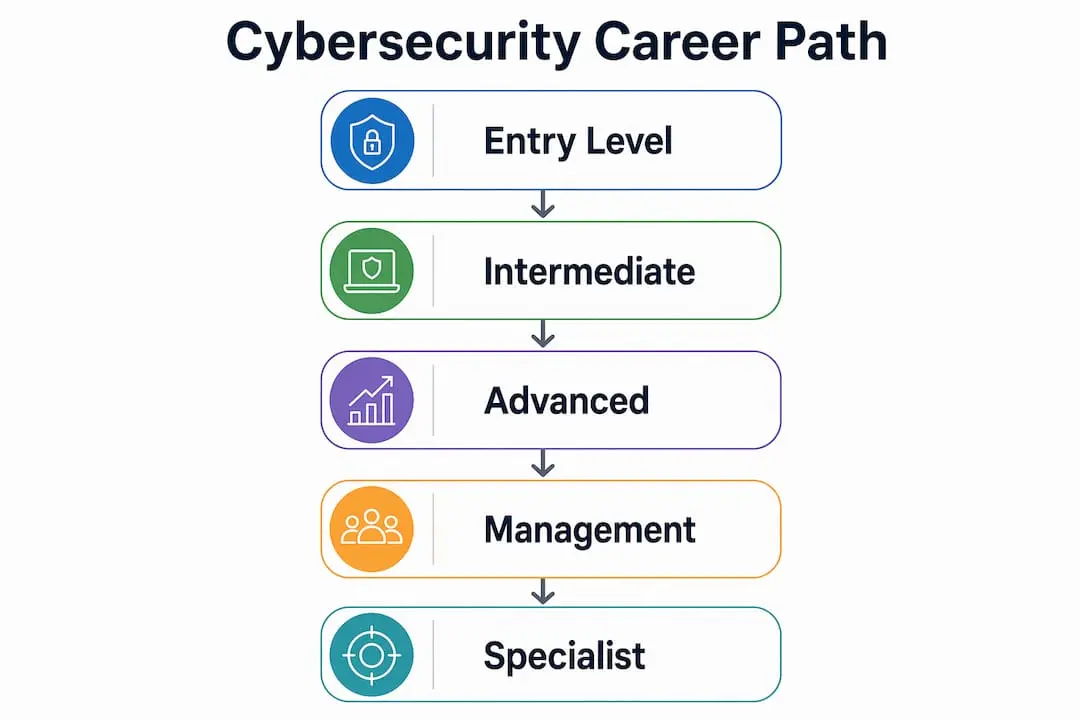
Reddit career threads consistently show that planned transitions outperform reactive ones. Professionals who identify their target specialisation at the 12-month mark in their SOC role, then deliberately build the required skills during that role, move faster than those who wait for an opportunity to appear. Advanced certifications like SANS GIAC qualifications, Offensive Security’s OSCP, or the EC-Council CEH support specific transitions, but they are most effective when chosen to match a defined next role rather than collected speculatively.
The top security certifications in the UK for career progression beyond SOC include CISM for those moving towards management, and GCIA or GCIH for those staying technical. Choosing the right credential at the right stage is a decision worth researching carefully before committing.
Key takeaways
A structured cyber security career requires combining Reddit’s peer-tested timelines with formal frameworks like NIST NICE and consistent proof-of-work to move from zero experience to employed professional within 12 months.
| Point | Details |
|---|---|
| Use NIST NICE as your validator | Cross-reference every Reddit skill recommendation against the NICE Framework TKS statements for your target role. |
| Target SOC analyst as your entry point | The Tier 1 SOC role offers structured experience and direct routes into advanced specialisations within two to four years. |
| Apply at month 9, not when ready | Starting applications before feeling fully prepared generates interview feedback that shortens total time to hire. |
| Ask precise questions on Reddit | Specific posts with credentials, target roles, and bottlenecks attract far better mentorship than general queries. |
| Build proof of work alongside certifications | Homelab documentation, CTF writeups, and scenario-based interview answers matter as much as CompTIA Security+ to hiring managers. |
Reddit is a hypothesis engine, not a career authority
I have spent years watching people treat Reddit career advice as gospel, and it consistently produces one of two outcomes. Either they follow a path that worked for someone in a different country, with different prior experience, in a different hiring climate. Or they get paralysed by conflicting advice and do nothing at all.
The professionals I have seen progress fastest treat Reddit as a hypothesis engine. They read a thread, extract a claim, then verify it against the NIST NICE Framework, a current job posting, or a conversation with someone already in the target role. That verification step takes twenty minutes and saves months of misdirected effort.
What Reddit does exceptionally well is provide emotional context. Knowing that someone else took 11 months to land their first SOC role, felt completely lost at month 6, and is now working in threat intelligence is genuinely motivating in a way that no textbook can replicate. That human dimension is the real value of the community. Use it for morale and for hypotheses. Use formal frameworks and live job adverts for decisions.
The other thing I would say is this: ask better questions. The average Reddit career post is so vague that it cannot possibly attract useful advice. If you write a post that describes your exact situation, your exact obstacle, and your exact timeline, you will receive responses that are worth acting on. That discipline of precise self-assessment is also, incidentally, exactly what good security professionals do when they analyse an incident.
— Rob
Start your cyber security job search with Securityjobsboard

Securityjobsboard is the UK’s specialist platform for security industry roles, connecting jobseekers directly with employers who understand the sector. Whether you are applying for your first SOC analyst position or targeting a senior security engineering role, the platform offers free candidate profiles, CV uploads, and job alerts tailored to your specialisation. Browse current security vacancies across the UK or visit the career advice hub for practical guidance on applications, certifications, and progression. The step-by-step application guide is particularly useful if you are ready to act on the roadmap above.
FAQ
How long does it take to get a cyber security job from scratch?
Most people following a structured self-study plan land a Tier 1 SOC analyst role within 9 to 12 months. Starting applications at month 9, before feeling fully ready, shortens the overall timeline.
Which Reddit communities are best for cyber security career advice?
r/cybersecurity, r/netsecstudents, r/CompTIA, and r/AskNetsec are the most active subreddits for paths in cyber security. Each serves a different level, from complete beginners to experienced professionals seeking specialisation advice.
Is CompTIA Security+ enough to get a cyber security job?
CompTIA Security+ is the standard entry-level credential but certifications alone rarely secure roles without practical proof of work such as homelab projects, CTF writeups, or documented lab experience.
What is the NIST NICE Framework and why does it matter for career planning?
The NIST NICE Framework standardises cybersecurity work roles using Task, Knowledge, and Skill statements. It lets you verify whether Reddit career advice maps to real employer requirements for your target role.
What roles can you move into after a SOC analyst position?
SOC analysts typically progress into incident response, threat intelligence, detection engineering, or security engineering within two to four years, depending on which skills they develop during their time in the SOC.


