Benefits of remote security jobs for UK professionals

TL;DR:
- Remote security jobs offer higher salaries and better retention rates than on-site positions. They also improve wellbeing, increase productivity, and expand job opportunities for UK professionals. Fully remote roles suit experienced analysts, while hybrid models benefit those at early career stages.
Remote security jobs are defined as cybersecurity and physical security roles performed primarily from a home or distributed location, without requiring daily attendance at a fixed workplace. The benefits of remote security jobs are well documented: remote roles carry a 15% salary premium over on-site positions and deliver 22% higher staff retention. Remote security job postings increased by 65% year on year in 2022, compared with just 18% growth for on-site roles. That gap signals a structural shift, not a temporary trend. For UK job seekers weighing their options, understanding these advantages is the clearest starting point.
What are the key benefits of remote security jobs for UK professionals?
Remote security roles pay more, and the data is unambiguous. A 15% salary premium applies to remote positions compared with equivalent on-site roles. Employers offer this premium because remote workers expand the talent pool beyond commuting distance, and competition for skilled security professionals is fierce.
The wellbeing gains are equally significant. Remote work reduces commute stress, improves happiness by 34%, and promotes better self-care routines by 23%. Removing a daily commute is not a minor perk. For security professionals working irregular hours or on-call rotations, reclaiming that time directly improves mental health and physical recovery.

Productivity rises too. Remote workers report 15% higher productivity in threat analysis tasks specifically. Deep, focused work such as log review, vulnerability assessment, and compliance auditing benefits from a quiet, controlled environment. Open-plan offices fragment concentration; home offices do not.
Retention is the metric employers care about most. Remote security roles achieve 22% higher retention than on-site equivalents. High turnover in security teams creates dangerous knowledge gaps. Remote flexibility is one of the most effective tools for keeping experienced analysts in post.
The core remote security job advantages, summarised:
- Higher base salary through a documented 15% premium over on-site roles
- Reduced burnout with hybrid flexibility cutting burnout rates by 23%
- Better work-life balance through eliminated commutes and flexible scheduling
- Increased productivity particularly in individual, analytical security tasks
- Wider job market access with no geographic restriction to local employers
- Greater staff retention benefiting both career stability and team continuity
Pro Tip: When negotiating a remote security role, ask specifically about the remote work policy in writing. Confirm whether the role is fully remote or requires periodic attendance at a secure facility, as these carry very different day-to-day realities.
How do remote and hybrid models compare in security roles?
Not all remote security jobs are identical. The distinction between fully remote and hybrid arrangements matters considerably depending on your career stage and the type of security work involved.
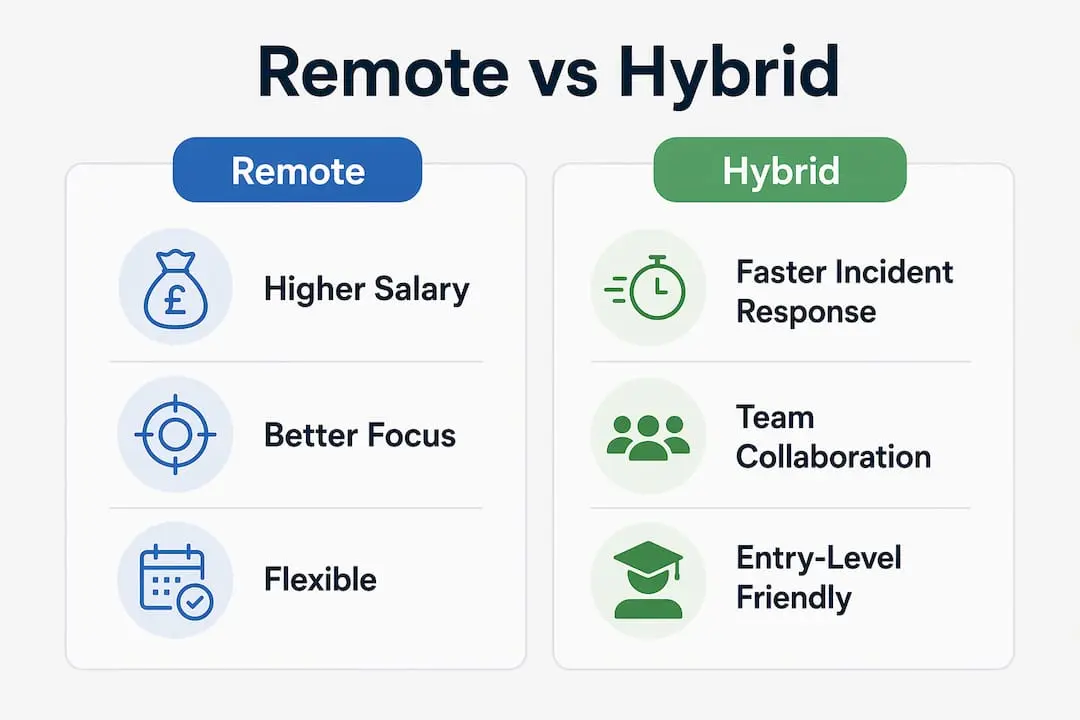
Hybrid teams resolve incidents 22% faster than fully remote teams. Real-time, in-person collaboration during active incident response gives hybrid setups a measurable edge. When a breach is live and decisions must be made in minutes, physical co-location accelerates communication in ways that video calls cannot fully replicate.
Fully remote arrangements, by contrast, excel in individual, analytical work. Deep security tasks such as threat analysis, governance, risk and compliance (GRC) work, and cloud security architecture perform better when professionals work without interruption. The concentration required for these tasks is genuinely higher at home.
Career stage also shapes which model is available to you. Entry-level security roles often remain hybrid because new professionals need hands-on infrastructure access and direct mentoring. Fully remote roles are predominantly accessible to experienced professionals who already hold cloud and compliance skills. If you are early in your career, a hybrid role is not a compromise. It is a structured path to building the skills that unlock fully remote positions later.
| Model | Best suited to | Key advantage | Key limitation |
|---|---|---|---|
| Fully remote | Experienced analysts, GRC, cloud security | Maximum flexibility and salary premium | Slower incident response coordination |
| Hybrid | Entry-level, incident response, team leads | Faster collaboration and mentoring access | Commute requirement on office days |
Pro Tip: If you are choosing between a fully remote and a hybrid offer, map the role’s core tasks first. Analytical and compliance-heavy roles suit full remote. Roles with active incident response components benefit from hybrid access.
What skills and certifications boost remote security careers?
The fastest salary growth in remote security comes from a specific combination: CISSP plus cloud certifications such as AWS Certified Security, Microsoft Azure Security Engineer, or Google Cloud Professional Security Engineer. Bootcamps alone do not produce the same salary trajectory. Employers hiring remotely for senior roles use these credentials as a reliable filter.
Cloud security, threat analysis, and GRC roles carry the highest remote-friendly proportions across the security sector. These specialisations share a common characteristic: the work is performed through software and platforms rather than physical infrastructure. That makes location irrelevant to job performance.
The certifications and skills most in demand for remote security roles in the UK:
- CISSP (Certified Information Systems Security Professional): the benchmark for senior remote roles
- AWS Certified Security Specialty, Azure Security Engineer Associate, or GCP Professional Security Engineer: cloud platform credentials that directly expand remote job eligibility
- Certified Information Security Manager (CISM): valued in GRC and compliance-focused remote positions
- CompTIA Security+: a strong entry point for professionals moving into remote roles from hybrid positions
- Identity and access management (IAM): a core skill as remote security becomes increasingly identity-centred
- Compliance frameworks: knowledge of ISO 27001, NIST, and UK GDPR requirements is consistently requested in remote GRC roles
Securityjobsboard publishes a 2026 skills guide covering the technical competencies UK employers currently prioritise for remote security positions. Reviewing it before updating your CV gives you a clear picture of where to focus your development.
How can UK job seekers find and secure remote security roles?
The single most important step is verifying that a role is genuinely remote. Many security jobs labelled “remote” require proximity to secure facilities or regional offices due to government classification rules or client contracts. Reading the job description carefully and asking directly during screening calls prevents wasted applications.
Practical steps for securing a remote security role:
- Use specialist job boards: Securityjobsboard lists UK-specific remote security vacancies with clear location requirements, saving time filtering out unsuitable listings
- Tailor your CV for remote readiness: highlight self-management, asynchronous communication, and any previous remote or distributed team experience
- Demonstrate cloud and compliance skills: these are the two attributes that most consistently appear in fully remote job requirements
- Build a professional network: LinkedIn connections within UK security communities surface unadvertised remote roles regularly
- Pursue continuous certification: employers treat active certification pursuit as evidence of professional discipline, which matters more in remote roles where direct supervision is limited
The UK remote security job trends guide on Securityjobsboard covers salary benchmarks and role specialisations in detail, giving you a grounded picture of what the market currently offers.
Pro Tip: During interviews for remote roles, ask: “How does your team handle incident response across distributed locations?” and “What tools does the team use for asynchronous collaboration?” The answers reveal whether the organisation has genuinely built a remote-first culture or is simply tolerating remote work.
Key takeaways
Remote security jobs offer higher salaries, better wellbeing outcomes, and greater career flexibility than on-site roles, making them the strongest option for experienced UK security professionals in 2026.
| Point | Details |
|---|---|
| Salary premium is real | Remote security roles pay 15% more than equivalent on-site positions on average. |
| Verify remote status early | Many roles labelled remote require periodic attendance at secure sites; always confirm in writing. |
| Career stage shapes model access | Entry-level professionals typically access hybrid roles first; fully remote roles suit experienced practitioners. |
| CISSP plus cloud certifications lead | This combination produces the fastest salary growth in remote security careers. |
| Wellbeing gains are measurable | Remote work improves happiness by 34% and reduces burnout by 23% in hybrid arrangements. |
The remote security shift is real, but it rewards the prepared
I have watched the UK security job market change significantly over the past few years, and the direction is clear: remote and hybrid roles are no longer exceptions. They are the expectation for a growing proportion of experienced professionals. What concerns me, though, is how many job seekers approach this shift passively.
The salary premium and flexibility are genuine. But the professionals who capture the best fully remote roles are not simply waiting for employers to offer them. They are building specific credentials, particularly cloud security qualifications, and they are positioning themselves as self-directed practitioners who do not need daily supervision to deliver results.
The identity-centred future of remote security is also worth taking seriously. As organisations move more infrastructure to cloud platforms, the perimeter of a network is no longer a physical location. It is an identity. Security professionals who understand IAM, zero-trust architecture, and cloud-native security controls are the ones employers will trust to work without a physical presence.
My honest advice: do not treat remote work as a lifestyle preference to negotiate after you get the job. Build the skills that make remote work the obvious choice for an employer. Then the conversation about location becomes straightforward.
— Rob
Remote security jobs on Securityjobsboard
UK job seekers ready to act on these advantages will find a focused starting point on Securityjobsboard, the BSIA-affiliated platform built specifically for the UK security sector.

Securityjobsboard lists current remote and hybrid security vacancies across the UK, including security jobs in Northern Ireland and other regional markets that are often underserved by generalist job boards. Candidates can create a free profile, upload a CV, and set targeted job alerts so new remote listings reach you immediately. The platform’s focus on the security sector means every listing is relevant, and the search tools let you filter by remote status, specialism, and location from the outset. Visit Securityjobsboard to browse current remote security vacancies.
FAQ
What is the salary difference between remote and on-site security jobs?
Remote security roles carry a 15% salary premium over equivalent on-site positions. Employers pay this premium to access a wider talent pool beyond local commuting distance.
Are entry-level security jobs available as fully remote roles?
Entry-level security roles are predominantly hybrid rather than fully remote. New professionals typically need hands-on infrastructure access and direct mentoring that fully remote arrangements cannot easily provide.
Which certifications most improve remote security job prospects?
CISSP combined with a cloud certification such as AWS Certified Security Specialty or Azure Security Engineer Associate produces the fastest salary growth and broadest access to fully remote roles.
How do I verify whether a security job is genuinely remote?
Ask the employer directly whether the role requires any attendance at a secure facility or regional office. Many roles advertised as remote carry location requirements tied to government classification rules or client contracts.
Does remote work improve productivity for security professionals?
Remote workers report 15% higher productivity in threat analysis tasks. Deep, analytical security work benefits from the focused environment that home working provides.


