Share Job Posts in Under a Minute: Ready UK Templates for Recruiters

Paste this: “We’re hiring a [Job Title] in [Location] — join a team that [one genuine reason to apply]. £[salary range], [contract type]. Apply here: [link].” That single line covers the role, place, hook and call to action in one breath, and it works whether you’re posting a routine vacancy or firing off an urgent shift-cover request. Swap the tone slightly for a referral ask (“Know a good [Job Title]? We’re hiring — tag them below”) and you’ve covered the three most common sharing situations without rewriting a thing.
TL;DR:
- Posting shorter, mobile-optimized job adverts with clear salary ranges improves candidate engagement and reduces unqualified applications.
- Limiting job requirements to three to five genuine must-haves broadens the applicant pool and aligns with legal guidance on non-discrimination.
- Leading with the role, location, and salary in the first lines of the post increases visibility and helps it perform better on platforms like LinkedIn and X.
- Early engagement, such as lining up three comments within 20 minutes and replying quickly, boosts post visibility due to platform algorithms.
- Using platform-specific tactics and concise language suited to each channel maximizes reach and application rates for security and other roles.
Table of Contents
- Quick checklist: what every social job post must include
- Platform-neutral example phrases and templates (ready to paste)
- Platform-specific examples and tactical tips
- Tone, audience and referral messages
- Legal, inclusivity and mobile-optimisation checklist
- Evidence and best-practice notes
- First-person recruiter note: quick habits and two go-to one-liners
- How Security Jobs Board helps you post faster and reach the right candidates
- Sources
- FAQ
Quick checklist: what every social job post must include
Before you write a single word, run through what the post actually needs to contain. Miss one of these and you’ll either confuse mobile readers or, worse, fall foul of recruitment marketing discipline in Australia.
- Hiring signal: open with “We’re hiring” or “Now recruiting” so the intent is obvious in the first three words.
- Job title: exact and searchable, not a nickname like “Security Ninja Wanted”.
- Contract type: full time, part time, temporary, or contractor, stated plainly.
- Location: town or region, or “remote” if genuinely home based.
- Salary or range: a realistic figure, not “competitive”, which best practice guidance treats as standard now for compliant, honest adverts.
- 3–5 must-haves: no more. A long wishlist puts off good candidates who tick four boxes out of six.
- One or two benefits: pension, training, shift patterns, whatever is genuinely true.
- Clear call to action: “Apply here”, “DM us”, or “Link in comments” with no ambiguity.
Format matters as much as content. Front-load the role in the first two lines, since most platforms truncate the preview before a reader taps “see more”. Use short paragraphs, a handful of bullets rather than a wall of text, one clear image, and alt text describing it. Keep language neutral and job-relevant. Avoid phrases like “young and dynamic team” or “must be able to work long hours without complaint”, both of which edge into discriminatory territory and expose you to risk under equality law.
Platform-neutral example phrases and templates (ready to paste)
These templates cover the situations recruiters hit most often. Swap the bracketed detail, keep the structure, and you’ve got a compliant, mobile-ready post in under a minute.
-
Public announcement: “We’re hiring a [Job Title] in [Location]. £[salary range], [contract type]. If you’ve got [1 must-have skill], we want to hear from you. Apply: [link].” Best for: standard vacancies going out to your full follower base. Edit the salary range and swap the skill to match seniority.
-
Urgent hire: “Urgent: [Job Title] needed in [Location], starting [date]. Immediate start considered. £[rate]. Apply today: [link].” Best for: shift cover or fast-turnaround roles. Keep the word “urgent” in the first line, not buried.
-
Referral request: “Know a great [Job Title]? We’re hiring in [Location] and referrals get priority interviews. Tag them or send us a message.” Best for: employee networks and closed groups. Add a reward line if one applies, e.g. “£150 referral bonus if they’re hired.”
-
Internal share (for staff to repost): “Proud to say we’re growing — we’re hiring a [Job Title] in [Location]. If you know someone who’d be great, share this or send them the link: [link].” Best for: prompting your own team to reshare on personal profiles.
-
Part-time / shift role: “Flexible hours, [Job Title], [Location]. Perfect if you need shifts around other commitments. £[hourly rate]. Apply: [link].” Best for: roles where flexibility is the real selling point, not just a footnote.
-
Remote role: “Fully remote [Job Title] role, UK-based. £[salary range]. Work from anywhere, report to [team/location]. Apply: [link].” Best for: clarifying “remote” doesn’t mean “anywhere in the world” if that’s not true.
-
Diversity-focused callout: “We’re hiring a [Job Title] in [Location] and actively encourage applications from underrepresented groups in [sector]. £[salary range]. Apply: [link].” Best for: roles where you’ve deliberately widened the criteria to reach a broader pool.
-
Apprenticeship: “New apprenticeship: [Job Title], [Location]. No experience needed, full training given. £[apprentice wage]. Apply: [link].” Best for: entry-level roles where “no experience needed” is genuinely true and should be said upfront.
-
Graduate role: “Graduate [Job Title] role, [Location]. Great first step into [sector]. £[starting salary]. Apply: [link].” Best for: posts aimed at university leaver networks and graduate schemes.
-
Contractor / agency role: “Contract [Job Title] needed, [Location], [duration]. Day rate £[rate]. Immediate start. Apply: [link].” Best for: short-term or agency-supplied positions where the contract length matters more than benefits.
For any of these, if the platform doesn’t support a clickable link in the main text (LinkedIn’s algorithm, for example, quietly deprioritises posts with outbound links), add a line at the end: “Full details and apply link in the first comment.” Then post the link as your own first comment within seconds of publishing.
Platform-specific examples and tactical tips
The same core message needs different framing depending on where it lands. What earns a click on LinkedIn will feel flat on Instagram, and a tweet that works needs a completely different rhythm.
Lead with the role and salary in the first line, since LinkedIn job posts perform best when they open with the opportunity rather than a company anecdote. Keep the link out of the main post and drop it in the first comment instead, posted by you the moment the update goes live.
Sample post: “We’re hiring a Security Officer in Manchester — £12.50/hr, full time, immediate start. Full training given, uniform provided. Comment ‘INFO’ and we’ll send the link, or check the first comment below.”
Pro Tip: Line up three or four colleagues before you post and ask them to comment within the first 20 minutes. Early engagement velocity is what pushes LinkedIn to show your post to more people, and replying to every comment quickly in that window matters more than the total number of comments by the end of the day.
X (formerly Twitter)
Keep it to one punchy line with the essentials and a hashtag or two, since X rewards brevity over context. Use a thread only when the role genuinely needs extra detail, such as a senior position with several responsibilities.
Sample tweet: “Hiring: Security Supervisor, Leeds. £26k + benefits. Apply today → [link] #SecurityJobs #LeedsJobs”
If threading, open with the hook line above, then use the second tweet for must-haves and the third for how to apply.
Company pages and local community groups behave differently. On the page, a slightly longer post with a friendly tone performs well; in closed local groups, keep it shorter and more direct, since group members often scroll fast and skip anything that looks like an advert.
- Company page: “We’re growing! Join our security team in Bristol as a Door Supervisor. £13/hr, weekend shifts, full SIA licence support. Apply: [link].”
- Community group post: “Hiring: Door Supervisor, Bristol. £13/hr. DM for details or apply here: [link].”
A small boost budget on the company page version tends to outperform organic reach alone, particularly for location-specific roles.
This is the one platform where the image does the heavy lifting, so an authentic photo of your actual team on site tends to beat a stock graphic. Keep the caption short and use the Story format with a link sticker as a second push.
Sample caption: “We’re hiring 👮 Security Officer, Sheffield, £12/hr. Full training, great team. Link in bio to apply.”
Story CTA: a simple “Apply Now” link sticker over a photo of the role’s actual work environment, live for 24 hours and reshared to your Story highlights afterwards so it doesn’t disappear.
Tone, audience and referral messages
The same vacancy needs different wording depending on who you’re trying to reach and how. A senior hire and a junior shift role should never sound identical, even when the underlying template is the same.
Senior vs junior roles
Senior candidates tend to check LinkedIn later in the day, so a second post or a targeted comment around early evening UK time can catch passive senior candidates who missed the morning wave. Keep senior posts more detailed, with a line on scope or reporting structure, and share them through your own network and relevant LinkedIn groups rather than a broad public blast. Junior and shift-based roles do better with a shorter, benefit-led post pushed early in the day when candidates are actively browsing.
Referral messages
Referral asks need a different structure entirely, since you’re not selling the role to a stranger, you’re asking an existing contact to vouch for someone.
- To employees: “We’re hiring a [Job Title] and I’d rather promote from our own network first. Know someone good? Send them my way or drop their name below.”
- To alumni or former colleagues: “Still in touch with anyone from [old team/project]? We’re hiring a [Job Title] in [Location] and referrals go straight to interview.”
- With a reward mention: “Refer a friend for our open [Job Title] role and get £[amount] if they’re hired and pass probation.”
Internal announcements
When you want your own team to reshare a post, tell them plainly why it matters: “We’re short-staffed on the [Location] site and need a [Job Title] fast. If you can share this with your network today, it genuinely helps.” Specificity gets more shares than a generic “please share our vacancy” line ever does.
Legal, inclusivity and mobile-optimisation checklist
Get this part wrong and you’re not just losing candidates, you’re exposed legally. Recruitment law under the Equality Act 2010 and the CAP Code treats certain phrasing as a red flag regardless of intent.
- Do: use neutral job titles (“Security Officer” not “Security Guy”), state genuine requirements only, and offer flexible working where it’s realistic.
- Don’t: specify age (“young team”), imply a preferred gender, or demand qualifications that aren’t actually necessary for the role.
- Limit essentials to 3–5: long requirement lists discourage applicants from underrepresented groups, and narrowing the list to true must-haves widens your candidate pool without lowering quality.
- Mobile-first copy: short lines, bullets over paragraphs, alt text on images, and a link that opens a clean, mobile-friendly application page.
68% of all job applications now happen on mobile devices, rising above 80% in frontline sectors like security. A post that reads fine on a laptop but wraps awkwardly on a phone screen loses candidates before they even reach the apply button.
Evidence and best-practice notes
The tactics above aren’t guesswork. Three data points explain why they work the way they do.
- Mobile dominance means short, scannable copy isn’t a style preference, it’s a conversion requirement given that most applicants apply from a phone.
- Legal guidance consistently points the same direction: fewer, genuine requirements produce a wider and fairer applicant pool.
- LinkedIn’s algorithm rewards speed of engagement, not just volume, which is why lining up early commenters beats simply posting and waiting.
“Recruitment legal guidance advises avoiding discriminatory language and listing only 3–5 genuine must-have requirements because long wishlists deter underrepresented groups.” This single point, drawn from current recruitment legal guidance, explains why the “3–5 essentials” rule appears throughout every template above rather than being a stylistic preference.
First-person recruiter note: quick habits and two go-to one-liners
The single habit that changes outcomes more than any template: line up three people to comment within the first 20 minutes of posting, then reply to every comment yourself in that same window. It sounds fussy. It works because platforms reward early activity, not eventual volume.
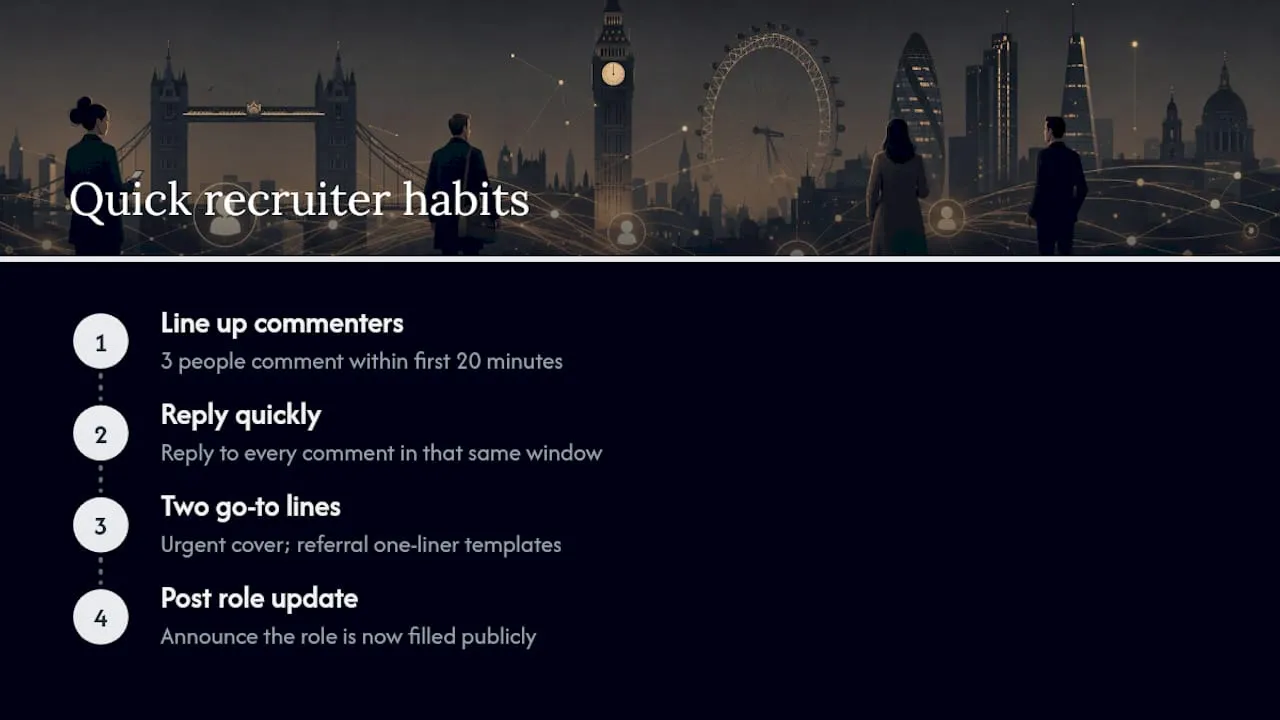
Two lines I reach for constantly. For urgent cover: “Need someone in [role] by [date] — apply today, quick turnaround on interviews.” For referrals: “If you know a good [role], now’s the time, we’re actively interviewing this week.” Both work because they carry urgency without sounding desperate.
One habit worth borrowing: post a short “role filled” update once the vacancy closes. “Update: our [Job Title] role in [Location] is now filled, thanks to everyone who shared and applied.” It closes the loop publicly, and it quietly reminds your network you’re a business worth watching next time you’re hiring.
— Rob
How Security Jobs Board helps you post faster and reach the right candidates
Writing the perfect post is only half the job. It needs to land somewhere candidates actually search, and for security roles specifically, that’s a narrower pool than the general jobs market. Security Jobs Board is built around that gap: a UK-focused platform where every listing reaches jobseekers already looking for security work, not a general audience scrolling past.

Listings are built mobile-first so candidates can apply from a phone without friction, and the platform carries a BSIA affiliation that adds a layer of trust employers in this sector value. You get human support if you’re stuck on wording, not just an automated form. If you’re hiring anywhere from Northern Ireland to the rest of the UK, the fastest next step is straightforward: head to Advertise Jobs and get your vacancy live in front of candidates who are already searching for it.
Sources
- UK jobseekers turning to mobile devices for their job search
- Recruitment legal requirements
- How to write a legally compliant job advert in the UK
- When to post a LinkedIn job announcement for best reach
FAQ
What is a good punch line for a job posting?
A strong opening line states the role, location and one genuine reason to apply in a single breath, such as “We’re hiring a Security Officer in Manchester, full training given, immediate start.” It works because it front-loads everything a scanning reader needs before the preview cuts off.
What do you say when recommending someone for a job?
Keep it short and specific: name the person, the one skill that makes them right for the role, and your relationship to them, for example “I’d recommend [name] for this, they managed a similar team at [previous role] and were reliable under pressure.” A specific reason carries far more weight than a general endorsement.
How do I announce a new job on social media?
Lead with the hiring signal, job title, location and salary or range in the first two lines, keep the post short, and put the application link either in the text or in the first comment depending on the platform. Include one clear call to action, such as “Apply here” or “DM us to find out more.”
Should I include salary in a job posting?
Yes. Posts with a visible salary or range tend to draw more engagement and fewer mismatched applicants, and it’s now considered standard practice for compliant, honest job adverts rather than an optional extra.
How many requirements should I list in a job post?
Stick to three to five genuine must-haves. Longer wishlists discourage good candidates, particularly from underrepresented groups, without meaningfully improving the quality of who applies.


