Turn £13.50/hr into £33,000: UK cyber security pay in physical security

Most UK security guards earn between £11.44 and £15 an hour, with annual pay typically landing around £27,000 to £34,000 depending on hours and role. The higher end of that annual range rarely comes from a better hourly rate. It comes from long shift rotas, night premiums, and overtime stacking up across the year. Role, location, and licensing explain the rest of the spread, which is what the next sections break down properly.
TL;DR:
- Rota effects, night premiums, and overtime significantly boost annual security guard earnings beyond base pay, often raising income by several thousand pounds.
- Pay varies more by role and certification than location, with specialist qualifications like IOSH or CCTV analytics unlocking higher wage bands.
- London’s higher hourly rates are offset by increased living costs, making regional roles potentially more financially beneficial depending on circumstances.
- Actual earnings are heavily influenced by additional responsibility and working unsocial hours, which carry the largest premiums within the sector.
- Verifying role specifics such as guaranteed hours, reimbursement policies, and pay structure is crucial before comparing security job adverts or negotiating salaries.
Table of Contents
- What does cyber security pay in the physical security sector?
- Security guard, door supervisor, CCTV operator: pay by role
- Does location change what security jobs pay?
- What actually moves your pay, and how you progress
- How to check an advert and negotiate better pay
- Why trust these figures
- Pay trends and outlook in the security sector
- How education and experience change security pay
- How security pay compares to related IT and security fields
- What the numbers actually tell you
- Find or fill a security role with clear pay from the start
- Sources
- FAQ
What does cyber security pay in the physical security sector?
Two figures dominate this market, and they don’t quite agree, which trips people up.
The ONS ASHE 2025 provisional data puts the full-time median for security guards and related occupations at £33,832 a year, with a 10th to 90th percentile spread of roughly £23,794 to £44,793. That’s a wideband. Meanwhile, SalaryExpert’s figures report average base salary estimates and typical ranges without quoting precise values here.
Neither number is wrong. ASHE captures the full spread of the occupation, including supervisors, long-hours contracts, and London weighting. SalaryExpert’s figure reflects a more typical base rate before rota effects kick in. The gap between them is basically the story of this whole industry: hourly pay is modest, but hours worked and shift patterns do the heavy lifting on annual income.
Here’s a worked example. A guard on £13.50 an hour working a standard 40-hour week earns roughly £28,080 a year before any premiums. Push that to a common 48-hour rota, factor in a night shift uplift, and the same base rate can produce £33,000 to £35,000. That’s the difference a rota makes, not the difference a pay rise makes.
Key figures to benchmark against:
- Typical base hourly range: £11.44 (National Living Wage) to £15
- ASHE full-time median salary reported in official statistics
- SalaryExpert average salary around the mid to high £20,000s per year
- 10th to 90th percentile spread: £23,794 to £44,793
The National Living Wage floor matters here. Most entry-level security contracts sit close to the statutory minimum, which is why the Gov flags this as a long-running recruitment and retention problem for the sector.
Security guard, door supervisor, CCTV operator: pay by role
Pay varies more by role than most job adverts let on. Here’s how the bands typically break down.
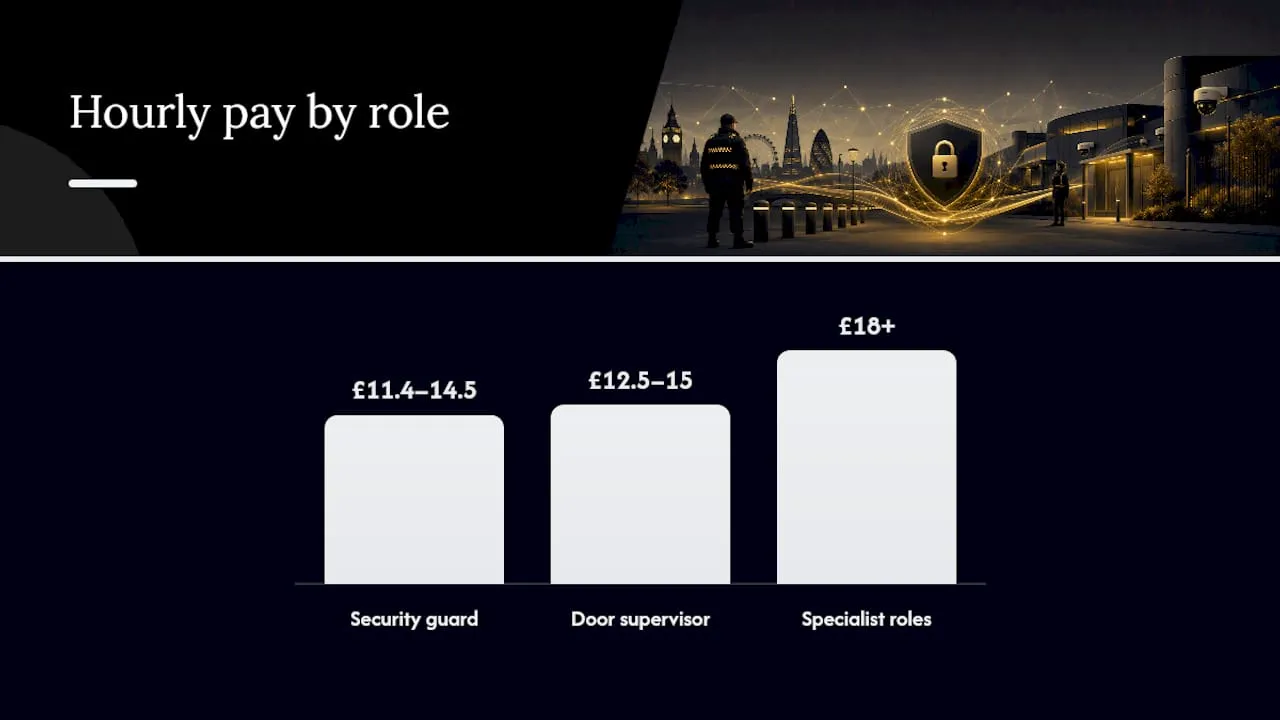
- Security guard (static/retail): £11.44 to £13.50/hr entry level, rising to £14.50/hr with experience. Annual pay usually sits between £24,000 and £29,000 depending on hours.
- Door supervisor: Slightly ahead of general guarding, often £12.50 to £15/hr, reflecting the extra risk and the mandatory SIA Door Supervisor licence. Weekend and night work push annual totals toward £30,000.
- CCTV operator: Hourly pay varies by role and location, with some higher-end roles offering above-average rates.
- Mobile patrol officer: Pay tends to be higher due to added requirements such as driving licences and allowances.
- Key holder/alarm response: Often paid a lower base rate plus a callout fee per incident, so headline hourly pay understates real earnings for anyone doing regular out-of-hours callouts.
- Supervisor/site manager: Pay is higher than front-line roles, reflecting added responsibility and shift patterns, with annual salaries in a noticeably higher band.
Specialist certification is the single biggest lever within any of these bands. Industry pay guides put close protection and specialist CCTV analytics roles at £18+/hr, well above general guarding, purely on the basis of extra qualifications.
Pro Tip: If you’re aiming for the top of a band, don’t just ask for more money. Bring a specific certificate to the conversation. IOSH Managing Safely, an NVQ Level 3, or a CCTV analytics course gives an employer a concrete reason to move you up a pay point rather than a vague reason to say no.
Does location change what security jobs pay?
London consistently pays more, but the premium is smaller in real terms than the headline number suggests.
Typical London contract rates are higher than the national average by several pounds per hour, with central London roles paying noticeably more. Scotland and Wales tend to track close to the national average, with Northern Ireland often slightly behind due to a different local labour market. Regional cities with major logistics, retail, or event venues (Manchester, Birmingham, Leeds) sit somewhere in between, usually a pound or so above rural and small-town rates.
The catch is cost of living and the growing need for cybersecurity for importers to protect trade data in logistics roles. A London premium of £3/hr rarely covers London-level commuting and housing costs, so a “better paid” London role can leave a worker with less disposable income than a mid-tier regional job. Before treating a headline figure as a like-for-like comparison, check:
- Whether the advertised rate is contractual or an on-target-earnings (OTE) figure that assumes maximum overtime
- Whether travel time and cost are factored into the effective hourly return
- Whether the role includes guaranteed minimum hours or is genuinely zero-hours
Adverts that quote OTE rather than base pay are one of the most common sources of disappointment in this sector, and it’s worth asking directly before applying.
What actually moves your pay, and how you progress
Four things move the needle on security pay more than anything else: licensing, certification, unsocial hours, and responsibility.
- SIA licence type. A basic Door Supervisor or Security Guarding licence gets you into the market. Combining licences (guarding plus door supervision, for example) opens more shifts and slightly better rates.
- Extra certification. Qualifications like IOSH, NEBOSH, or CSCS (for construction site guarding) commonly unlock supervisory and site-manager pay bands that a standard SIA licence alone won’t reach.
- Unsocial-hours exposure. Night shifts, weekend cover, and bank-holiday work routinely carry premiums of 10 to 25% over daytime rates, and these compound fast across a full rota.
- Supervisory responsibility. Moving from guard to shift supervisor to site manager typically adds £2 to £6/hr at each step, alongside a jump in annual salary of several thousand pounds.
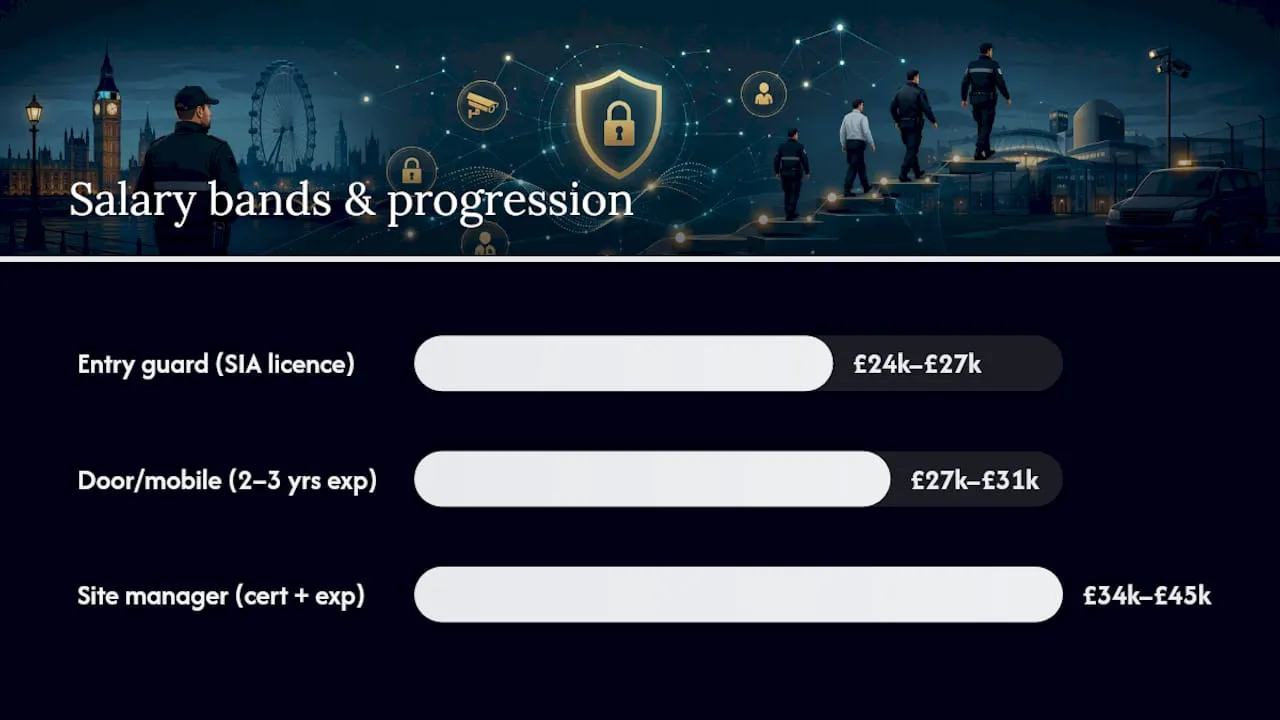
A realistic ladder looks like: entry guard (£24,000 to £27,000) → door supervisor or mobile patrol (£27,000 to £31,000) → shift supervisor (£31,000 to £36,000) → site/contract manager (£36,000 to £45,000+). Certification and rota flexibility, more than tenure alone, decide how fast someone climbs it.
Pro Tip: When negotiating, bring evidence, not just a request. A completed IOSH course, a clean shift-attendance record, or a willingness to cover nights and bank holidays gives a manager something concrete to justify a pay rise against, especially in a sector where the GOV.UK sector profile already flags recruitment as a persistent problem for employers.
How to check an advert and negotiate better pay
Before applying to anything, run the advert through a short checklist:
- Is the pay figure hourly, weekly, or annual, and is it contractual or OTE?
- Are guaranteed minimum hours stated, or is this genuinely zero-hours?
- Is bank-holiday and night-shift pay itemised, or bundled vaguely into “competitive rate”?
- Does the employer reimburse SIA licence renewal and uniform costs?
Roughly 8 to 10% of a guard’s effective hourly return can disappear if licence and uniform costs come out of pocket rather than being reimbursed, so this one question is worth asking outright.
When negotiating, keep it simple: state your certifications, your shift flexibility, and your attendance record, then ask for a specific number rather than “more”. Employers respond better to a concrete ask backed by evidence than an open-ended request.
Security Jobs Board makes the search side straightforward. You can filter listings by role and region, set alerts for new postings that match your licence type, and upload a CV once rather than repeating the process on every application. Employers, meanwhile, can post roles directly and specify pay bands upfront, which cuts down on the OTE confusion candidates run into elsewhere.
Why trust these figures
These figures are pulled from a mix of public and private data, not a single guess. Security Jobs Board cross-references the ONS ASHE dataset, SalaryExpert’s survey data, and current UK job listings rather than relying on one source alone.
The platform is affiliated with the BSIA, built to GDPR standards, and works properly on mobile, which matters given how many security professionals apply for shifts between jobs rather than from a desk. For a deeper breakdown of current bands, the site’s own salary ranges guide covers more roles in detail.
Pay trends and outlook in the security sector
Pay growth in physical security has tracked close to the National Living Wage for years rather than pulling ahead of it, and that’s the central tension the sector faces. The GOV.UK sector profile notes this explicitly: pay has historically moved with statutory minimum increases rather than independent market pressure, which contributes directly to recruitment and retention problems employers still struggle with.
That’s starting to shift, but unevenly. Specialist roles, CCTV analytics, close protection, and site management, are pulling away from the general guarding rate faster than general guarding itself is rising. Employers competing for guards with clean records and flexible availability are increasingly offering rota guarantees and reimbursed licensing costs rather than simply raising the headline hourly figure, because that’s often the cheaper lever to pull.
The practical outlook for 2026 and beyond: base hourly rates will likely keep tracking near the statutory floor for entry-level guarding, while the gap between entry pay and supervisory or specialist pay widens. Anyone wanting genuine wage growth in this sector is better served chasing certification and responsibility than waiting for base rates to rise on their own.
How education and experience change security pay
Formal education matters less here than in most professions, but it’s not irrelevant. A university degree carries almost no premium for standard guarding work. What matters instead is licensing and experience, and the two compound each other.
An entry-level guard with a basic SIA licence and no experience sits at the bottom of the band, typically £24,000 to £27,000 a year. Add two to three years of clean-record experience and the same person can move into door supervision or mobile patrol work at £27,000 to £31,000, often without any additional formal qualification beyond the relevant licence.
The bigger jump comes from targeted vocational training rather than academic study. An NVQ Level 3 in security or an IOSH Managing Safely course does more for pay progression than a general degree, because it maps directly onto supervisory competency that employers can point to when justifying a promotion. Experience without certification tends to plateau around the mid-band; certification without experience rarely gets someone past entry level either. It’s the combination, several years on the job plus a relevant qualification, that pushes someone into the £34,000 to £45,000 site-manager range.
How security pay compares to related IT and security fields
Physical security guarding sits at a different point on the pay scale to information security and IT-adjacent roles, and it’s worth being clear about why rather than treating them as comparable careers.
Roles like IT security analysts or network security specialists typically require a technical qualification or degree-level training and sit in a fundamentally different labour market, one shaped by software skills shortages rather than statutory minimum wage pressure. That’s a different profession with a different training path, and comparing the two directly, as some generic salary guides do, understates how much specialist certification (rather than a computing background) drives pay within physical security itself.
Within the physical security world, the closer comparison is facilities management or health and safety roles, where NEBOSH or IOSH qualifications carry real weight. A security site manager with IOSH Managing Safely and several years of experience can reasonably expect pay comparable to a junior facilities manager, both in the £34,000 to £42,000 range. That’s the honest benchmark for anyone wondering whether to specialise inside guarding or retrain into an adjacent field entirely.
What the numbers actually tell you
The conventional advice in this sector is “get your SIA licence and apply widely.” That’s necessary but nowhere near sufficient. The data points to something more specific: pay in physical security barely moves without one of three things happening, added certification, added responsibility, or added unsocial hours. Waiting for a general pay rise, or assuming tenure alone will lift your rate, doesn’t match how this market actually behaves.
What’s overrated is chasing the headline London rate without checking the small print. A £16/hr London advert can pay worse in real terms than a £13.50/hr regional role with guaranteed hours and reimbursed licensing. What’s underrated is the negotiating power a single extra qualification gives you. IOSH, an NVQ Level 3, or a CCTV analytics certificate routinely moves someone into a different pay band entirely, faster than years of unqualified experience will.
If you take one thing from this, prioritise verifying the actual rota and reimbursement terms before comparing hourly figures across adverts. The number on the page rarely tells the whole story, and Security Jobs Board publishes these ranges precisely so employers and candidates can have that conversation with real figures instead of guesswork.
— Rob
Find or fill a security role with clear pay from the start
Security Jobs Board is the direct route to security vacancies with pay terms stated upfront, not buried behind OTE language or vague “competitive rate” wording. Search current listings, set alerts for roles matching your SIA licence type, and upload your CV once rather than re-entering it for every application.

If you’re job hunting in Northern Ireland specifically, the regional listings are worth checking directly through Northern Ireland security jobs, where local pay bands and rota patterns differ slightly from the rest of the UK. Employers looking to fill shifts with candidates who already understand realistic pay expectations can post a vacancy and set clear hourly and annual terms from the outset, which cuts down on mismatched applications and wasted interview time. Start by browsing what’s live right now at Security Jobs Board.
Sources
FAQ
What is the average hourly pay for a UK security guard?
Most security guards earn between £11.44 and £15 an hour, with SalaryExpert data putting the average base rate around £13.18/hr.
What is the average annual salary in security guarding?
Figures vary by source: ONS ASHE data shows a full-time median of £33,832, while private survey data shows a lower average of £27,410 before rota-driven uplifts.
Does an SIA licence increase pay?
An SIA licence is mandatory to work legally, but it doesn’t itself raise pay much beyond entry level. Additional certification, such as IOSH or a Door Supervisor licence, moves you into higher bands.
Is security pay higher in London?
Yes, typically £2 to £4/hr higher than the national average, but check whether the higher figure is contractual or OTE, and weigh it against London’s higher living costs.
How can I find better-paid security roles?
Search live listings and set alerts on Security Jobs Board, check whether advertised rates are contractual, and target roles that reimburse SIA licence and uniform costs.


