Looking for Cyber Security Jobs? 8 UK Physical Security Roles & Pay

When people search for a “list of cyber security jobs,” they usually land on articles about penetration testers and SOC analysts. This one is different: it covers the physical and private security roles that keep UK sites, events, and premises safe day to day. Expect a breakdown of core roles such as security officer, door supervisor, CCTV operator, mobile patrol, keyholder, event steward, close protection operative, and security manager, plus straight answers on SIA licensing, training, and pay.
TL;DR:
- Most security roles involving physical guarding or surveillance require an SIA license, regardless of the job title, especially if duties include searching or access control.
- Licenses are activity-based, meaning managers who oversee licensable duties without performing them do not need front-line licenses, but those doing physical tasks do.
- Entry-level pay starts around £24,000 and can rise to about £32,000 with experience, with specialist roles like close protection often paying more due to additional training and risk.
- Fast recruitment is driven by license expiry and shift gaps; sector-specific platforms and networking significantly improve the chances of quick placement.
- Most qualifications are short, practical courses with extra certificates in first aid and conflict management, making careers accessible without formal degrees.
Table of Contents
- What jobs are there in the UK security industry?
- Which security jobs need an SIA licence?
- Training and qualifications behind these roles
- What does security pay, and where can it lead?
- How employers and jobseekers actually fill these roles
- A note on the other “cyber security jobs”
- Qualifications that matter for physical security careers
- Career paths and realistic pay across the sector
- Skills and tools that actually matter on the job
- Where demand is heading in the UK security sector
- Practical job-hunting advice for the security sector
- Why a specialist board beats a generic jobs site here
- Start browsing security roles on Security Jobs Board
- Sources
- FAQ
What jobs are there in the UK security industry?
The UK security workforce splits into frontline operational roles and specialist or supervisory positions, and knowing which is which matters when you’re applying or hiring.
- Security guard / security officer patrols or stations at a fixed point, checks access, monitors alarms, and writes incident reports. You’ll find them in retail parks, warehouses, offices, and construction sites, often working 12-hour shifts on a rotating pattern.
- Door supervisor controls entry to licensed premises such as pubs, clubs, and festivals, and manages conflict when it flares up. This is one of the most licence sensitive roles in the sector because the duties themselves trigger the legal requirement.
- Public space surveillance (CCTV) operator watches live camera feeds, flags suspicious behaviour to control rooms or police, and handles footage as evidence when incidents happen. Evidence handling matters here: poorly logged footage can undermine a prosecution.
- Keyholder carries responsibility for opening, closing, and responding to out-of-hours alarm activations at a site. Employers use keyholders because insurers often require a rapid, accountable response to alarms rather than relying on police attendance alone.
- Mobile patrol officer drives a set route between multiple sites, checking perimeters, responding to alarms, and covering gaps between static guarding contracts. Shift patterns tend to be nights and weekends, when static cover is thinnest.
- Event steward / event security operative manages crowd flow, bag checks, and welfare at concerts, sports fixtures, and festivals. Not every stewarding task is licensable; it depends on whether the duties cross into searching or refusing entry.
- Close protection operative provides personal security for individuals facing elevated risk, and the training bar sits well above standard guarding. Fewer people qualify for this route, and demand tends to concentrate around corporate, celebrity, and diplomatic clients.
- Security supervisor / team leader and security manager oversee rotas, quality control, client liaison, and site compliance. A manager who never performs licensable activity personally doesn’t always need a front line SIA licence, though many employers expect a non-front line one for credibility.
Each of these titles covers a distinct set of duties, and the differences matter more than the label once licensing comes into play.
Which security jobs need an SIA licence?
The rule that trips up most new employers is this: licensing follows the activity, not the job title. If the tasks involve manned guarding, door supervision, public space surveillance (CCTV), key holding, vehicle immobilisation in Northern Ireland, close protection, or cash and valuables in transit, an SIA licence is required regardless of what the advert calls the role.
There’s also a split between front line and non-front line licences. Front line licences cover people physically performing licensable duties: the guard on the gate, the door supervisor checking IDs, the CCTV operator monitoring feeds. Non-front line licences apply to certain managers and directors of security businesses who don’t perform the duties themselves but oversee people who do.
- Check the actual tasks in the job description, not just the title.
- Confirm whether the role touches searching, guarding property, or monitoring surveillance equipment.
- Ask whether the premises or event falls under licensable activity definitions used by the SIA’s buyer guidance for events.
- When in doubt, cross-reference against the licence categories on Gov: door supervision, public space surveillance, security guarding, close protection, key holding, and cash and valuables in transit.
Pro Tip: Event organisers often assume stewards never need licences, but a steward who searches bags or ejects a guest has crossed into licensable territory. Check the duties, not the badge.
Training and qualifications behind these roles
Most frontline licences sit on top of a Common Security Industry Knowledge (CSIK) module, and course length varies by specialism. Door supervision training runs longer than a standard security guarding course because it adds searching procedures, drugs awareness, and conflict management on top of the core knowledge.
- CSIK plus door supervision content, typically covering conflict management and physical intervention basics.
- CCTV-specific modules covering surveillance law, evidence handling, and data protection.
- Security guarding CSIK, generally shorter than the door supervision route.
- Close protection training, which sits well above standard licensing hours and includes risk assessment and surveillance awareness.
Employers also look for support skills that don’t always carry a licence requirement: emergency first aid, customer service under pressure, and clear incident report writing. Some SIA Approved Contractor Scheme members manage licence applications on behalf of new starters, which can shorten the time between hiring and deployment.
What does security pay, and where can it lead?
Starting pay for frontline security officers in the UK sits around £24,000, rising toward £32,000 for experienced or specialised operatives, according to BSIA research. Close protection and specialist surveillance work tends to sit at the upper end of that range or beyond, reflecting the extra training and risk involved.
Progression rarely stops at the frontline. A typical route runs from security officer or door supervisor into supervisor, then operations manager, with some professionals branching into close protection, specialist surveillance, or consultancy roles later on. The BSIA notes that many senior figures in the sector started as operatives, so the entry point doesn’t cap the ceiling.
Demand is also shifting upward. The Protect Duty legislation, growing event security requirements, transport hub protection, and ongoing pressure on police resources are all pushing employers to recruit more frontline and supervisory staff than in recent years.
How employers and jobseekers actually fill these roles
Recruitment in this sector moves fast, largely because shift gaps and licence expiries create urgent hiring windows. Here’s a practical route through it:
- Jobseekers: list your current SIA licence type and expiry date clearly on your CV, along with training certificates, availability (nights, weekends, event work), right-to-work status, and references from previous security employers.
- Employers: state the licensable activity in the advert, the shift or contract type, whether training is provided or required in advance, and any vetting or DBS checks involved.
- Both sides: use a specialist channel rather than a general jobs site. A sector-specific board like Security Jobs Board lets jobseekers upload a CV once, set alerts for relevant licence types and locations, and apply quickly, while employers search a CV database filtered by licence and location instead of sifting general applications.
- Employers using SIA Approved Contractor status: consider whether your organisation can manage licence applications for new starters, since this can cut the delay between offer and start date.
- Networking: industry associations and local SIA training providers often hear about vacancies before they’re advertised, so staying connected pays off for both recruiters and candidates.
A note on the other “cyber security jobs”
Search engines often assume “cyber security jobs” means IT roles: security analyst, penetration tester, incident responder, security architect, cryptographer. Those are real careers, but they sit in a completely different profession from the one this article covers, with different training routes, regulators, and employers. If you landed here expecting IT security roles, the guidance you need concerns computing qualifications and employers hiring for digital risk teams, not the SIA licensing and frontline recruitment covered above.
This article focuses squarely on the UK’s physical and private security workforce: the guards, supervisors, CCTV operators, and close protection professionals who work sites, events, and premises rather than networks and servers. That’s the profession the SIA regulates, the BSIA represents, and Security Jobs Board serves.
Qualifications that matter for physical security careers
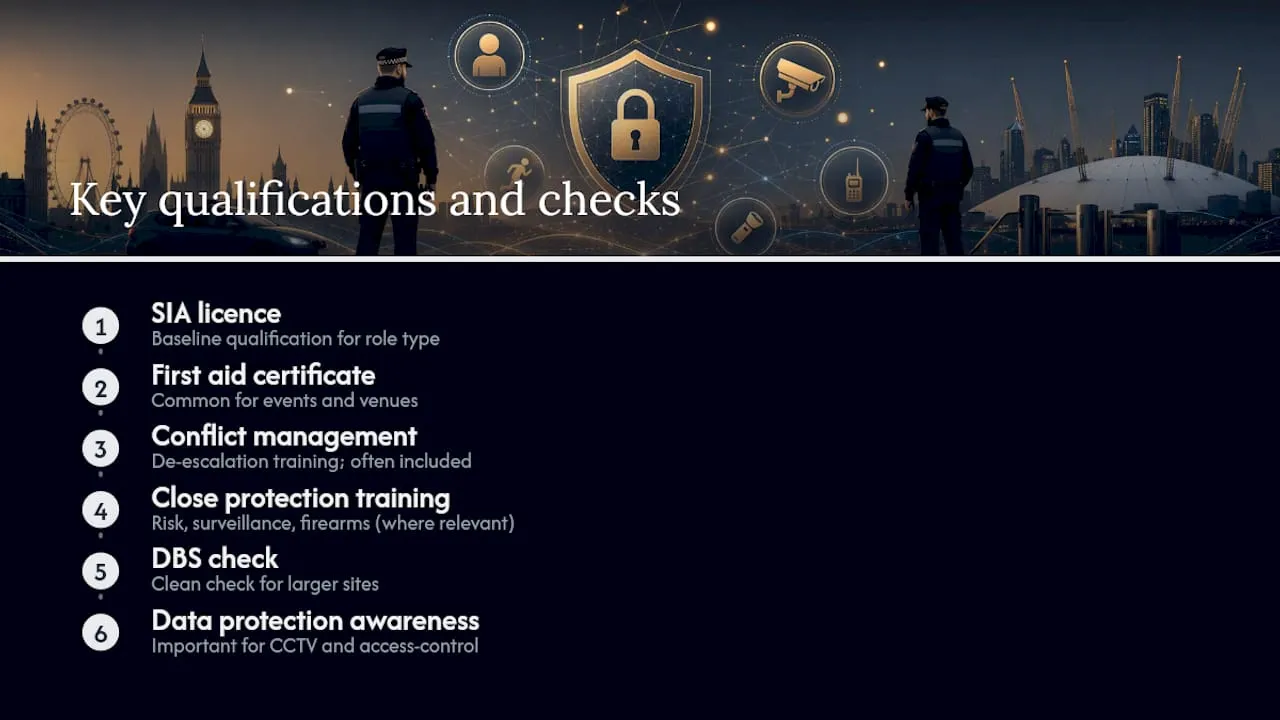
Unlike IT security, where certifications like CISSP or CompTIA Security+ dominate hiring decisions, physical security careers hinge on SIA licensing plus a handful of supporting certificates. The baseline is the CSIK qualification tied to your specific licence type, whether that’s door supervision, CCTV, or security guarding.
Beyond the licence itself, employers commonly ask for a valid first aid certificate, especially for event and venue roles where medical incidents happen regularly. Conflict management training, often bundled into door supervision courses but sometimes taken separately, signals to employers that you can de-escalate before a situation turns physical. For close protection work, additional certificates in risk assessment, surveillance awareness, and sometimes firearms familiarity (where legally relevant) separate general applicants from genuine specialists.
Employers running larger sites or multi-site contracts also value a clean DBS check and, increasingly, evidence of data protection awareness given how much CCTV and access-control work touches personal data under GDPR. None of this requires a degree. Most people qualify through short, practical courses rather than years of academic study, which keeps the entry route accessible compared with many other regulated professions.
Career paths and realistic pay across the sector
The route into physical security rarely looks linear on paper, but it follows a consistent shape in practice. Most people start as a security officer or door supervisor, build up shift experience, and then either move sideways into a specialism like CCTV or close protection, or upward into supervision and management.
Pay reflects that structure. Entry-level frontline pay starts around £24,000, and experienced or specialised operatives can reach roughly £32,000, based on BSIA sector reporting. Supervisory and management roles typically sit above that range, particularly for multi-site operations managers handling several contracts. Specialist tracks, close protection especially, can outpace standard management pay once you factor in the additional risk and training investment.
What differs from many other industries is how quickly someone can move from entry-level to supervisory work: two to three years of solid frontline performance often opens the door to a team leader role, faster than equivalent progression timelines in many other regulated sectors.
Skills and tools that actually matter on the job
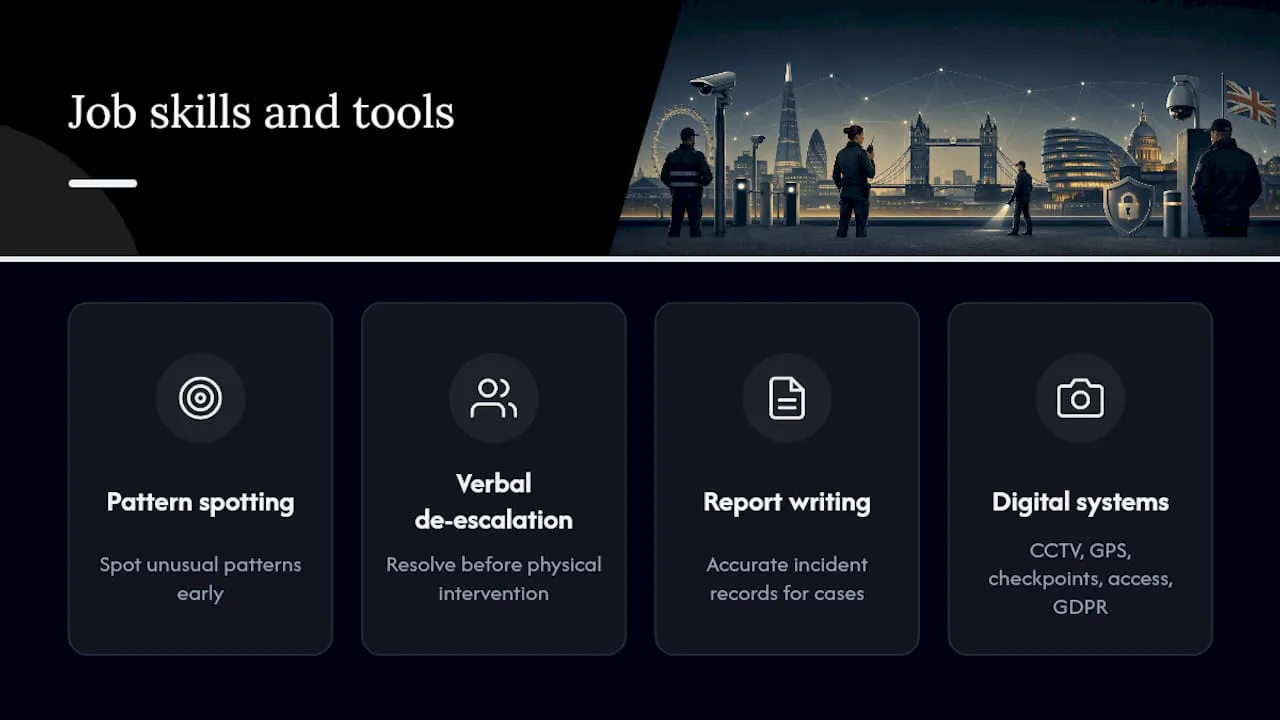
Physical security work rewards a specific mix of practical skills rather than technical certifications. Situational awareness sits at the top: spotting an unusual pattern before it escalates is the core skill that separates a reliable operative from an average one.
Communication matters just as much, particularly for door supervisors and event stewards who need to de-escalate verbally before physical intervention becomes necessary. Report writing is underrated but essential, since a poorly documented incident can undermine a disciplinary case or police referral months later.
On the technology side, CCTV operators need comfort with digital recording systems, footage export tools, and basic data protection principles under GDPR. Mobile patrol officers increasingly use GPS tracking and digital checkpoint apps that log patrol routes in real time, which has replaced paper logbooks at most established contractors. Keyholders and supervisors often manage access control systems and alarm monitoring platforms, so basic digital literacy has become a genuine hiring filter even in roles that were once purely physical.
Where demand is heading in the UK security sector
Hiring demand across UK physical security has been climbing, driven by several overlapping pressures rather than one single factor. Protect Duty legislation is pushing venues and event organisers to formalise security provision in ways many previously handled informally. Transport hubs and retail environments are expanding their guarding contracts amid ongoing concerns about theft and public safety.
Police resource constraints are also reshaping demand: when response times stretch, businesses and venues lean more heavily on private security to fill the gap, particularly for out-of-hours keyholding and rapid alarm response. Event security has grown alongside the return of large-scale festivals, sporting fixtures, and concerts, all of which need stewards and supervisors on short notice.
This combination means vacancies often move quickly, and employers who can onboard licensed, trained staff fast have a real advantage over those relying on slower, generalist recruitment channels.
Practical job-hunting advice for the security sector
Finding the right role, or the right candidate, works best through channels built specifically for this industry rather than general job sites where security postings get buried. Specialist platforms filter by licence type and location from the outset, which saves time on both sides.
Networking still counts for more than most jobseekers expect. Local SIA-approved training providers often hear about openings before they’re formally advertised, and staying in touch with instructors or fellow trainees after a course can surface leads weeks ahead of a public listing. Industry events, trade association meetups, and even shift-swap conversations with colleagues at other sites frequently turn into referrals.
For jobseekers, keeping your CV current with your licence expiry date visible at the top avoids a common rejection reason: employers often can’t risk placing someone whose licence lapses mid-contract. For employers, posting clearly what licensable activity the role involves, rather than a vague title, attracts applicants who are actually qualified rather than a flood of unsuitable enquiries.
Why a specialist board beats a generic jobs site here
Security recruitment has quirks that generic platforms don’t handle well: licence types, shift patterns, and vetting requirements that a standard jobs site simply doesn’t filter for. That’s the gap a specialized platform can close, with a design that emphasizes GDPR compliance and mobile responsiveness so operatives can search and apply from a phone between shifts.
The BSIA affiliation matters here too. It signals that the platform sits inside the sector’s own professional network rather than treating security as just another category on a generic board, and it gives employers a layer of credibility when they’re trying to attract licensed, serious applicants. Whether you’re hiring for a single door supervisor shift or building a multi-site patrol team, a platform designed around this industry’s actual mechanics, licences, shift types, and vetting tends to save time that a generalist board simply can’t.
— Rob
Start browsing security roles on Security Jobs Board
If you’re job hunting or hiring in Northern Ireland, specialized platforms let jobseekers browse current vacancies filtered by licence type, upload a CV once, and set alerts so new roles land in their inbox automatically, while employers can post a role and start reviewing candidates from the CV database promptly.

Whether you’re a licensed door supervisor looking for your next contract or a business owner trying to fill a mobile patrol gap before the weekend, the Northern Ireland security jobs page is built to get you moving faster than a general jobs site ever could. Head over, set up a free profile, and see what’s currently listed.
Sources
- Events guidance for buyers of security (SIA events guidance)
- Gov
- People, property, places: Professionally protected — BSIA report
FAQ
Does every security job need an SIA licence?
No. Licensing depends on the actual duties performed, such as guarding, door supervision, CCTV monitoring, or key holding, not the job title on the advert.
What’s the difference between front line and non-front line licences?
Front line licences cover people performing licensable duties directly, while non-front line licences apply to certain managers or directors overseeing licensable work without performing it themselves.
How much do UK security jobs pay?
Starting pay for frontline officers sits around £24,000, rising to roughly £32,000 for experienced or specialised roles, according to BSIA figures.
Where’s the best place to find or post UK security vacancies?
A sector-specific platform like Security Jobs Board filters by licence type and location, which speeds up matching for both jobseekers and employers compared with general job sites.
Can I get into security without prior experience?
Yes. Most entry routes require CSIK training tied to your chosen licence type rather than prior experience, making frontline roles accessible to career changers.


