Job interview preparation checklist: 10 steps to be ready
Get ready for a job interview by working through ten steps in order: confirm the logistics, research the employer, map the job description to your experience, prepare STAR examples, practise your answers, sort your outfit and route, check your tech if it’s a video call, manage the day itself, and follow up afterwards. Do these in sequence and you walk in with fewer surprises and sharper answers.
Here’s the condensed version to work from right now:
- Confirm format, time, duration and interviewer names
- Research the company’s website, news and LinkedIn presence
- Match the job description against your CV, line by line
- Build 2 to 3 STAR examples for the toughest requirements
- Rehearse answers aloud, ideally with someone else listening
- Sort your outfit, route and documents the night before
- Test your camera, microphone and internet if it’s a video call
- Arrive or log in early, breathe, listen more than you talk
- Send a thank-you message within 48 hours
Spread this across your prep time: research and STAR work in the days before, practical checks the night before, and calm, focused execution on the day itself.
Key Takeaways
Thorough interview preparation combines confirmed logistics, employer research, rehearsed STAR examples, and calm, practised delivery on the day itself.
| Point | Details |
|---|---|
| Confirm logistics early | Check format, time, duration and panel names within 48 hours of booking. |
| Match job description to evidence | Highlight requirements in the advert and pair each with a specific example. |
| Build 2 to 3 STAR examples | Structure each around Situation, Task, Action, Result, spoken in 60 to 90 seconds. |
| Rehearse with feedback | Mock interviews with a peer or recording reveal timing and clarity issues fast. |
| Apply what you’ve prepared | Securityjobsboard lets security jobseekers create a free profile, upload a CV and set alerts for relevant roles. |
Table of Contents
- Job interview preparation checklist: confirm the essentials first
- Research the employer and match the role to your experience
- Refresh your CV and prepare STAR examples.
- Practise your interview answers before the day
- What to prepare the night before your interview
- How to handle interview day: arrival, nerves and body language
- Following up after your interview
- Security-sector interview add-ons
- Prepare your own elevator pitch
- Virtual interview etiquette and troubleshooting beyond the basics
- How to reflect on your interview and improve for next time
- What recruiters actually remember
- Find your next security role after you’ve prepared
- Useful resources for interview preparation
- Sources
- FAQ
Job interview preparation checklist: confirm the essentials first
Before anything else, get the practical facts pinned down. Contact the recruiter or hiring manager to confirm the interview format (in person, phone, or video), the exact start time, how long it will run, and who’s sitting on the panel. Ask whether there’s a written test, a presentation, or documents you need to bring, because checking these details early prevents that kind of last-minute scramble that throws you off before you’ve even started talking.
Work through this timeline:
- Immediately on booking: confirm format, time zone (if remote), and duration
- Within 48 hours: ask about panel members, dress code, and any tasks required
- The day before: double-check the video link or building access instructions
Research the employer and match the role to your experience
Spend an hour on the company website, its recent press coverage, and its LinkedIn page, plus the LinkedIn profiles of your interviewers if you know who they are. Look at the team page too. It tells you who you’d be working alongside and often hints at the department’s current priorities.
Next, go through the job advert line by line. Highlight every keyword, every required behaviour, and every measurable outcome, then build a simple mapping:
- Job requirement: “Manage a team of security officers across multiple sites”
- Your proof: the time you scheduled cover for 12 officers across three locations with zero gaps
Repeat that for each major requirement. This is the single most effective thing you can do to sound relevant rather than generic, and it feeds directly into your STAR examples in the next step.
Pro Tip: Check the company’s most recent news, a new contract win, a funding round, an operational change, and mention it naturally when asked why you want the role. It signals genuine interest rather than a copy-paste application.
Refresh your CV and prepare STAR examples.
Update your CV so its language mirrors the job advert. If the role asks for “conflict de-escalation” and your CV says “handled difficult situations,” change it. Recruiters and interviewers scan for matching terms, and vague phrasing costs you points before you’ve said a word.
Then build 2 to 3 STAR examples (Situation, Task, Action, Result) tied to the role’s most critical requirements. Each one should run roughly 60 to 90 seconds when spoken aloud:
- Situation: one or two sentences of context
- Task: what you were specifically responsible for
- Action: the steps you personally took
- Result: the measurable outcome, with a number if you have one
Competency-based interviews are structured and timed, and interviewers expect you to describe your individual contribution using “I” rather than “we”, because panels are assessing your specific role in the outcome, not your team’s.
Pro Tip: Prepare more than one example per competency. If your first story gets a probing follow-up question, you don’t want to be caught with nothing else to offer.
Practise your interview answers before the day
Run through common categories: competency questions (“Tell me about a time you…”), strengths and weaknesses, technical or role-specific scenarios, and situational “what would you do if…” prompts. Practising answers using the STAR method before the interview is what separates a fluent answer from a rambling one.
Set up a mock interview with a friend, mentor, or careers adviser, or record yourself on your phone. Rehearsal with feedback from another person reveals filler words, weak timing, and unclear structure far faster than practising alone in your head.
- Record a 60 to 90 second personal introduction
- Record one full STAR answer and time it
- Ask your practice partner what was unclear or too long
Pro Tip: Watch the recording back with the sound off first. You’ll notice fidgeting, poor eye contact, or slouching before you even hear what you said.
What to prepare the night before your interview
Lay out your outfit the night before, and have a backup ready in case of a coffee spill or a missing button. Plan your route with a buffer for delays, and save the recruiter’s phone number in your contacts in case you need to flag you’re running late.
Pack or prepare digitally:
- Two printed copies of your CV
- A copy of the job advert and your application
- Photo ID and any licence documents relevant to the role
- References, if requested in advance
If it’s a video interview, check your format and technology setup in advance: charge your device fully, test your camera angle and lighting, check your microphone, run a speed test on your internet, and pick a quiet room with a plain background.
How to handle interview day: arrival, nerves and body language
Aim to be ready 10 to 15 minutes before an in-person interview, or log into a video call 5 to 10 minutes early to catch any technical hiccups before they matter. Interviewers remember candidates who engage with the question, not ones who deliver a rehearsed monologue.
Taking a breath before you answer buys you a second to structure your response, and upright posture genuinely improves how confident you sound. Keep your STAR answers to around 60 to 90 seconds unless the interviewer explicitly asks for more.
- Pause for two seconds before answering a hard question
- Keep your hands visible and relaxed, not clenched
- Use a mental cue (“slow down, breathe”) if nerves spike
Pro Tip: If you blank on a question, say “That’s a good question, let me think for a moment” out loud. It buys time and sounds composed rather than panicked.
Following up after your interview
Send a short thank-you message within 24 to 48 hours. Reiterate your interest in the role and reference one specific point from the conversation, a project mentioned, a challenge discussed, so it doesn’t read as a generic template.
Then sit down and record what happened while it’s fresh:
- Which questions caught you off guard, and what you’d say differently
- Which STAR example landed well
- Anything you forgot to mention that you’d want to work into a follow-up email
If you haven’t heard back within the timeframe they gave you, a brief follow-up message asking politely for an update is entirely reasonable. Keep it short and professional, not anxious.
Security-sector interview add-ons
If you’re interviewing for a security role, general checklists miss a few sector-specific essentials. Confirm your SIA licence type and expiry date, and have proof ready, either physical card or digital record, in case the interviewer asks to see it on the day.
Security-specific preparation should also cover scenario-based questions on conflict management, emergency evacuation procedures, and professional integrity, since recruiters typically expect two or three concrete incident examples prepared end-to-end, not vague generalisations.
- Review the site or location mentioned in the advert and its known procedures
- Prepare questions about shift patterns, lone working policy, and CCTV protocols
- Check whether the role requires a specific SIA licence category before you attend
Prepare your own elevator pitch
Every interview opens with some version of “tell me about yourself,” and a rambling answer here sets a poor tone for everything that follows. Build a 60 to 90 second personal introduction that covers three things: where you are now professionally, the experience most relevant to this specific role, and why you’re applying for it.
Avoid reciting your entire CV chronologically. Instead, structure it around the job you’re going for. If you’re applying for a door supervisor role, lead with your SIA licence, your years of front-line experience, and a specific example of handling a difficult situation calmly, not your unrelated retail job from five years ago.
Write it out first, then cut it down. A common mistake is trying to cram in everything, which makes the pitch sound rushed and unfocused. Aim for three or four sentences you can deliver naturally, without sounding like you’re reading from a script. Practise it out loud until it feels conversational rather than memorised.
Tailor the ending line to the specific employer. Instead of a generic “I’m excited about this opportunity,” reference something concrete, their recent expansion, a particular contract, their reputation in a specific sector, so the interviewer knows you’ve done more than send the same pitch to twenty different companies.
Test your pitch on a friend or family member who doesn’t know your work history. If they come away confused about what you actually do or why you want the job, refine it further. A strong elevator pitch also doubles as your answer to “why should we hire you,” so it earns its place in your preparation twice over.
Virtual interview etiquette and troubleshooting beyond the basics
Testing your camera and microphone in advance solves most problems, but virtual interviews throw up issues that a basic tech check won’t catch. Have a backup plan: know the interviewer’s phone number or email so you can message them immediately if your connection drops, rather than leaving them staring at a frozen screen wondering what happened.
Close every other application and browser tab before you start. A notification popping up mid-answer, or your laptop fan roaring because fifteen tabs are open, is distracting and avoidable. Mute your phone completely, not just silent mode, because a buzzing table is picked up by microphones more than people expect.
Etiquette matters as much as technology. Look at the camera lens when speaking, not at your own face on the screen, because it creates the impression of eye contact for the interviewer. Keep your background tidy and plain if possible; a chaotic room behind you is a small but real distraction from what you’re saying.
If something does go wrong, a screen freeze, a dropped call, a delayed audio feed, stay calm and address it directly rather than pretending it didn’t happen. Say “I think we lost you for a second there, could you repeat the last part?” It reads as composed, not flustered. If the whole call drops, ring back immediately or send a quick message rather than waiting for them to chase you.
Finally, have a wired internet connection as a backup option if your Wi-Fi is unreliable. A £10 ethernet cable has saved more interviews than most candidates realise, and it removes one of the most common causes of virtual interview disasters entirely.
How to reflect on your interview and improve for next time
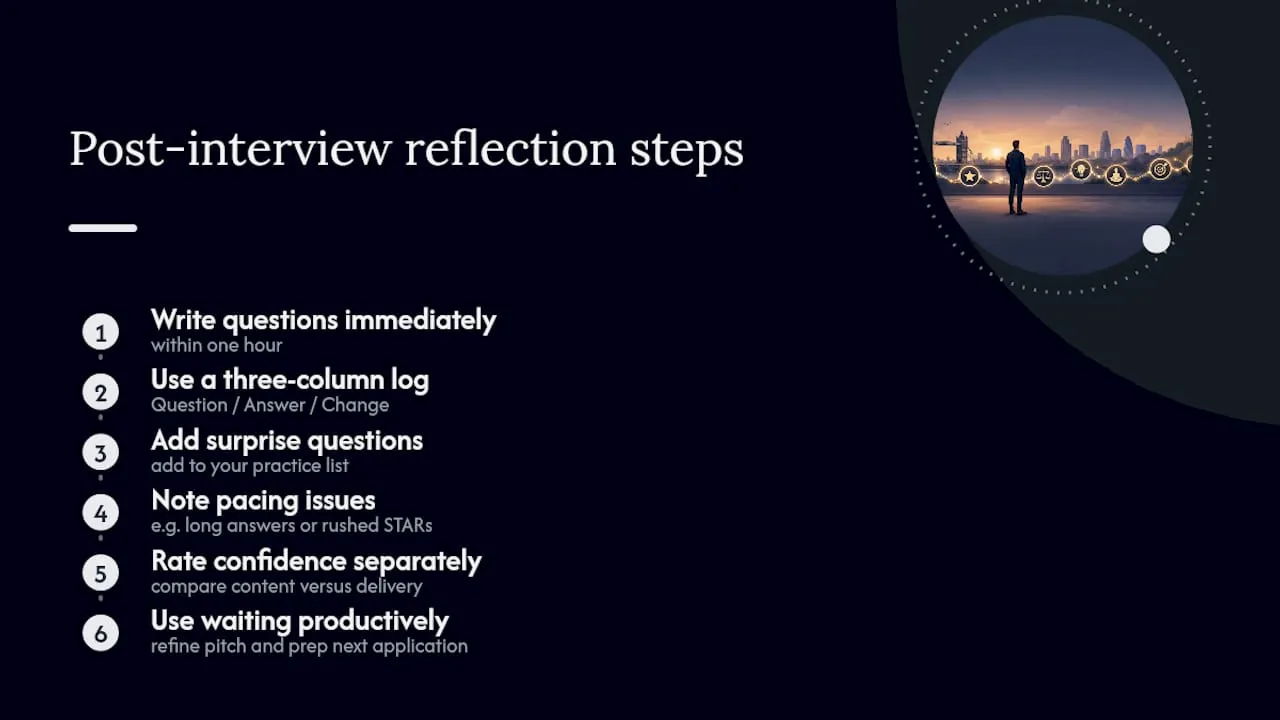
The interview isn’t over once you’ve said goodbye. The most useful thing you can do in the following hour is write down what was actually asked, while your memory is still sharp, rather than relying on a vague recollection three days later.
Use a simple three-column structure: the question asked, how you answered it, and what you’d change next time. This turns a single interview into a repeatable improvement process rather than a one-off event you either pass or don’t. If a question caught you completely off guard, that’s valuable information, add it to your practice list for next time, because it will likely come up again in a similar form at your next interview.
Be honest about pacing too. Did you talk for three minutes when 90 seconds would have done? Did you rush through a strong STAR example because you were nervous, missing the impact of a good result? These are fixable problems, but only if you notice them.
It’s also worth rating your own confidence separately from your content. You might have given a technically strong answer but delivered it in a way that undersold it, or the reverse: a thin answer delivered so confidently it landed better than it deserved to. Recognising the gap between what you said and how you said it helps you calibrate both for future interviews.
If you don’t hear back, don’t treat silence as proof you did badly. Recruitment timelines are often slower than candidates expect, and a lack of response frequently reflects internal delays rather than your performance. Use the waiting period productively: refine your elevator pitch, tighten a STAR example, and move on to the next application rather than replaying the interview on a loop.
What recruiters actually remember
Candidates who stand out aren’t the ones with the most polished script, they’re the ones who clearly did their homework and can explain their experience without hesitation. A candidate who mentions something specific about the site, the shift pattern, or a recent development at the company immediately reads as more engaged than one giving generic answers that could apply to any employer.
One habit worth adopting: always ask a genuine question at the end, something about team structure, day-to-day priorities, or how success is measured in the role, rather than “How did I do?” It shows you’re evaluating the fit as much as they are.
Find your next security role after you’ve prepared
Once you’ve worked through this checklist, the next move is putting it into practice. Securityjobsboard exists for exactly this moment: a UK-focused job board built specifically for the security sector, so instead of sifting through generic listings, you’re searching roles from employers who already understand SIA licensing, shift patterns, and site-specific requirements.

Creating a profile takes a few minutes and costs nothing. Upload your CV, set job alerts for the locations and roles you’re targeting, and apply directly to vacancies that match your licence type and experience. If you’re based in Northern Ireland, you can browse current security vacancies in Northern Ireland right now and start applying with the STAR examples and elevator pitch you’ve just built. Set up your profile today and let job alerts do the searching while you focus on interview prep.
Useful resources for interview preparation
A handful of trusted resources are worth bookmarking alongside this checklist:
- National Careers Service interview advice for a broad overview of the interview process and STAR guidance
- Prospects interview tips for mock-interview techniques and role-specific advice
- MI5 careers interview preparation for a detailed look at competency-based question structure
- London SIA Course’s guide to SIA interview questions for security-sector scenario preparation
- Parrillo Air’s interview prep guide for punctuality and presentation tips that transfer well beyond aviation
Sources
- Interview advice | National Careers Service
- Interview preparation - MI5 careers
- Common Interview Questions for SIA Security Jobs - London SIA Course
- Interview tips - Prospects
FAQ
What are the 5 C’s of interviewing?
There’s no single fixed definition, but a common version covers Confidence, Clarity, Competence, Compatibility and Communication, the qualities interviewers commonly assess beyond your technical answers.
What are the 5 P’s of an interview?
Definitions vary across sources, but Preparation, Punctuality, Presentation, Positivity and Practice appear most often as the core themes recruiters look for.
What is the 30-60-90 rule in an interview?
It typically refers to outlining a plan for your early time in a new role, useful when an interviewer asks how you’d approach the position if hired.
What are good weaknesses to mention in an interview?
Choose genuine but manageable weaknesses, such as being overly detail-focused, struggling to delegate, or finding public speaking uncomfortable, and pair each with a specific step you’re taking to improve it.
How far in advance should I start my interview preparation checklist?
Start research and STAR example preparation several days before, save practical checks like your outfit and route for the night before, and keep the morning of the interview for a final read-through and calm breathing.


