Industry Accreditation in Security – Why It Matters

In a competitive job market, nearly every British security professional knows that accredited credentials set you apart. Employers increasingly demand proof of competence and compliance, often making industry accreditation a requirement for hiring or advancement. With rigorous standards enforced by bodies like the Security Industry Authority, understanding how accreditation works and why it matters can shape your career trajectory and boost your professional reputation.
Table of Contents
- Defining Industry Accreditation In Security
- Major Types Of Security Accreditation Schemes
- How Accreditation Processes Work In The UK
- Benefits For Security Professionals And Employers
- Risks, Common Pitfalls, And Misconceptions
Key Takeaways
| Point | Details |
|---|---|
| Importance of Accreditation | Accreditation ensures competence and enhances reliability within the security industry. It is crucial for both individual professionals and organisations to meet established performance standards. |
| Role of Key Organisations | The Security Industry Authority (SIA) and SSAIB are vital in regulating and certifying security professionals, enforcing high standards of practice. |
| Benefits of Accreditation | Accredited professionals enjoy improved employability and access to ongoing training, while employers benefit from verified talent and increased client trust. |
| Dynamic Nature of Accreditation | Accreditation should be viewed as a continuous journey of skill enhancement; maintaining credentials is essential for staying relevant in the security sector. |
Defining Industry Accreditation in Security
Industry accreditation in the security sector represents a structured system of professional recognition and validation designed to ensure individuals and organisations meet rigorous performance standards. At its core, accreditation provides a critical mechanism for establishing competence, reliability, and legal compliance within the complex security landscape.
The Security Industry Authority plays a pivotal role in this ecosystem, serving as the statutory body responsible for regulating private security professionals in the United Kingdom. Established under the Private Security Industry Act 2001, this organisation oversees mandatory licensing for specific security roles and manages the voluntary Approved Contractor Scheme. By setting clear professional benchmarks, the SIA ensures that security practitioners demonstrate appropriate skills, knowledge, and ethical standards.
Accreditation typically involves a comprehensive assessment process where independent certification bodies evaluate an individual’s or organisation’s capabilities against established industry standards. These assessments cover multiple dimensions, including technical competence, professional conduct, operational procedures, and ongoing training requirements. For security professionals, obtaining recognised accreditation from bodies like SSAIB signals a commitment to excellence and provides tangible proof of their expertise to potential employers and clients.
Pro tip: Research specific accreditation requirements for your security specialisation and maintain a portfolio of professional development certificates to enhance your career prospects.
Major Types of Security Accreditation Schemes
The United Kingdom’s security industry encompasses diverse accreditation schemes that target specific sectors and professional requirements. These schemes serve as critical quality assurance mechanisms, ensuring practitioners and organisations maintain high standards of competence and professionalism across various security disciplines.
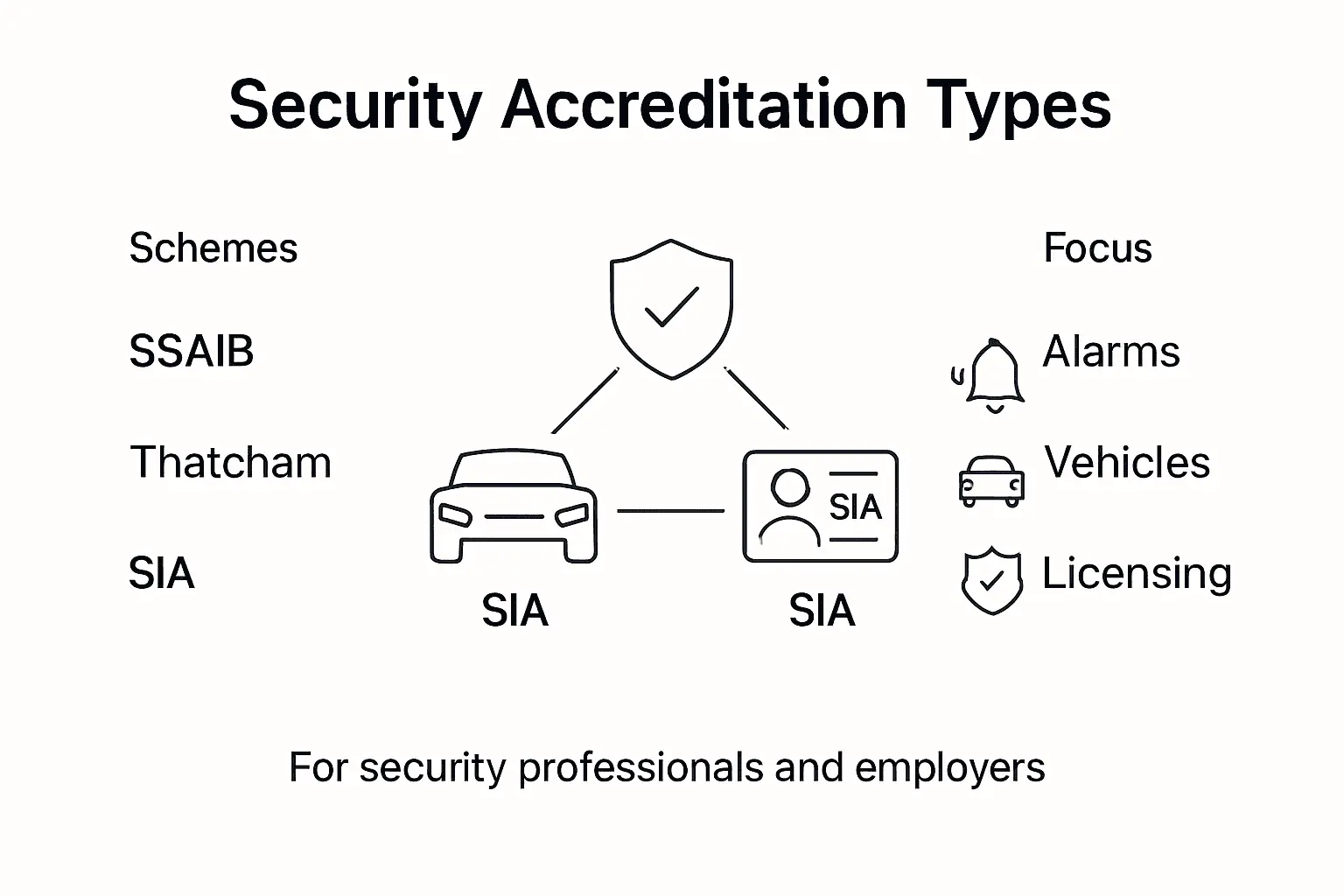
One prominent example is SSAIB’s comprehensive accreditation programme, which covers multiple security domains including fire detection, electronic security systems, security guarding, and monitoring services. These schemes are typically assessed against recognized national and international standards, with many receiving UKAS recognition to validate their impartiality and technical competence. This multi-dimensional approach allows security professionals to obtain specialised certifications that demonstrate their expertise in specific areas of the security landscape.
Specialised accreditation schemes also exist for niche technological sectors. Thatcham Security Certification represents an excellent illustration, focusing exclusively on vehicle security product standards. Their rigorous certification process involves detailed testing against risk-based criteria, ensuring that automotive security technologies meet stringent performance and reliability benchmarks. These targeted schemes complement broader industry accreditations by providing in-depth validation for specific technological and operational contexts.
To clarify the main UK security accreditation organisations and their roles, see the table below:
| Organisation | Primary Focus | Role in Security Accreditation |
|---|---|---|
| Security Industry Authority (SIA) | Private security professionals | Regulates and licenses security staff |
| SSAIB | Electronic and fire security systems | Provides industry-specific certification |
| United Kingdom Accreditation Service (UKAS) | Certification bodies and schemes | Verifies impartiality and competence |
| Thatcham Security Certification | Vehicle security products | Certifies automotive security standards |
Pro tip: Identify and pursue accreditation schemes most relevant to your specific security specialisation to enhance your professional credibility and career progression.
How Accreditation Processes Work in the UK
The accreditation process in the UK security industry represents a systematic and rigorous approach to verifying professional competence and maintaining industry standards. It involves multiple stages designed to comprehensively assess an organisation’s or individual’s capabilities, ensuring they meet strict regulatory requirements and demonstrate exceptional professional expertise.
The United Kingdom Accreditation Service (UKAS) serves as the primary national body responsible for overseeing these complex verification processes. Their comprehensive assessment typically involves several critical stages: initial application, detailed documentation review, extensive on-site audits, and ongoing periodic monitoring. This multi-layered approach ensures that accredited entities consistently meet international standards of quality, competence, and operational integrity.
Typically, the accreditation journey begins with an organisation submitting a formal application alongside comprehensive documentation demonstrating their professional capabilities. Independent assessors then conduct meticulous on-site evaluations, examining operational procedures, technical competence, management systems, and compliance with relevant industry standards. Accreditation bodies like UKIAF play a crucial role in facilitating these assessments, providing independent verification that helps build public trust and supports professional credibility across various security sector disciplines.
Pro tip: Prepare comprehensive documentation and maintain meticulous records of your professional training and achievements to streamline the accreditation assessment process.
Benefits for Security Professionals and Employers
Accreditation in the security sector serves as a powerful catalyst for professional growth and organisational excellence, providing substantial advantages for both individual practitioners and employing organisations. By establishing clear standards of competence and professional conduct, these certification processes create a robust framework that elevates industry performance and credibility.

The Security Institute highlights the critical role of accreditation in supporting professional development and career progression. For security professionals, accredited certification offers tangible benefits such as enhanced employability, recognition of skills, and opportunities for continuous learning. Employers gain significant advantages through access to validated talent pools, reduced recruitment risks, and the ability to demonstrate commitment to high-quality service delivery.
Moreover, accreditation schemes play a pivotal role in organisational success by facilitating insurance approvals, improving tender success rates, and establishing client trust. Employers who prioritise professionally accredited personnel can differentiate themselves in a competitive marketplace, while security professionals can leverage their credentials to negotiate better career opportunities and professional recognition. This symbiotic relationship between individual skill development and organisational quality assurance creates a virtuous cycle of continuous improvement within the security industry.
For a quick comparison, here are key benefits of accreditation for individuals and organisations:
| Benefits for Professionals | Benefits for Employers |
|---|---|
| Enhanced career prospects | Access to validated talent pools |
| Recognition of specialised skills | Increased client trust and credibility |
| Continuous professional development | Improved tender success rates |
| Proof of legal and ethical compliance | Easier insurance approval processes |
Pro tip: Actively maintain and update your professional accreditations, treating them as dynamic credentials that reflect your ongoing commitment to excellence and professional growth.
Risks, Common Pitfalls, and Misconceptions
Navigating the landscape of industry accreditation requires a nuanced understanding of potential challenges and misconceptions that can undermine the true value of professional certification. Security professionals and organisations must be aware of these potential pitfalls to ensure they approach accreditation strategically and effectively.
Independent evaluation processes reveal that many individuals and organisations mistakenly view accreditation as a mere bureaucratic exercise or an automatic guarantee of quality. This fundamental misunderstanding can lead to significant risks, including inconsistent service delivery, reduced professional credibility, and potential vulnerabilities in security operations. The reality is that accreditation represents a rigorous, ongoing assessment of professional competence that demands continuous commitment to maintaining high standards.
One of the most critical risks emerges when professionals or organisations treat accreditation as a static achievement rather than a dynamic process of professional development. Some security practitioners fall into the trap of obtaining a certification and then assuming their professional growth is complete. In contrast, truly successful professionals understand that accreditation is an evolving journey of skill refinement, staying current with industry developments, and demonstrating consistent excellence. Employers who fail to support ongoing professional development risk creating a workforce that becomes progressively disconnected from emerging industry standards and best practices.
Pro tip: Treat your professional accreditation as a living credential by scheduling regular skills assessments, attending industry update seminars, and proactively seeking opportunities to demonstrate and expand your professional capabilities.
Elevate Your Security Career with Accredited Excellence
Achieving industry accreditation is a vital step towards demonstrating your professional competence and commitment to high standards in the security sector. Yet navigating the job market to find opportunities that value these credentials can be challenging. If you are seeking to leverage your accredited skills and enhance your career prospects, the right platform can make all the difference.

At The Security Jobs Board, we understand the importance of recognised accreditations such as those from the Security Industry Authority and SSAIB. Our specialised UK-wide job marketplace connects accredited security professionals with employers who value verified expertise and professional development. Whether you are looking to showcase your qualifications or access roles that demand confirmed competence, our user-friendly site helps you find the perfect match quickly and securely.
Take control of your professional journey today by creating your profile, uploading your CV and setting targeted job alerts. Start exploring opportunities that respect your commitment to excellence at The Security Jobs Board.
Frequently Asked Questions
What is industry accreditation in the security sector?
Industry accreditation in the security sector is a structured system that recognises and validates the competence of individuals and organisations, ensuring they meet rigorous performance standards and comply with legal requirements.
Why is accreditation important for security professionals?
Accreditation is important for security professionals as it enhances their employability, demonstrates their skills and expertise, and provides opportunities for continuous professional development, which are critical in a competitive job market.
How does the accreditation process work in the UK security industry?
The accreditation process typically involves submitting a formal application, undergoing a detailed documentation review, extensive on-site audits, and ongoing monitoring to ensure compliance with industry standards.
What are the benefits of accreditation for employers in the security industry?
Employers benefit from accreditation through access to validated talent pools, improved client trust and credibility, enhanced organisational quality, and easier processes for insurance approvals.
Recommended
- The Essential Guide to Choosing the Security Industry|BM
- Understanding Security Job Classifications in the UK|BM
- Learn Security Skills
- Understanding Why Security Jobs in UK Matter | Brainiac Media
- Why Choose Insured Movers: Complete Guide for 2025
- Why Display Military Badges: Honouring Service in the UK – The Regimental Store Ltd


