How to optimise job ads for security recruiters

TL;DR:
- Optimizing security job ads involves defining the ideal candidate and including essential structural details like title, location, and salary to improve visibility. Writing clear, outcome-focused descriptions with transparent salary information and natural language enhances ranking and candidate trust. Regularly updating ads and tracking performance metrics ensures continuous improvement in attracting qualified applicants.
Posting a job ad and hoping the right candidates find it is not a strategy. In security recruitment, where competition for licenced, experienced professionals is fierce, poorly structured postings routinely sink to the bottom of search results before a single qualified applicant sees them. Knowing how to optimise job ads, which recruiters increasingly call job ad optimisation or job posting optimisation, means balancing what search algorithms and AI tools need to surface your listing with what real candidates need to trust it enough to apply. This guide walks you through preparation, writing, troubleshooting, and measuring results.
Key takeaways
| Point | Details |
|---|---|
| Preparation comes first | Define your ideal candidate profile and gather all role specifics before writing a single word. |
| Structure beats volume | A 300–800 word ad with a clear answer block and tiered qualifications outperforms lengthy, unstructured descriptions. |
| Salary transparency wins | Including a salary range builds candidate trust and directly increases application volume and quality. |
| Freshness matters for ranking | Ads older than 30 days lose search visibility; minor updates reset the ranking signal without a full repost. |
| Measure what you post | Track time-to-hire, source of hire, and funnel drop-off to know which ads are actually working. |
How to optimise job ads: the foundations to get right first
Before you write a single sentence, you need to know exactly who you are trying to reach and what information your ad must contain. In security recruitment, that sounds obvious. In practice, most postings go live without half of it.

Start by building a clear picture of your ideal candidate. For a door supervisor role in Manchester, that means knowing the required SIA licence class, whether night shifts are involved, the expected experience level, and whether you want someone who can work across multiple sites. These specifics shape every word you write later.
Next, gather the structural information the ad must include:
- Job title: Use common search language. “Door supervisor” outperforms “access control operative” in most search queries.
- Location: Specify the city, borough, or site. If the role is mobile, list the operational area. Vague location data is one of the top reasons job ads fail to appear on Google for Jobs, since location and salary metadata is required for full visibility.
- Salary range: Confirm the pay bracket before posting. You will need it.
- Key outcomes: What does success look like in this role after three months?
On the technical side, if your careers site or ATS supports it, implement JobPosting schema markup. This structured data tells Google exactly what your listing is and helps it appear as a rich result in job searches. Many recruiters skip this step entirely, then wonder why their ads receive little organic traffic.
Pro Tip: Create a one-page brief for each vacancy before you begin writing. Include the job title, location, salary, top three must-have qualifications, and two sentences describing the team. This brief becomes your source of truth and keeps your ad consistent across every platform you post it on.
Writing job ads that rank and convert
Job ads in 2026 function less like notices and more like performance marketing pages. AI tools summarise and rank them before most candidates ever click through, so clarity drives conversion at every stage. Here is a practical writing process built for security roles.
-
Write a searchable job title. Use the term candidates actually type. “CCTV operator” beats “surveillance monitoring professional.” Keep it under eight words and avoid internal jargon or creative branding that candidates will never search for.
-
Open with a 40–60 word answer block. This short paragraph answers the four questions every candidate has immediately: what is the job, where is it, what does it pay, and who is the employer. Effective answer blocks increase conversion because AI search tools use them to generate summaries, and candidates get the facts before they scroll.
-
List key responsibilities as outcomes, not tasks. Instead of “Patrol the premises,” write “Maintain a safe, secure environment across a 50,000 sq ft retail site by conducting regular patrols and incident reports.” Outcomes give candidates context and signal to employers what good performance looks like.
-
Tier your qualifications clearly. Research shows that listing 3–5 must-haves and separating nice-to-haves reduces drop-off from candidates who would otherwise self-select out unnecessarily. For a security officer role, must-haves might be a valid SIA licence and right-to-work in the UK. Nice-to-haves might be first aid certification or experience with a specific access control system.
-
Include the salary range. Hiding pay information causes candidates to abandon applications. Salary transparency builds trust and is increasingly expected. A bracket like “£12.50–£14.00 per hour depending on experience” is far more effective than “competitive salary.”
-
Add a brief employer brand signal. Candidates seeking security roles want to know who they will be working for and what the team culture is like. Two or three sentences covering company size, management style, and the working environment is enough. Quick trust signals matter far more than long corporate narratives.
-
Describe the application process. Tell candidates how many stages are involved, what to expect at each one, and when they will hear back. Transparent process information reduces anxiety and follow-up queries, and it improves completion rates.
-
Use natural language throughout. AI screening tools now favour semantic and contextual matching over exact keyword repetition. Weave in terms like “security officer,” “SIA licence,” and “lone working” where they fit naturally rather than listing them in a block at the bottom of the ad.
-
Add a short note on AI screening. A single sentence telling candidates that your ATS values context over keyword precision reduces candidate anxiety and encourages more authentic, honest applications.
Pro Tip: Aim for 300–800 words per ad. Shorter ads lack the context candidates and algorithms need; longer ones lose readers before the call to action. For most security roles, 450–600 words hits the sweet spot.
For a deeper look at structure and copy specific to the sector, the security job ad best practices guide from Securityjobsboard is worth reading alongside this.
Common mistakes that quietly kill applications
Even well-intentioned postings contain errors that reduce visibility and put candidates off. Here are the ones that appear most often in security recruitment.
-
Non-standard job titles: Titles like “security executive” or “protective services coordinator” sound professional but rarely match what candidates search for. Stick to recognised terminology: security officer, door supervisor, CCTV operator, close protection officer.
-
Stale ads left untouched: Ads older than 30 days are deprioritised by search algorithms. A minor content refresh, updating a shift pattern detail or adjusting a bullet point, resets the freshness signal without requiring a full repost.
-
Vague job descriptions: “Responsible for security duties” tells candidates nothing and signals to algorithms that the content is thin. Specificity is what earns attention from both.
-
Keyword stuffing: Pasting “SIA licence SIA licence security officer security guard” at the bottom of an ad does not help. It reads poorly and risks penalisation by modern AI recruitment systems that value natural writing.
-
Unclear work location: Stating “various locations” without further detail frustrates candidates and confuses location-based search filters. Be specific, even if the role involves travel.
-
No salary information: This is the single most common reason strong candidates abandon an application halfway through.
-
Long application forms: Every extra step between “apply” and “submitted” costs you candidates. If your application form takes more than ten minutes to complete, you are losing people.
A job ad is not the place to be mysterious. The more clearly you communicate who you want, what you offer, and what happens next, the better the candidates you will attract. Ambiguity filters out the wrong people for the wrong reasons.
Measuring and maintaining performance over time
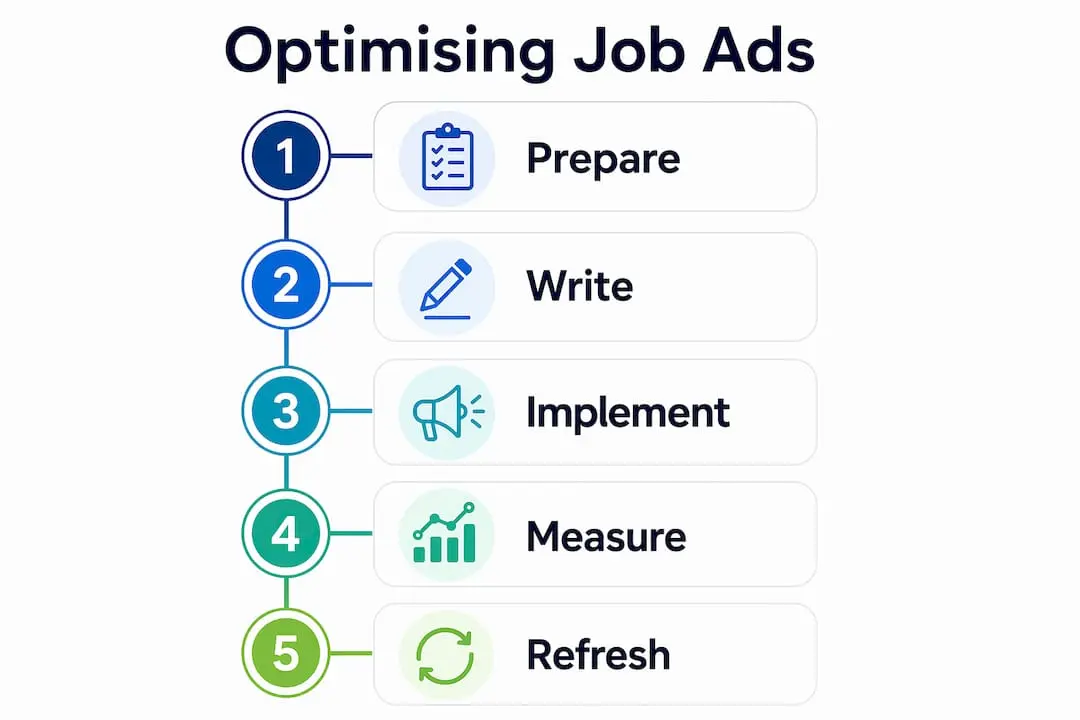
Writing a strong ad is not a one-off task. The most effective job advertisement strategies treat postings as living documents that respond to data and market changes.
| Metric | What it tells you | How to act on it |
|---|---|---|
| Time-to-hire | How long it takes from posting to offer | If too long, check ad clarity and application friction |
| Source of hire | Which platforms deliver quality applicants | Concentrate spend and effort on high-performing sources |
| Application-to-interview rate | Whether your ad is attracting the right candidates | Low rates suggest a mismatch in requirements or poor ad copy |
| Drop-off rate | Where candidates abandon the process | High drop-off at application stage usually means friction or missing salary info |
| Quality of hire | Post-hire performance of candidates sourced | Feeds back into whether the ad attracted the right profile |
Tracking these numbers across your postings gives you a clear picture of which ads are performing and which need work. Securityjobsboard’s applicant tracker is built specifically for security recruiters and integrates candidate data in one place, which makes this kind of analysis much easier.
Beyond metrics, gather qualitative feedback. Ask hiring managers whether the shortlisted candidates matched the brief. Ask candidates who withdrew why they did not proceed. Small adjustments based on real feedback often produce bigger improvements than a complete rewrite.
Pro Tip: Set a calendar reminder to review every active job ad every three weeks. Even refreshing one or two bullet points keeps the freshness signal active and maintains search visibility without the effort of reposting from scratch.
For a full breakdown of how to manage this process efficiently, Securityjobsboard’s job posting workflow guide covers the end-to-end process well.
My take on writing for machines without losing the humans
I’ve seen recruiters spend hours obsessing over keyword density while writing job ads that no real person would want to respond to. The irony is that in 2026, that approach actually performs worse on the algorithmic side too, because AI screening now rewards natural, contextually rich writing over keyword-heavy lists.
What I’ve found actually works is writing for the candidate first, then checking that the technical elements are in place. When you describe a role honestly, include the awkward details like shift patterns or lone working, and explain what support looks like, you attract people who genuinely fit. The filtering happens in the ad itself rather than during a first interview.
The trust problem in security recruitment is real. Candidates in this sector have seen too many vague postings, undisclosed pay rates, and applications that disappear into silence. The recruiters who get this right treat their job ads the same way a good employer treats a new hire: with clarity, honesty, and respect for the other person’s time.
I’ve seen simple changes, adding a salary range, describing the team in two sentences, or explaining the interview stages, produce a measurable uptick in both application volume and quality. These are not technical fixes. They are human ones.
— Rob
Post smarter on Securityjobsboard

Securityjobsboard is built specifically for UK security employers and recruiters who want their postings seen by the right people, not just more people. The platform supports structured, sector-specific job listings designed for visibility across search and AI-driven job discovery tools. Whether you are hiring in London or looking to reach candidates through Northern Ireland security jobs, the platform gives you targeted reach within the security sector. Combined with the built-in applicant tracker for managing candidates efficiently, it removes the guesswork from security recruitment. Visit Securityjobsboard to post your next role.
FAQ
What is the ideal length for a security job ad?
Effective job ads should be between 300 and 800 words. For most security roles, 450–600 words provides enough detail for candidates and search algorithms without losing readers before the application call to action.
Why is my job ad not showing up on Google for Jobs?
Missing or incomplete location and salary data is the most common cause. JobPosting schema markup with full metadata is required for Google for Jobs visibility, and ads without it are unlikely to appear as rich results.
How often should I refresh a job ad?
Refresh active ads every three weeks. Ads older than 30 days lose ranking priority, but a minor update resets the freshness signal without requiring a full repost.
Does including a salary range really make a difference?
Yes. Ads with salary ranges receive more applications and attract better-matched candidates. Hiding pay information is one of the leading causes of mid-application drop-off in security recruitment.
Should I write differently for passive candidates?
Passive candidates require marketing-led messaging that speaks to culture and opportunity rather than requirements. Active and passive candidates respond to very different signals, so consider separate employer brand content alongside your standard job postings if you want to reach both pools.


