How to Apply for Airport Security Jobs in the UK
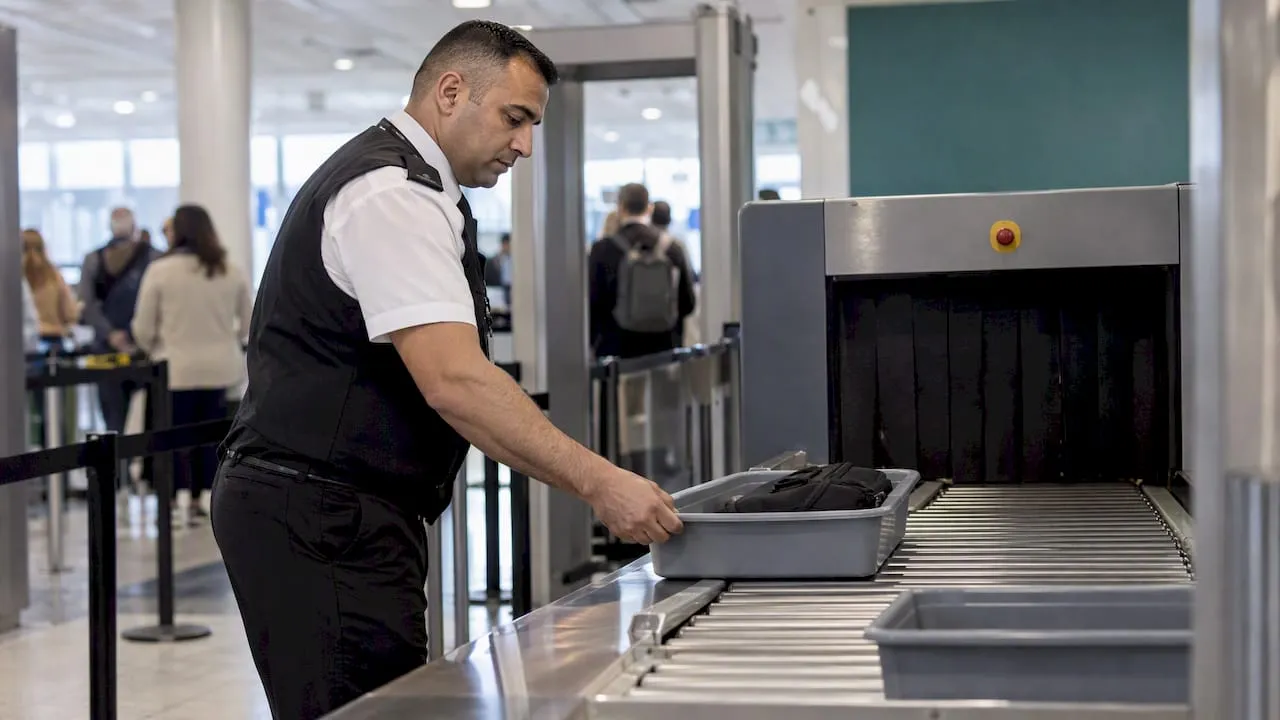
To apply for an airport security job in the UK, apply directly through the careers page of the airport or the security employer that runs screening there. Have your right-to-work documents and five years of employment history ready. Expect an online application, an assessment or interview, and background checks before you start. Those checks are the slowest part, so begin gathering your paperwork before you click “apply”.
This guide covers where to find vacancies, what employers ask for, how vetting works, what the assessments look like and how to give yourself the best chance.
TL;DR
- Apply through the airport’s own careers site or the security company named in the advert, and set up job alerts so you see new roles quickly.
- You need UK right to work, a criminal record check and usually a continuous UK residence history. Some roles ask for three years.
- Prepare a five-year history with no unexplained gaps, plus ID documents, before you apply.
- Expect an online form, an assessment or interview, then vetting and training. Allow weeks, not days, between offer and start date.
- Browse UK security vacancies on Security Jobs Board for free, and read our guides on checks and applications first.
Table of Contents
- What airport security jobs actually involve
- Where to find airport security vacancies
- What you need before you apply
- How to apply, step by step
- Tests, interviews and what to expect
- Vetting, training and how long it takes
- Pay and conditions
- How hard is it to get an airport security job?
- Perspective from Security Jobs Board
- Find airport and wider security roles
- FAQ
- Sources
What airport security jobs actually involve
“Airport security” covers more than the people who check your bag. Manchester Airports Group lists security roles such as Security Ambassador, Aviation Security Officer, Security Performance Leader, Security Duty Manager, Terminal Duty Manager and Airfield Security Operations. Its stated focus is moving passengers safely through security while reducing threats.
For most newcomers the entry point is the screening officer role. The exact title differs by employer: security officer, aviation security officer, terminal security officer or security ambassador. Day to day, that means:
- screening passengers and their cabin baggage at the central search area;
- operating X-ray and other screening equipment;
- searching people and bags when an alarm or a flag calls for it;
- controlling access points for staff and vehicles;
- dealing with passengers who are stressed, late or confused.
The work is physical and shift-based. Airports run early mornings, late nights, weekends and bank holidays. Overseas aviation regulators describe the same pattern. The US Transportation Security Administration, for example, says its officers may lift or carry bags weighing up to 50 lb and work odd hours. UK employers do not set identical rules, but it is a fair picture of the working pattern, so read each advert’s shift and fitness details.
If you are weighing airport work against other security careers, our guide to security job roles in the UK shows how the roles compare and where each can lead.
Where to find airport security vacancies
There are three main routes. Use all of them, because airport security is often run by a different organisation from the airport itself.
1. The airport’s own careers site
Many larger UK airports recruit screening staff directly. Heathrow takes applications online through its careers site. Edinburgh Airport has its own careers FAQs and application process pages. Manchester Airports Group advertises across Manchester, Stansted and East Midlands from one careers portal. Smaller airports often post a single “Security” page with current vacancies and a contact form.
Sign up for job alerts wherever the site offers them. Screening vacancies tend to open in waves, ahead of summer and Christmas peaks, and close once enough applications arrive.
2. Contracted security companies
Some airports outsource passenger or staff screening to specialist security companies. In that case the advert sits on the contractor’s site, on a general job board, or both. The employer’s name in the advert tells you who you would work for, and it may not be the airport brand on your uniform’s backdrop. Check who the employer is before you apply, because pay, contracts and training are set by them.
3. Specialist security job boards
A dedicated board saves you filtering out unrelated roles. On Security Jobs Board you can create a free profile, upload your CV, set job alerts and apply to UK security vacancies. Employers there post security-specific roles, so your searches stay relevant. Candidates pay nothing to use the service.
| Route | Best for | What to watch |
|---|---|---|
| Airport careers site | Roles directly employed by the airport | Windows can be short, so use alerts |
| Security contractor site | Screening run by a specialist company | Check the employer, contract and pay terms |
| Specialist job board | Comparing many UK security roles at once | Always apply through the genuine advert |
What you need before you apply
Airport security sits inside restricted areas, so eligibility is stricter than for most guarding jobs. Four things come up again and again.
Right to work in the UK
Heathrow states that applicants need UK right-to-work documentation and must pass a criminal record check. Other employers ask the same. Have your passport or share code ready.
Residence history
Some roles need a period of continuous UK residence. Heathrow says some roles require three years’ continuous UK residence. Edinburgh Airport says applicants for certain roles, such as Aviation Security Officer, must have lived in the UK for the last three consecutive years. If you have recently returned from abroad, check this before you invest time in an application.
A five-year history with no gaps
Heathrow asks new colleagues for a five-year employment history, including gaps. Gaps are not an automatic problem. Unexplained gaps are. Write down every job, period of study, spell of unemployment, caring responsibility or time abroad, with start and end months. Your references and the vetting team will check them against your answers.
A clean enough criminal record check
The UK Civil Aviation Authority explains that criminal record checks are required for certain roles, including unescorted access to an airport security restricted area. Those checks are managed by the Disclosure and Barring Service in England and Wales, Disclosure Scotland in Scotland and Access NI in Northern Ireland. Which body handles yours depends on where you live and where the role is based.
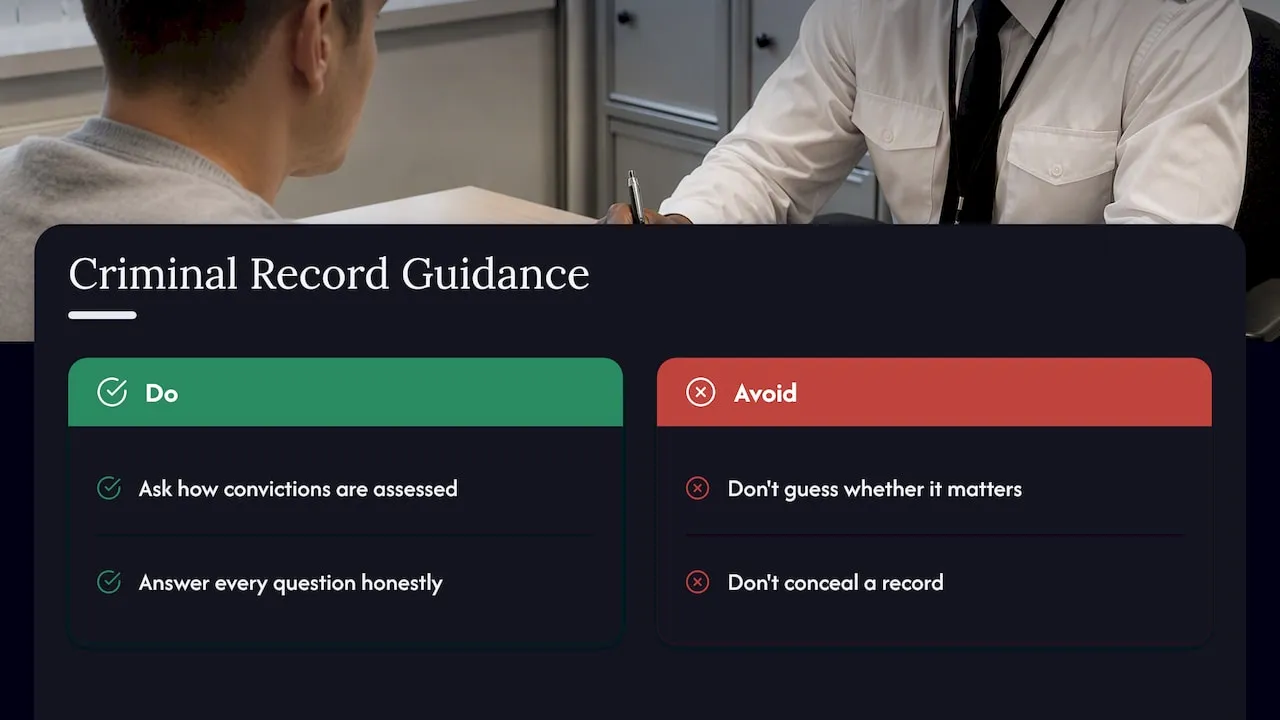
If you have a conviction or caution, do not guess whether it matters. Ask the employer’s recruitment team how they assess it, and answer every question honestly. Concealing something is usually a bigger problem than the record itself. Our guide to how security checks work in the UK walks through the different checks and what each one looks at.
How to apply, step by step
- Pick the right vacancy. Read the advert for shift pattern, location, employer, contract type and any residence or vetting conditions. Check whether you can reach the airport at 4am by public transport, because that matters more than many applicants expect.
- Gather your documents. Passport or other right-to-work evidence, National Insurance number, proof of address and your five-year history. For selection events, Heathrow says candidates may need to bring a passport, proof of National Insurance number and a utility bill.
- Tailor your CV. Put customer service, shift work, reliability and any security, military, police, retail or hospitality experience near the top. Keep it to two pages and use dates that match your application form exactly.
- Complete the online application. Answer every question fully. Do the form in one sitting if you can, and save a copy of your answers.
- Do the assessment. This may be an online questionnaire, a recorded interview or a group event. More on that below.
- Interview. Expect questions about handling difficult passengers, following procedures and staying alert.
- Accept the conditional offer and start vetting. Offers are almost always conditional on checks and training.
- Complete training and any required medical. Then you begin on shift.
The same sequence works for most UK security applications. Our step by step guide to applying for security roles and the workflow for job applications in the UK security industry cover the general process in more detail.
Tests, interviews and what to expect
Assessments vary by employer and role. Heathrow says they may include situational-judgement or ability tests, interviews, presentations and assessment-centre exercises such as role plays and group exercises. Not every airport uses all of these, but the logic is the same everywhere: employers want people who follow procedure, stay calm and treat passengers well.
How to prepare
- Situational questions. You will be given a scenario, such as a passenger refusing to remove an item, and asked what you would do. The best answers are calm, follow the rules and stay polite.
- Ability tests. Practise basic numerical and checking exercises online so the format is familiar.
- Interview answers. Use real examples: a time you dealt with an upset customer, spotted a problem or kept to a rule under pressure. Say what you did and what happened.
- Group exercises. Listen, include quieter people and keep to the brief. You are not trying to dominate.
Airport security is also a customer-facing job. Show that you can be firm about safety rules and still pleasant.
Vetting, training and how long it takes
The gap between a job offer and your first shift catches many applicants out. Heathrow says its checks must be completed before a new colleague joins and may delay the start date by 4 to 14 weeks. Edinburgh Airport says vetting includes a CTC and a criminal record check and takes a minimum of four weeks, and that onboarding includes a medical assessment and online training.
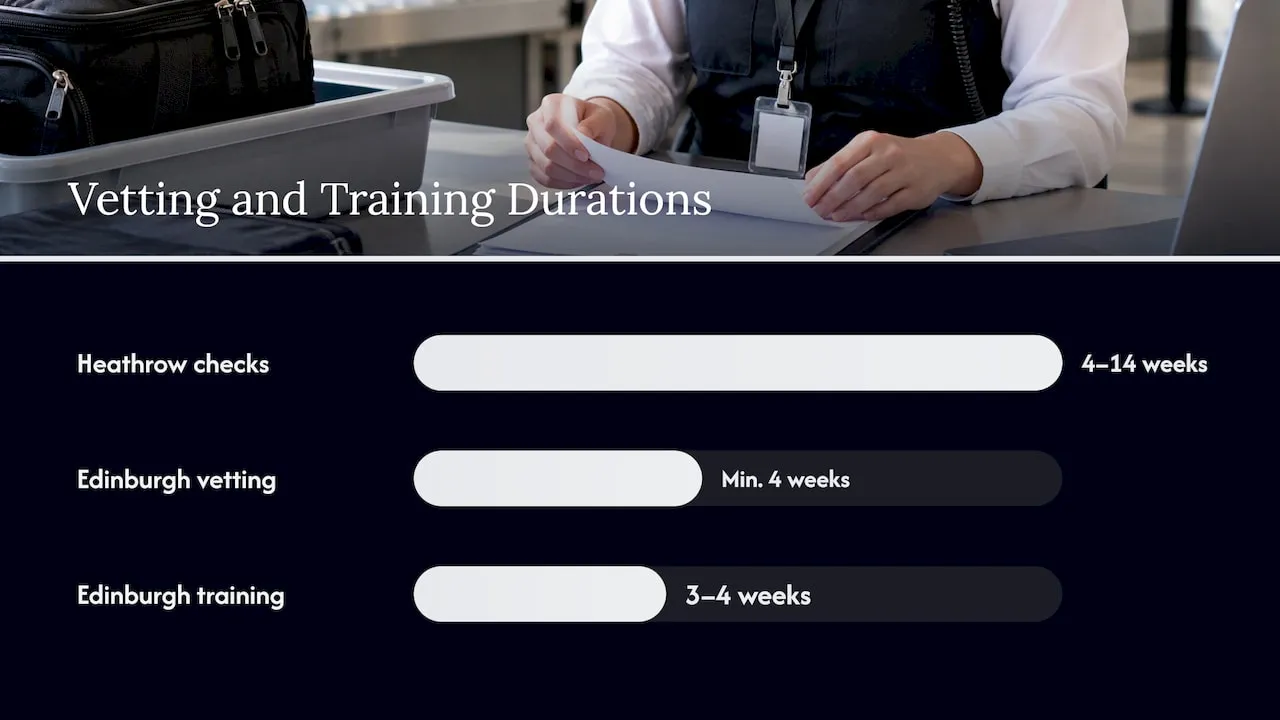
Training then follows. Edinburgh’s aviation security training lasts three to four weeks and combines classroom and on-the-job learning with assessments. Other employers set their own length, so ask at interview.
Practical tips while you wait:
- Reply to vetting requests the same day. Delays on your side stretch the timeline.
- Keep your current job until you have a confirmed start date, not just an offer.
- Keep copies of every form you submit.
- Tell referees to expect a request.
Pay and conditions
Pay differs by employer, airport, shift pattern and role level. A screening officer, a supervisor and a duty manager are on different scales, and airports in and around London often differ from regional ones. Rather than rely on a salary figure from an unrelated source, read the pay line in each advert, and compare allowances for night work, weekends and overtime. If an advert gives no pay, ask the recruiter before you accept an interview slot.
Also weigh up the non-pay conditions: staff travel and parking, uniform, shift rota notice, annual leave rules and whether the contract is permanent, part-time or seasonal.
How hard is it to get an airport security job?
The entry requirement is not a degree. The difficulty is in the checks and in the paperwork. People who struggle usually fall at one of four points:
- they cannot show a full five-year history;
- they do not meet the residence requirement;
- they give inconsistent dates or incomplete answers;
- they cannot manage the shift pattern or commute.
If you can show reliability, steady customer-facing experience and a tidy application, you are in a strong position. Armed forces, police, retail, hospitality and ordinary guarding experience all transfer well.
Perspective from Security Jobs Board
We see the same pattern on the applicant side again and again: people lose weeks at the airport vetting stage because their paperwork was not ready, not because they were unsuitable.
That is why we built Security Jobs Board around the UK security sector only. A candidate can set up a profile, upload a CV and receive alerts for security vacancies without paying anything. An employer can reach people who already want security work and understand that compliance checks come with it.
Our advice is simple: treat your application like the first compliance check. Keep your employment history complete, your dates consistent and your documents to hand. Employers notice that, and it is exactly the habit security work requires. Our affiliation with the BSIA is part of how we keep the board focused on credible industry employers.
Rob
Find airport and wider security roles
If you want one place to watch for security vacancies, create a free profile on Security Jobs Board, upload your CV and set alerts for the locations and roles you want. You can apply quickly from your phone, and the site is built to handle your data in line with GDPR.

Hiring instead? Security employers can use our employer pages to post standard listings, featured ads or multi-role campaigns, and to access CVs from security candidates.
FAQ
Do I need experience to get an airport security job?
Not always. Many employers advertise screening roles with full training provided, and MAG’s Stansted pages mention that full training will be provided for these roles. Customer service, shift work and reliability still count heavily in your favour.
How long does it take to start after I apply?
Allow roughly two to four months from application to first shift. Heathrow says its checks may delay the start date by 4 to 14 weeks, and training follows. Your own speed in returning forms can shorten or lengthen this.
Will a criminal record stop me applying?
Not necessarily, but airport roles with access to restricted areas need a criminal record check, as the Civil Aviation Authority explains. Be honest on the form, and ask the employer’s recruitment team how they assess your specific situation.
Where can I find the current vacancies?
Start with the careers pages of the airports near you, check the security contractor they use, and set alerts on Security Jobs Board. Vacancies change often, so rely on the live adverts for dates and closing times.
Sources
- Application Process | Heathrow
- Criminal record checks | UK Civil Aviation Authority
- FAQs, Careers at Edinburgh Airport
- Application process, Careers at Edinburgh Airport
- Operations | MAG careers
- Transportation Security Officers | TSA


