Reply to a UK Security Job Offer Email in 24 Hours With Templates

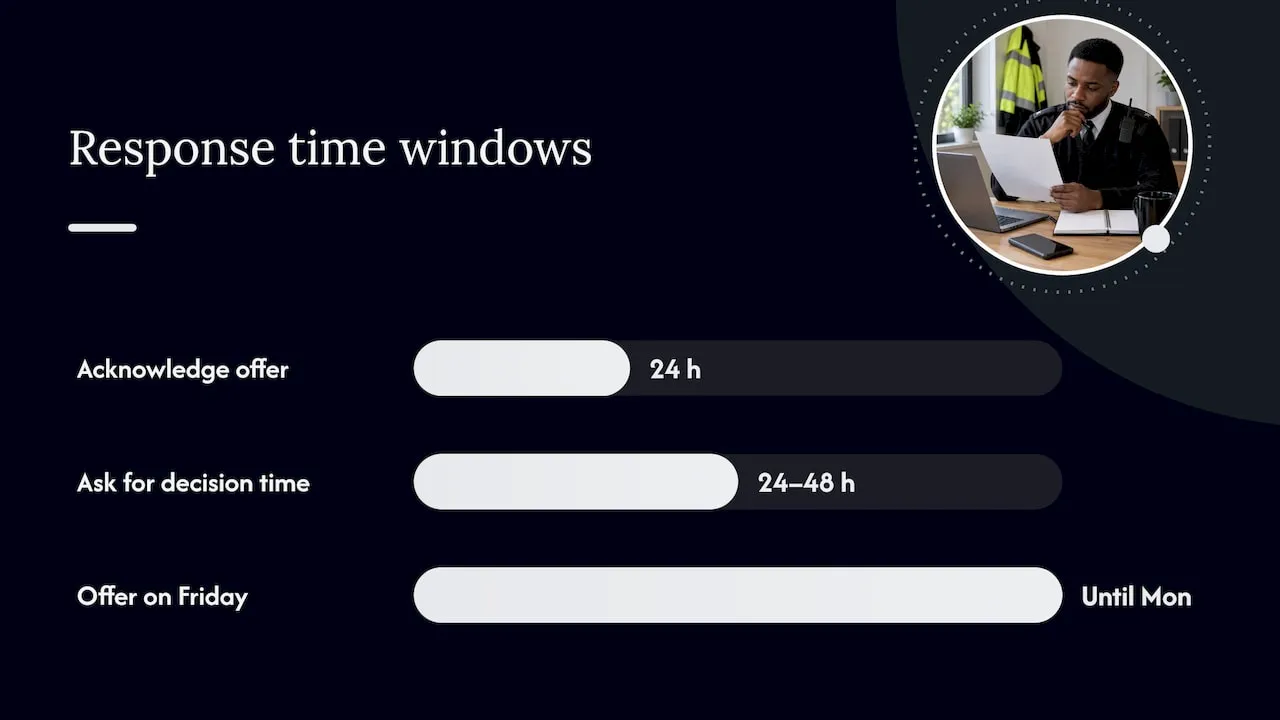
Reply within 24 hours to acknowledge receipt and state whether you accept, decline, or need time to decide. Keep the message short, professional, and specific: confirm the job title and proposed start date if you are ready to accept, or give a firm date by which you will respond if you need more time. Save every message in one place and chase up any verbal promises so they end up in writing.
TL;DR:
- Most candidates should respond within 24 hours to acknowledge receipt of the offer and state their decision or request more time, ideally with a specific deadline.
- Carefully review the written offer and contract, confirming key details like salary, start date, hours, holiday entitlement, probation, and any attached conditions before replying.
- Negotiations should be brief, specific, and framed as questions, with requests supported by relevant reasons such as experience or licensing, and followed by a short call or email confirmation.
- Once you accept, sign and return the contract promptly, and keep copies of all documents; if declining, do so quickly and professionally to preserve future opportunities.
- Keep a complete record of all exchanges, promises, and documentation to avoid misunderstandings or disputes later.
Table of Contents
- Step-by-step: acknowledge, review the offer, decide and reply
- Templates: copy-and-paste email examples for every situation
- What to check in the offer and contract before you reply
- How to negotiate the offer by email: practical steps and wording
- After you accept or decline: immediate tasks and record-keeping
- Why trust this guidance and how Security Jobs Board supports UK security candidates
- Editorial take on replying to job offers in security recruitment
- Keep your options open with Security Jobs Board
- Sources
- FAQ
Step-by-step: acknowledge, review the offer, decide and reply
The first message you send matters more than its length. A brief note sent within a day shows you take the role seriously, even if your final answer comes later.
- Acknowledge fast. Send a short reply within 24 hours confirming you’ve received the offer and thanking the employer.
- Read the offer properly. Check the job title, salary, start date, hours, and any conditions before you respond further.
- Decide your response window. Most candidates can reasonably ask for 24 to 48 hours, or until the following Monday if the offer lands on a Friday, to weigh things up.
- Choose your response type. Work out whether you’re accepting outright, accepting subject to seeing the contract, asking questions, negotiating, or declining.
- Put verbal agreements in writing. If a manager promises something by phone, follow up with an email summarising what was agreed and ask them to confirm.
- Send your final written reply. Once you’ve decided, send a clear, complete response and keep a saved copy.
If you genuinely need longer than a couple of days, Newcastle University’s careers team suggests contacting the employer straight away to express enthusiasm while asking politely for extra time, rather than staying silent and hoping they’ll wait.
Some situations call for a phone call instead of an email, particularly if you want to ask sensitive questions about salary or negotiate directly. Even then, follow the call with a short email confirming what was discussed. This gives both sides a written record and avoids any confusion about what was actually agreed. If the employer cannot move their deadline and you’re still unsure, weigh the certainty of a firm offer against the uncertainty of other applications still in progress before you decide.
Templates: copy-and-paste email examples for every situation
Different situations call for different wording, but each template below can be adapted in minutes. Replace the bracketed details with your own and keep the tone warm but businesslike.
- Acknowledgement (buying time): “Thank you for the offer of [job title]. I’m pleased to have been offered the role and would like a little time to review the details. I will confirm my decision by [date].”
- Formal acceptance: “I’m writing to formally accept the offer of [job title] with [company], starting on [start date] at [location]. I confirm my agreement to the salary and terms outlined, and I’m happy to provide any further information you need.”
- Acceptance with queries: “I’d like to accept the offer of [job title], subject to reviewing the full contract. Could you confirm [specific point, such as start date or shift pattern] before I sign?”
- Negotiation: “Thank you for the offer of [job title]. I’m genuinely enthusiastic about joining the team. Based on [reason, such as experience or licensing], would you consider a salary of [figure]? I’m happy to discuss this further on a short call.”
- Polite decline: “Thank you for offering me the [job title] role. After careful thought, I’ve decided not to proceed at this time. I appreciated the opportunity and hope our paths cross again.”
Each of these works best when it stays short. Avoid vague phrases like “I’ll think about it” without a date attached, since that leaves the employer guessing. Never promise a start date you haven’t checked against your notice period, and never send an acceptance you’re not prepared to honour: once you accept an unconditional offer in writing, Cambridge’s careers service treats that as forming a contract, so it’s worth being certain before you press send. For more worked examples specific to security roles, see Security Jobs Board’s guide to replying to recruiters.
What to check in the offer and contract before you reply
Before you reply with anything final, read the written offer line by line. A proper offer letter should set out the essentials clearly, and ACAS guidance states that a written offer should include the job title, start date, salary, hours, holiday entitlement, probation period, and notice periods.
- Salary and pay frequency: confirm the exact figure and whether it’s paid weekly or monthly.
- Start date and hours: check these match what was discussed at interview.
- Probation and notice periods: shorter probation notice is common but should be stated clearly.
- Holiday entitlement and benefits: confirm what’s included beyond statutory minimums.
- Conditions attached to the offer: references, background checks, or security clearance requirements should be listed.
Watch for unusual clauses too. Oxford’s careers service advises reading every line of a contract carefully, since clauses covering training repayment can leave you financially liable if you leave the role early.
Pro Tip: If you spot a training repayment clause or anything unfamiliar, ask the employer to explain it in writing before you sign. A one-line email query costs nothing and avoids a costly misunderstanding later.
If anything was promised verbally that isn’t in the written offer, ask for it to be added or confirmed by email. Keep every document, email, and text exchange together in one folder so you have a full record if a dispute ever arises.
How to negotiate the offer by email: practical steps and wording
Negotiating by email works best when it’s brief, specific, and framed as a genuine question rather than a demand. Start by thanking the employer and confirming your interest in the role before raising anything about pay or terms.
- Open with appreciation. A short line confirming your enthusiasm sets a positive tone before you ask for anything.
- Make one clear request. Name a specific figure or benefit rather than a vague “more”.
- Give a short reason. Point to relevant licensing, experience, or a comparable role to support your ask.
- Suggest a next step. Offer a short call or ask them to confirm in writing, and show you’re flexible on timing.
Negotiating politely is considered normal practice, and employers generally expect candidates to ask, according to Youth Employment UK. That means a well-worded request rarely damages your standing. If the employer declines, thank them for considering it and confirm whether you’re still accepting on the original terms, rather than letting the conversation stall.
After you accept or decline: immediate tasks and record-keeping
What you do in the days after your reply matters as much as the reply itself.
- If you accept: sign and return the contract promptly, confirm any onboarding steps, and keep copies of every signed document.
- If you decline: tell the employer as soon as possible, ideally by phone followed by a confirming email, and keep the tone professional.
- If you must withdraw after accepting: act quickly, explain honestly, and confirm the withdrawal in writing, accepting that this may affect future opportunities with that employer.
- Withdraw other applications: once you’ve accepted unconditionally, Sussex’s careers service recommends notifying other employers you’re no longer available, done politely and without unnecessary detail.
For a full breakdown of what to prepare before day one, see Security Jobs Board’s onboarding checklist for UK security roles.
Why trust this guidance and how Security Jobs Board supports UK security candidates
This guidance draws on published careers advice from UK university careers services and ACAS, the bodies most commonly cited on job offer etiquette and employment terms. Security Jobs Board is a UK platform built specifically for the security sector, offering free profiles, CV uploads, job alerts, and quick apply, with GDPR-compliant handling of candidate data and an affiliation with the BSIA that underpins its focus on the industry.
If you’re weighing up more than one offer, our guide to working in UK security covers what different roles and employers typically offer, which can help you compare beyond salary alone.
Editorial take on replying to job offers in security recruitment
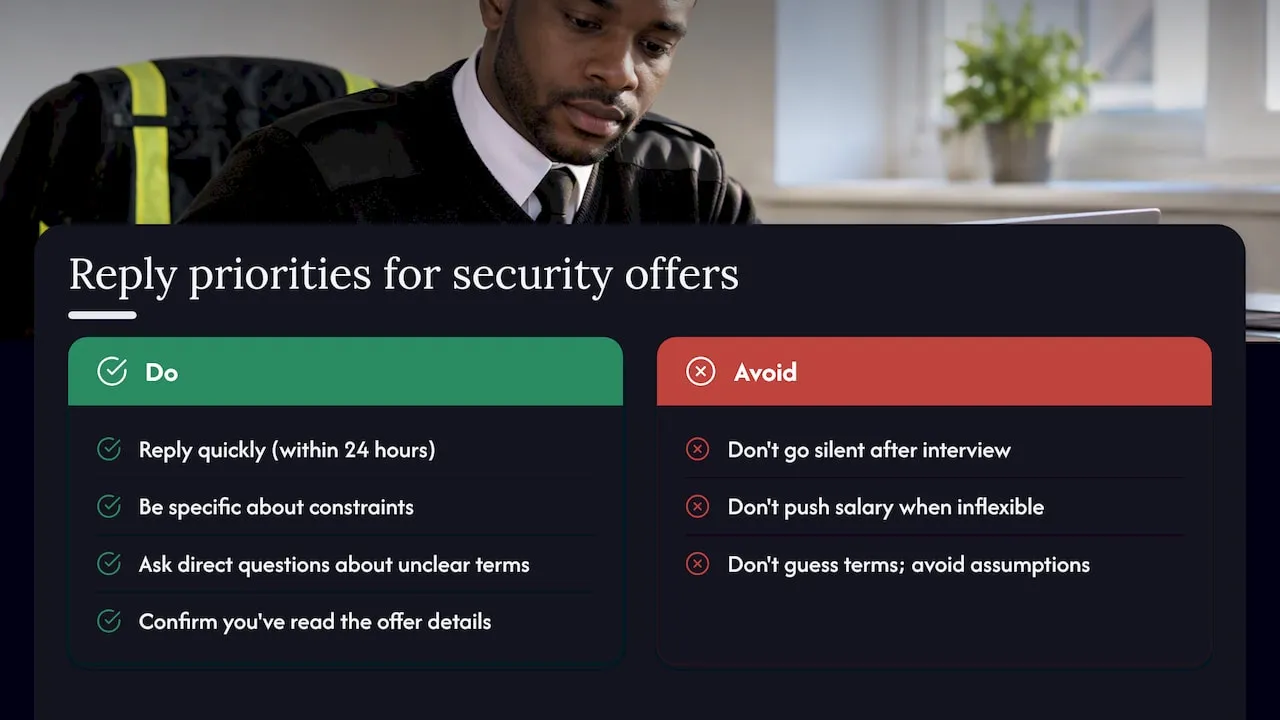
Most advice on job offers focuses heavily on negotiation tactics, as if the hardest part is squeezing out an extra few hundred pounds. In practice, the bigger risk is candidates going quiet after an interview goes well, leaving employers to chase them or move on to someone else. Timing and clarity matter more than clever wording.
The conventional advice to “always negotiate” also misses that some security roles, particularly those tied to shift patterns or client contracts, have far less flexibility on pay than a typical office job. Pushing hard on salary in those cases can stall an otherwise strong offer. What matters most is a fast, specific reply that shows you’ve read the details properly and asking direct questions when something is unclear, rather than guessing or staying silent.
— Rob
Keep your options open with Security Jobs Board
Once you’ve replied to an offer, whether you accepted, declined, or are still weighing things up, it’s worth keeping your search moving. Security Jobs Board lets you build a free profile, upload your CV, and set job alerts so relevant security roles reach you directly.

Browse current vacancies and set up your alerts at Security Jobs Board.
Sources
- Job offers | Newcastle University Careers
- Negotiating job offers | Cambridge Careers Service
- Offering someone a job | ACAS
- How to negotiate a job offer or salary | Youth Employment
FAQ
How do I answer an email about a job offer?
Reply within 24 hours to confirm you’ve received the offer and state whether you’re accepting, declining, or need more time. If you need time, give a specific date by which you’ll respond rather than leaving it open-ended.
How do I write an email reply to accept a job offer?
State clearly that you accept the role, naming the job title and agreed start date, and confirm you accept the salary and terms outlined. Keep the tone warm but businesslike, and offer to provide any further information the employer needs.
How do you formally accept a job offer email?
A formal acceptance should include a direct acceptance statement, the job title, the start date, and confirmation of the agreed salary and terms. Once you accept an unconditional offer in writing, Cambridge’s careers service treats this as forming a contract, so send it only once you’re certain.
How do I reply to job offers?
Acknowledge the offer promptly, review the written terms carefully, and choose the response that fits your situation: accept, accept subject to contract, ask for more information, negotiate, or decline. Whatever you decide, put it in writing and keep a copy for your records.


