UK CISO Career Path for Physical Security: 8–15 Years, CSyP
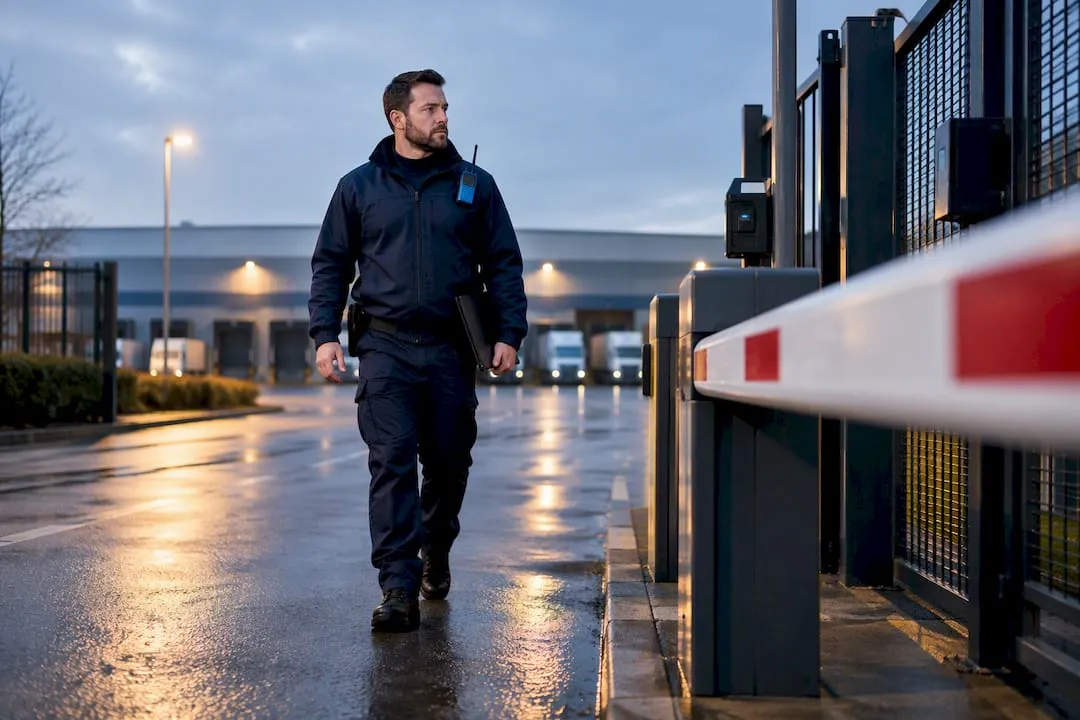
The typical route to senior UK physical security leadership runs from security officer to supervisor, then to site or operations manager, and finally to head of security. Your immediate move should be securing your SIA licence and starting a Level 3 apprenticeship, or logging supervisory hours if you already work frontline. Everything else in this career path, from vetting to salary, builds on that first step.
TL;DR:
- Progression usually takes between eight to fifteen years, with apprenticeships and professional designations helping to shorten the timeline.
- Securing an SIA license is mandatory before starting any frontline security role and remains essential for promotion to higher levels.
- Completing Level 3 or Level 4 apprenticeships significantly accelerates skill development and eligibility for supervisory and security adviser positions.
- Employers increasingly screen for measurable incident reduction, risk management, and stakeholder engagement skills at higher levels.
- Senior security roles often require national security vetting, which depends on employer sponsorship and can take several years of UK residency to qualify.
Table of Contents
- What does the CISO career path look like in physical security?
- Which qualifications and training speed up promotion?
- What skills and experience do employers actually screen for?
- How does vetting and licensing affect your career choices?
- How can you accelerate your progression to the top?
- How do you find the right physical security role?
- A straight-talking view on where the opportunity really is
- Ready to move? Here’s how Securityjobsboard helps
- Sources
- FAQ
What does the CISO career path look like in physical security?
Progression to senior physical security leadership follows a recognisable ladder, though the speed varies enormously depending on sector, employer size, and whether you actively chase qualifications or just wait for tenure to do the work.
Security officer is where almost everyone starts. You need an SIA licence before you can legally work a shift, and the role covers access control, patrols, incident response, and basic reporting. Starting pay across the sector sits roughly in the £24,000 to £32,000 band, though London and specialist contracts push higher.
Supervisor or shift lead comes next, usually after twelve to eighteen months of solid frontline performance. You take on rostering, first-line incident management, and basic contractor liaison. Most people move up because a manager notices they already act like a supervisor before the title arrives.
Site or operations manager is where the job changes shape. You are now managing multiple sites or a large single contract, overseeing suppliers, holding a budget, and dealing directly with clients. This stage typically demands three to five years of combined frontline and supervisory experience.
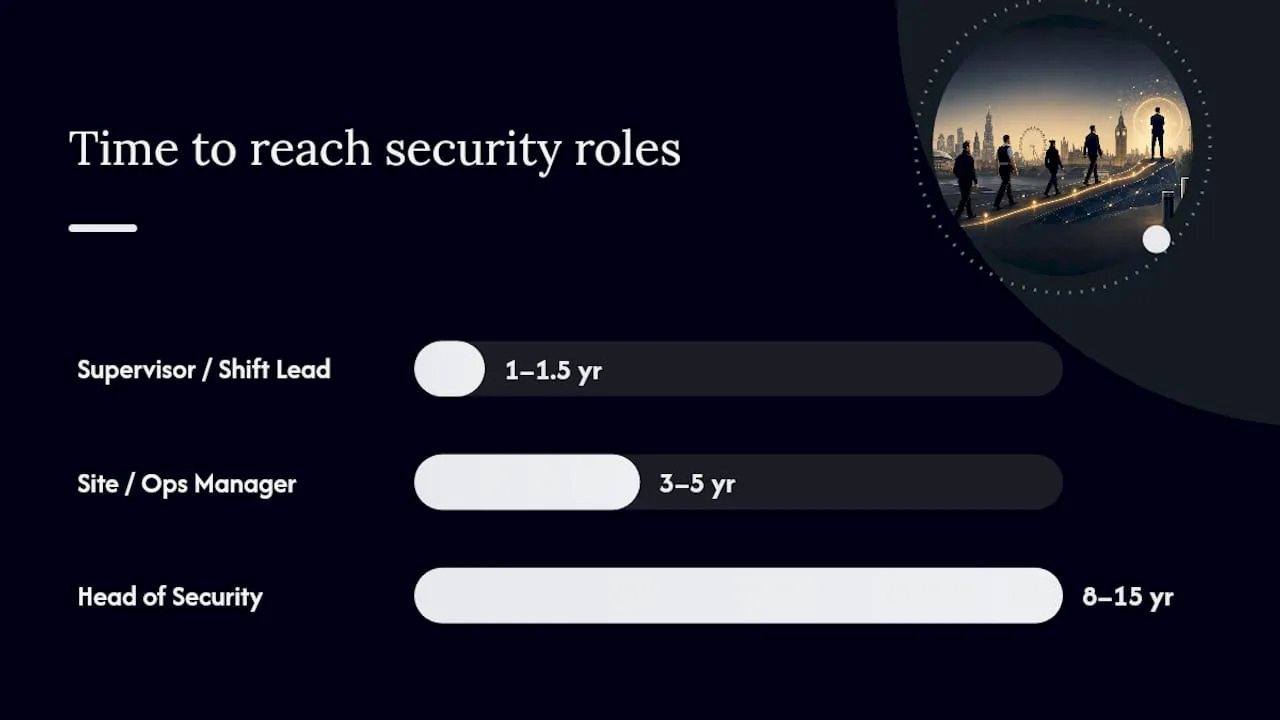
Head of security or chief security officer sits at the top of the physical security track. Responsibilities shift to enterprise-wide risk, policy ownership, and strategic input at board or senior-management level. Getting here usually takes eight to fifteen years, though ex-military or emergency-services entrants sometimes compress that timeline given their existing leadership and risk experience.
Alternative specialist routes run parallel to this ladder rather than replacing it:
- CCTV and surveillance operations, often leading into control room management
- Technical security, covering access control systems, intruder detection, and integration work
- Close protection, a distinct discipline with its own SIA licence category and client-facing skill set
Which qualifications and training speed up promotion?
Vocational apprenticeships do more for career velocity in this sector than almost anything else, largely because employers can see exactly what a candidate has learned rather than guessing from a CV.
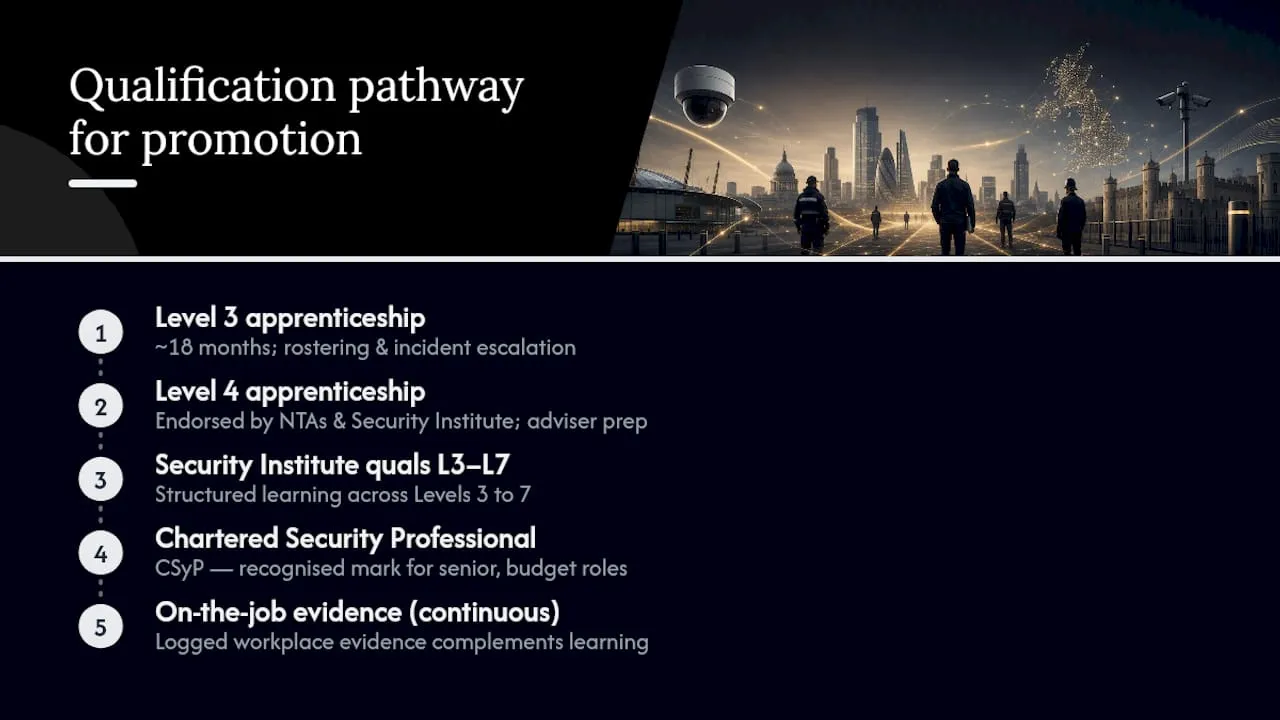
The Level 3 Security First Line Manager apprenticeship is the standard entry into supervisory training. It runs for about 18 months and carries a government funding cap, which means many employers can put staff through it at little or no direct cost. It covers rostering, incident escalation, and basic contract awareness, exactly the gaps that stall officers stuck at frontline level.
The Level 4 Protective Security Adviser apprenticeship sits a tier above. It is endorsed by National Technical Authorities and the Security Institute, and it prepares candidates for protective security adviser, security risk manager, and technical specialist roles. It also suits ex-military entrants making the jump into civilian protective security work.
Pro Tip: Don’t wait for your employer to nominate you for Level 3 or Level 4 training. Ask directly. Apprenticeship funding rules mean many companies have budget allocated that goes unused simply because nobody asked.
Beyond apprenticeships, Security Institute qualifications run from Level 3 right through to Level 7, and Chartered Security Professional (CSyP) status functions as the sector’s recognised mark of strategic competence for senior, budget-owning roles. Combine structured learning with logged on-the-job evidence. Neither works well alone.
What skills and experience do employers actually screen for?
Screening changes at every stage, and understanding what a hiring manager is checking for saves you from applying with the wrong evidence.
At officer and supervisor level, employers look for:
- Incident handling under pressure, evidenced through logged reports rather than claims
- Shift rostering and basic contractor coordination
- Familiarity with CCTV, access control, and perimeter intrusion detection systems (PIDS)
At site manager level and above, the checklist shifts toward strategic capability: risk assessment, programme management across multiple contracts, and stakeholder engagement with clients who rarely speak “security” fluently. Transferable experience from the armed forces or emergency services translates well here, though candidates often undersell it by describing duties instead of outcomes.
That distinction matters when writing a CV or interview answer. “Managed a security team” tells an employer nothing. “Reduced reported incidents by a measurable margin across three sites through revised patrol scheduling” tells them exactly what you are capable of repeating for them. Use audit scores, incident reductions, and retention figures wherever you have them.
How does vetting and licensing affect your career choices?
Your SIA licence is the entry gate. Without it, you cannot legally work a frontline security role, and it remains the baseline credential every subsequent promotion assumes you already hold. Full detail on obtaining one sits in Securityjobsboard’s guide to SIA licensing and entry routes.
Senior roles in certain sectors add another layer: national security vetting. Security Check and Developed Vetting are sponsor-led, meaning you cannot apply for clearance independently. Your employer or the government department sponsors the process. Higher clearance levels commonly require five to ten years of continuous UK residency, which rules some candidates out regardless of skill.
- Sectors that commonly require vetting: critical national infrastructure, central government, counter-terrorism policing
- Preparation tip: keep address history, employment records, and references organised well before you need them, since sponsor-led vetting moves slowly once submitted
How can you accelerate your progression to the top?
Speed depends less on luck than on what you actively collect and present.
Immediate actions: secure your SIA licence if you haven’t already, gather your continuing professional development (CPD) records into one place, and join the Security Institute. Start logging measurable impact now, not when you next apply for a job.
Mid-term actions: enrol in Level 3 or Level 4 apprenticeships, or accredited eLearning pathways, and work towards CSyP once you have the experience to qualify for it.
Pro Tip: Keep a running document of every incident you’ve handled, every audit score you’ve improved, and every budget you’ve overseen. Six months before you apply for your next role, you will thank yourself for not trying to reconstruct three years of evidence from memory.
Employers benefit from a mirrored approach. List clearance requirements explicitly in job adverts rather than assuming candidates will ask. Name specific KPIs instead of vague phrases like “strong leadership skills.” Where possible, accept verified credential sharing to cut onboarding delays, since re-verifying the same SIA licence and training records for every applicant wastes time on both sides.
How do you find the right physical security role?
Finding the right role at each stage means matching your search method to the level you’re targeting, since senior vacancies rarely surface through the same channels as entry-level ones.
- Use a specialist board rather than a general jobs site, since sector-specific platforms filter for licensing and clearance requirements automatically
- Set your CV visibility and job alerts so recruiters can find you before you find them
- Attend Security Institute events and network deliberately if you’re targeting site manager roles or above, since many senior vacancies never get advertised publicly
Employers writing adverts should specify vetting level, required qualifications, and measurable outcomes expected in the first six months. Vague adverts attract vague applicants. Candidates ready to move now can browse live roles or set alerts directly through Securityjobsboard’s SIA licence and career guide.
A straight-talking view on where the opportunity really is
Demand for genuinely senior physical security leaders in the UK outstrips supply, largely because too many candidates stall at supervisor level without ever collecting the paperwork that proves they’re ready for more. The gap isn’t talent. It’s evidence. If you’re serious about reaching head of security within a decade, start your CPD file today, not after your next appraisal.
— Rob
Ready to move? Here’s how Securityjobsboard helps
This platform offers a focused alternative to general job sites for physical security roles that better match licences, clearance levels, and career stages. Every listing sits inside a sector-specific platform, which means jobseekers create a free profile, upload a CV, and set alerts without wading through irrelevant vacancies, while employers post through Standard listings, Featured ads, or Multi-role campaign packages and access a CV database of candidates already filtered by relevance.

The platform emphasizes GDPR compliance, mobile compatibility, and provides human customer support. It also highlights a credible industry affiliation not found on generic job boards. Whether you’re chasing your next supervisor role or trying to fill a site manager vacancy this quarter, start on the Securityjobsboard homepage and create your profile or post your first vacancy today.
Sources
- Security first line manager apprenticeship standard
- Level 4 Protective Security Adviser qualification (Security Institute)
- Gov
FAQ
What is the typical CISO career path in physical security?
The standard route runs from security officer through supervisor, site or operations manager, and finally head of security or chief security officer. Progression to the top typically takes eight to fifteen years, though apprenticeships and professional recognition like CSyP can shorten that timeline.
Do I need an SIA licence to start a physical security career?
Yes. An SIA licence is legally required for frontline security roles in the UK and remains the baseline credential every later promotion builds on. Securityjobsboard’s step-by-step SIA licence guide covers the application process in full.
How long does the Level 3 Security First Line Manager apprenticeship take?
It typically runs for about 18 months and prepares candidates for supervisory roles. Many employers can access government funding to cover the cost.
What is national security vetting and who needs it?
Security Check and Developed Vetting are sponsor-led clearance levels required for roles involving critical national infrastructure, government contracts, or counter-terrorism policing. Higher clearances commonly require five to ten years of continuous UK residency, and you cannot apply for them independently.
How much does it cost to post a job on Securityjobsboard?
Current prices for job postings, CV access plans, and campaign packages are listed on the Securityjobsboard employer page. Pricing varies by listing type and package.


