Why job board GDPR compliance matters for UK recruiters

TL;DR:
- Job boards are data controllers under UK GDPR once they collect candidate personal data, creating wide-ranging obligations. To ensure compliance, they must document lawful processing bases, publish transparent privacy notices, and regularly audit data handling practices. Failure to meet these standards risks ICO fines, reputational damage, and candidate attrition.
Job boards are data controllers under UK GDPR from the moment they collect a candidate’s name and email address. That means the full weight of controller obligations lands on you: lawful basis, transparency, security, retention limits, and the right to respond to subject access requests within one calendar month. Ignore any of those and you are not just risking an ICO fine; you are risking the trust of every candidate who uploads a CV to your platform.
Three things to do right now:
- Document your lawful basis for every processing activity (CV upload, email alerts, searchable database access by employers).
- Publish a compliant privacy notice that meets Articles 13 and 14, naming your lawful bases and explaining candidate rights.
- Map your data so you know exactly where candidate records sit across your platform, ATS, email, and backups.
The Information Commissioner’s Office treats compliance as an ongoing operational expectation, not a one-off project. The British Institute of Household Staff (BIHS) and sector bodies such as APSCo have published practical guidance reinforcing the same point: documentation, transparency, and regular audits are the baseline, not the ceiling.
Table of Contents
- Why does GDPR compliance apply to job boards?
- What are the real business risks of non-compliance?
- Consent or legitimate interest: which lawful basis should you use?
- How do you handle candidate data subject rights in practice?
- What retention periods should your job board apply?
- How do you share candidate data with employers securely?
- What extra safeguards apply to special-category and criminal offence data?
- What does a practical GDPR checklist for job boards look like?
- Who is responsible for GDPR compliance inside your organisation?
- What are the most common GDPR mistakes job boards make?
- What does the ICO expect, and what are the penalties?
- What do experts say about legitimate interest and candidate rights?
- Key takeaways
- The compliance gap most job boards ignore
- Securityjobsboard: built for compliant UK security recruitment
- Useful sources and further reading
- FAQ
Why does GDPR compliance apply to job boards?
Job boards decide why and how candidate personal data is processed, which makes them data controllers under UK GDPR and the Data Protection Act 2018. That is not a technicality. It means every obligation that falls on a controller falls on you.
The core principles come from Article 5 of UK GDPR:
- Lawfulness, fairness and transparency — candidates must know what you collect, why, and on what legal basis.
- Purpose limitation — data collected for a job application cannot be repurposed for unrelated marketing without a fresh lawful basis.
- Data minimisation — collect only what the role genuinely requires; a CV upload form asking for date of birth when the role has no age requirement is a red flag.
- Accuracy — keep records current; stale candidate data in a searchable database creates both compliance and commercial risk.
- Storage limitation — you cannot keep CVs indefinitely. Retention must be time-limited and documented.
- Integrity and confidentiality — appropriate technical and organisational security measures are mandatory, not optional.
- Accountability — you must be able to demonstrate compliance, not just assert it.
Mapped to typical job board activities: a CV upload triggers Article 13 transparency obligations at the point of collection; a searchable CV database shared with employer clients requires a documented lawful basis and processor or controller-to-controller agreement; email job alerts require a separate lawful basis, usually consent or legitimate interest with a documented balancing test.
A clear privacy notice is the primary mechanism for meeting your Article 13 and 14 obligations. It must name your lawful bases, explain data sharing, and set out candidate rights in plain English.
Pro Tip: Keep a processing register (a simple spreadsheet works) that lists each activity, the lawful basis, the data categories involved, and the retention period. The ICO can request this at any time, and having it ready is the fastest way to demonstrate accountability.
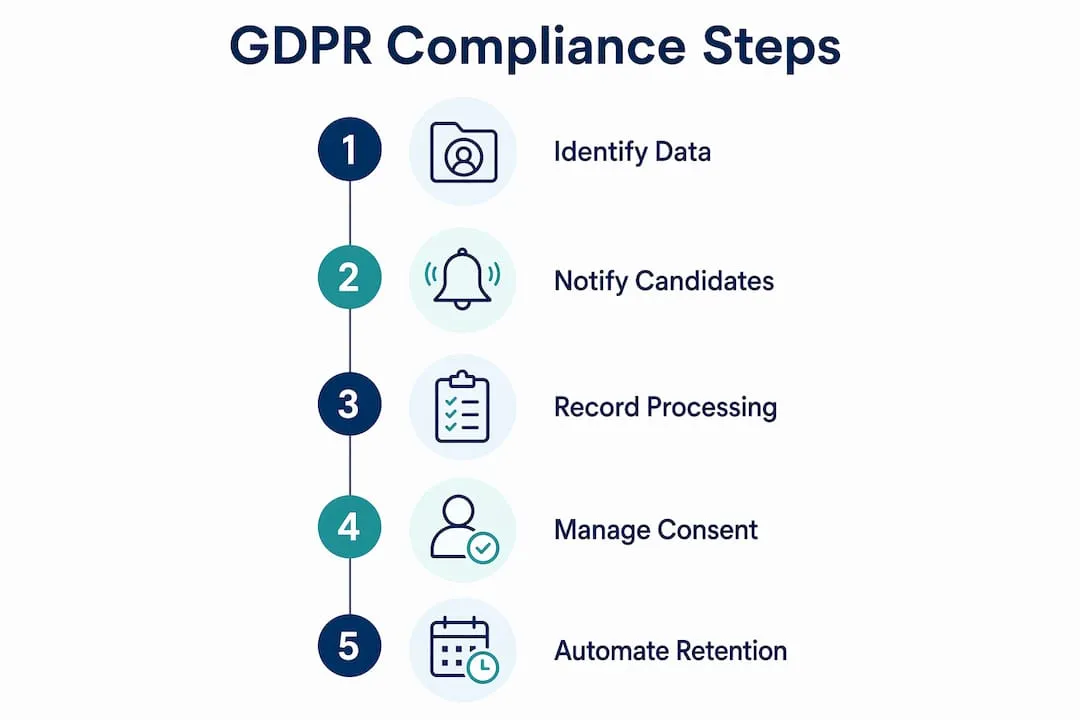
What are the real business risks of non-compliance?
The ICO’s enforcement toolkit goes well beyond fines. Reprimands, mandatory audits, and public disclosure of enforcement action can do more lasting damage to a specialist job board than a financial penalty.

Analysis of UK recruitment data breaches found that most breaches involve HR files, and a misconfigured cloud container exposed thousands of candidate records, resulting in an ICO reprimand in August 2023. That incident cost the organisation far more in reputational terms than any fine: candidates lost confidence, employer clients asked questions, and the board faced a mandatory remediation programme.
The commercial upside of getting this right is just as real. Candidates increasingly check privacy notices before uploading a CV. Boards that publish clear, honest notices and respond promptly to data requests see higher application completion rates and lower candidate churn. For a niche platform serving the UK security sector, where candidates often hold sensitive vetting information, that trust premium is significant.
Key risks at a glance:
- ICO fines of up to £17.5 million or 4% of global annual turnover (whichever is higher) for serious breaches.
- Mandatory remediation orders that can require platform changes within tight deadlines.
- Public reprimands that appear on the ICO register and are indexed by search engines.
- Loss of employer client contracts where clients require GDPR warranties from their data processors.
- Candidate attrition when a breach or poor privacy practice becomes public.
The commercial benefits of compliance are not abstract. A board that can demonstrate clean data practices wins employer trust and candidate loyalty simultaneously.
Consent or legitimate interest: which lawful basis should you use?
This is where most job boards go wrong. Legitimate interest is not a catch-all. APSCo guidance is explicit: recruiters often misapply it, and job boards should favour consent for CV uploads that feed searchable databases, reserving legitimate interest for backend processing with a documented balancing test.
When consent works: A candidate actively uploading their CV to a public-facing searchable database is a strong case for consent. The processing is not something they would obviously expect as a side-effect of applying for a specific role; it is a distinct activity. Consent must be freely given, specific, informed, and unambiguous. A pre-ticked box does not count.
When legitimate interest works: Sending a candidate a job alert based on their saved search preferences, or processing application data to match them to a vacancy, can often rely on legitimate interest. The ICO three-part test requires you to show: (1) a legitimate interest exists; (2) the processing is necessary for that purpose; (3) the individual’s interests do not override yours. Record the outcome of that test in writing.
Sample consent wording for a CV upload: “By uploading your CV, you consent to [Board Name] storing and making your profile searchable to registered employer clients for the purpose of matching you to relevant security sector vacancies. You may withdraw consent at any time by deleting your profile.”
Checklist for lawful-basis documentation:
- Record the chosen basis for each processing activity in your register.
- For legitimate interest, attach the completed three-part balancing test.
- For consent, keep a timestamped record of when and how consent was given.
- Review bases annually or when processing activities change.
Pro Tip: You can use different lawful bases for different features on the same platform. Consent for the searchable CV database; legitimate interest for internal fraud-prevention checks; contract performance for processing an active application. Document each separately.
How do you handle candidate data subject rights in practice?
Candidates have six rights you must be operationally ready to fulfil. Knowing the theory is not enough; you need a process that works on a Tuesday afternoon when a request arrives by email.
The six rights in brief:
- Access (Subject Access Request) — candidates can request a copy of all personal data you hold about them.
- Erasure (“right to be forgotten”) — candidates can ask you to delete their data where there is no overriding legal basis to retain it.
- Rectification — candidates can require you to correct inaccurate data.
- Restriction — candidates can ask you to pause processing while a dispute is resolved.
- Portability — candidates can request their data in a machine-readable format to transfer to another service.
- Objection — candidates can object to processing based on legitimate interest.
Handling a Subject Access Request: step by step
- Acknowledge receipt in writing within three working days.
- Verify the requester’s identity (ask for one piece of ID if there is any doubt).
- Search all systems: platform database, ATS, email, cloud storage, and backups.
- Compile the response, redacting third-party data where necessary.
- Deliver the response within one calendar month of receipt, free of charge in electronic format.
- Log the request, the steps taken, and the date of response.
Handling an erasure request:
- Confirm whether any statutory retention obligation overrides the request (see the retention section below).
- If no override applies, delete from all live systems and flag for deletion from backups at the next scheduled purge cycle.
- Confirm deletion to the candidate in writing.
- Failure to locate and delete candidate data across all systems within one month is itself a UK GDPR breach.
The practical challenge is data mapping. If you cannot tell a candidate exactly where their data sits, you cannot respond to a SAR accurately. A data map covering your platform, email provider, cloud storage, and any third-party ATS is not optional; it is the operational foundation for rights compliance.
What retention periods should your job board apply?
Retention is one of the most common compliance failures, and one of the most fixable. The ICO recommends not keeping unsuccessful candidate data longer than six months, but employment regulations require certain records (including unsuccessful candidate CVs) to be kept for at least one year. The practical solution is to use the statutory minimum of 12 months as your default for candidate records, documenting your justification and automating deletion after that period.
| Record type | Suggested retention trigger | Retention period |
|---|---|---|
| Unsuccessful candidate CV | Date of rejection notification | 12 months (statutory minimum), then delete |
| Active candidate profile (searchable) | Last login or consent renewal | 12 months from last activity |
| Placed candidate records | End of placement | 12 months minimum |
| Interview notes | Date of interview | 12 months, unless you document justification for a shorter period |
| DBS check records | Date of check | Do not retain the certificate; record date and outcome only |
| Employer client correspondence | End of contract | As required by contract law (typically 6 years) |
A practical deletion policy does three things: sets a clear trigger date for each record type, automates the deletion or anonymisation at that date, and logs the deletion event for audit purposes. Manual deletion processes fail. Automation is the only way to demonstrate ongoing accountability to the ICO.
Key steps for a retention policy:
- Define a trigger date for each record category (rejection date, last login, placement end).
- Set automated deletion or anonymisation at the trigger plus the retention period.
- Document the justification for any period that exceeds the ICO’s six-month recommendation.
- Review the policy annually and after any change to statutory requirements.
How do you share candidate data with employers securely?
The moment an employer client accesses your CV database, you have a data-sharing relationship that UK GDPR governs. Whether that employer is a controller in their own right or your processor depends on the facts, but the contractual and technical safeguards are required either way.
Technical measures your platform should have in place:
- Encryption at rest and in transit for all candidate data.
- Role-based access controls so employer clients see only the data they need.
- Multi-factor authentication for all employer and administrator accounts.
- Audit logging of every access to candidate records.
- Regular penetration testing and vulnerability assessments.
- Documented incident response procedure, including a 72-hour breach notification workflow to the ICO.
When an employer accesses your database as a processor (acting on your instructions), your contract with them must include:
When an employer receives candidate data and makes their own decisions about it (a controller-to-controller transfer), you need a data-sharing agreement and a documented lawful basis for the transfer. Redacting direct identifiers before sharing a candidate profile is both a data-minimisation measure and a commercial protection: it limits the personal data transferred and reduces the risk of candidate bypass.

Pro Tip: Vetting employer clients before granting CV database access is a compliance step, not just a commercial one. Confirm they have a privacy notice, a named data protection contact, and a process for handling SARs before you share a single CV.
What extra safeguards apply to special-category and criminal offence data?
Security sector recruitment regularly involves DBS checks, health declarations, and disability information. All of these are either special-category data or criminal offence data under UK GDPR and the Data Protection Act 2018, and they require a higher standard of protection.
Special-category data in recruitment includes: health and disability information, criminal convictions and offences (including DBS check results), biometric data used for identification, and in some contexts, trade union membership.
Processing conditions for special-category data in employment are set out in Schedule 1 of the Data Protection Act 2018. The most relevant for job boards is the employment condition: processing is permitted where it is necessary for employment law obligations, provided the controller has an appropriate policy document in place explaining compliance with Article 5 principles and retention policies.
Practical safeguards:
- Store special-category data separately from standard CV data, with stricter access controls.
- Apply purpose limitation strictly: DBS information collected for vetting must not be used for any other purpose.
- Do not retain DBS certificates. Record the date of the check, the level, and the outcome only.
- Conduct a Data Protection Impact Assessment (DPIA) before launching any new processing activity involving special-category data at scale.
- Limit disclosure to employer clients to the minimum necessary; redact health information from profiles shared with clients unless the role specifically requires it.
Pro Tip: If your platform allows candidates to voluntarily disclose a disability for reasonable adjustments, treat that data as special-category from the moment it is entered. Separate storage, restricted access, and a clear retention trigger are non-negotiable.
What does a practical GDPR checklist for job boards look like?
Compliance is easier to manage when it is broken into timed tasks with clear owners. The list below is ordered by urgency.
This week (immediate fixes):
- Audit your privacy notice against Articles 13 and 14. Does it name your lawful bases, explain data sharing with employer clients, and set out all six candidate rights? If not, rewrite it. The job seeker privacy guide has practical examples of clear notice language.
- Create or update your records of processing activities (ROPA). One row per processing activity, with lawful basis, data categories, recipients, and retention period.
- Check that your CV upload form collects only what is necessary. Remove any fields that are not required for the role category.
- Confirm you have a named data protection contact and that their details are in your privacy notice.
This quarter (mid-term):
- Implement automated retention and deletion for candidate records, using the trigger dates in your retention policy.
- Review all processor contracts with third-party suppliers (cloud hosting, email, ATS). Add GDPR-compliant clauses where missing.
- Conduct a DPIA for any processing activity involving special-category data, AI-assisted screening, or large-scale profiling.
- Run a tabletop breach response exercise. Can your team detect, contain, and notify the ICO within 72 hours?
Ongoing monitoring:
- Schedule annual staff training on data protection, including breach recognition and SAR handling.
- Review your privacy notice and ROPA every time you add a new feature or change a processing activity.
- Keep an audit trail of all compliance decisions, including legitimate-interest balancing tests and DPIA outcomes.
| Task | Owner | Deadline |
|---|---|---|
| Rewrite privacy notice | Data protection lead | This week |
| Complete ROPA | Data protection lead | This week |
| Automate retention/deletion | Product/technical lead | This quarter |
| Processor contract review | Legal/operations | This quarter |
| DPIA for high-risk processing | Data protection lead | This quarter |
| Annual staff training | HR/operations | Annually |
For a deeper walkthrough of platform-level controls, the GDPR compliance guide for 2026 covers candidate rights and practical steps in detail.
Who is responsible for GDPR compliance inside your organisation?
Accountability under UK GDPR does not sit with one person. It is distributed across roles, and the ICO expects you to be able to show who owns what.
Role responsibilities:
- Data protection lead (or DPO): Maintains the ROPA, oversees DPIAs, handles ICO correspondence, and manages SAR responses. For most small-to-medium job boards, a named data protection contact is sufficient; a formal Data Protection Officer is only mandatory where processing is carried out on a large scale as a core activity, or involves systematic monitoring or special-category data at scale.
- Security lead / technical owner: Responsible for encryption, access controls, logging, and incident detection.
- Product owner: Ensures new features are assessed for data protection impact before launch (privacy by design).
- All staff: Must understand what personal data they handle, how to recognise a breach, and who to report it to.
Training checklist:
- Onboarding: every new staff member receives a data protection briefing covering the basics of UK GDPR, the organisation’s privacy notice, and the breach reporting procedure.
- Annual refresher: covers any regulatory changes, lessons from internal incidents, and updates to the ROPA.
- Breach response drill: at least annually, test the 72-hour notification process end to end.
- Supplier awareness: anyone managing processor relationships must understand what a compliant processor contract requires.
Practical compliance requires routine data audits, documented retention policies, and an auditable processing record. The ICO can request evidence of all three.
What are the most common GDPR mistakes job boards make?
Most compliance failures are not dramatic. They are mundane: a retention policy that was never automated, a privacy notice that was copied from a template and never updated, a legitimate-interest basis that was asserted but never tested.
Common mistakes and quick fixes:
- Indefinite retention: CVs sitting in a database with no deletion trigger. Fix: implement automated deletion at the retention period trigger date.
- Vague privacy notices: Generic notices that do not name lawful bases or explain data sharing with employer clients. Fix: rewrite against an Article 13/14 checklist; the best practices guide for job postings has a useful data-minimisation checklist.
- Misusing legitimate interest: Applying it to every processing activity without a balancing test. Fix: complete and document the ICO three-part test for each activity where you rely on it.
- Unsecured cloud storage: Candidate data in a misconfigured cloud container with no access controls. The August 2023 ICO reprimand that exposed 12,000 records was exactly this scenario. Fix: audit cloud storage permissions quarterly.
- No DPIA for high-risk processing: Launching AI-assisted screening or large-scale CV profiling without a DPIA. Fix: build a DPIA template and make it a mandatory gate for new product features.
- No breach response plan: Discovering a breach and not knowing whether it meets the 72-hour notification threshold. Fix: document the decision tree and test it in a drill.
Pro Tip: The single fastest compliance win for most job boards is fixing the privacy notice. A notice that clearly names your lawful bases, explains employer data sharing, and links to a SAR request form costs nothing to produce and immediately reduces your regulatory exposure.
What does the ICO expect, and what are the penalties?
The ICO’s recruitment and selection guidance is the primary reference for job boards. It covers lawful bases, transparency, special-category data, AI and automated decision-making, and vetting. Where the guidance says “should”, the ICO treats that as an expectation: you can depart from it, but you must be able to justify the departure.
Key enforcement expectations:
- 72-hour breach notification: From the moment you become aware of a breach likely to risk individuals’ rights and freedoms, the clock starts. Documentation of all breaches, including those below the notification threshold, is required.
- Subject access response: One calendar month from receipt, with a possible one-month extension for complex requests (notified to the requester before the first deadline).
- Reprimands: The ICO issues reprimands for breaches that do not meet the threshold for a fine but still represent a failure of compliance. These are published and indexed.
- Fines: Up to £17.5 million or 4% of global annual turnover for the most serious infringements.
Cross-border transfers post-Brexit: The UK operates its own adequacy framework. Transfers to countries on the UK’s adequacy list (which includes the EEA) are permitted without additional safeguards. Transfers to other countries require an appropriate transfer mechanism, such as the UK’s International Data Transfer Agreement (IDTA) or the Addendum to the EU Standard Contractual Clauses. If your job board shares candidate data with employers or processors outside the UK, you need a documented transfer mechanism in place.
The Data (Use and Access) Act 2025, provisions of which came into force in early 2026, updated obligations for platforms using automated decision-making to screen or rank candidates. If your platform uses AI scoring, you must apply safeguards and maintain meaningful human oversight.
What do experts say about legitimate interest and candidate rights?
The most persistent compliance trap in recruitment is treating legitimate interest as a default rather than a tested and documented choice.
APSCo’s GDPR guidance is direct on this point: recruiters routinely misapply legitimate interest, and the absence of a documented balancing test is the single most common finding in ICO investigations of recruitment organisations. The test must be completed before processing begins, not retrospectively after a complaint.
Two practical examples where documentation would have prevented a breach:
- A job board relied on legitimate interest for making candidate CVs searchable to all registered employers, without a balancing test. A candidate objected, the board had no documented basis to rely on, and the ICO found the processing unlawful. A completed balancing test, filed before the feature launched, would have resolved the question.
- A recruiter shared a candidate’s health disclosure with an employer client without redacting it, on the basis that the employer “needed to know”. No purpose-limitation check was in place. Redacting the health information before sharing, and documenting the decision, would have been both compliant and commercially sensible.
The ICO’s own guidance reinforces this: compliance is not a one-off project. Ongoing operational controls, regular audits, and up-to-date privacy notices are the expectation, not the exception.
Key takeaways
Job boards that document their lawful bases, automate retention, and publish a clear privacy notice meet the core UK GDPR obligations and reduce both regulatory and commercial risk.
| Point | Details |
|---|---|
| Document lawful bases | Record the basis for every processing activity; complete and file a balancing test for any legitimate interest claim. |
| Automate retention and deletion | Set trigger-based deletion for all candidate record types; adopt the one-year statutory minimum where required and document the justification. |
| Publish a compliant privacy notice | Meet Articles 13 and 14 by naming lawful bases, explaining employer data sharing, and setting out all six candidate rights. |
| Respond to SARs within one month | Map your data across all systems so you can locate, compile, and deliver a subject access response within the one-calendar-month deadline. |
| Securityjobsboard | Built for UK security sector compliance, with candidate profile controls, CV upload settings, and privacy features designed to support GDPR obligations. |
The compliance gap most job boards ignore
The conventional wisdom on GDPR for job boards tends to focus on the privacy notice and the SAR process. Both matter, but neither is where most boards actually fail.
The real gap is retention. Boards launch, collect thousands of CVs, and never build a deletion workflow. Two years later, they are sitting on a database of candidates who applied for roles that no longer exist, whose consent (if it was ever properly obtained) has long since lapsed, and who have no idea their data is still there. That is not a theoretical risk. It is the scenario that produced the August 2023 ICO reprimand, and it is the scenario most likely to produce the next one.
The fix is not complicated. It requires a trigger date, an automated deletion job, and a log. What it requires is treating retention as a product feature, not a legal afterthought. The boards that get this right build it into their platform architecture from the start. The ones that do not end up retrofitting it under pressure, usually after a complaint or an ICO inquiry.
Legitimate interest is the other persistent trap. It is genuinely useful for backend processing, fraud prevention, and matching. It is not a substitute for consent when you are making a candidate’s CV searchable to hundreds of employer clients. The distinction is not subtle, but it is routinely ignored. Document the test, file the outcome, and review it when the processing changes.
Securityjobsboard: built for compliant UK security recruitment
Running a job board in the UK security sector means handling candidate data that is often sensitive: vetting history, licence numbers, and employment records that candidates trust you to protect. Securityjobsboard is built with that responsibility in mind. Candidate profiles include privacy controls, CV upload settings, and consent management features that align with UK GDPR obligations from the moment a candidate registers.

For recruiters and employers, the platform provides a structured environment for accessing candidate data, with clear terms governing how CVs can be used and shared. The BSIA affiliation adds an additional layer of sector credibility, and the platform’s focus on the UK security market means the compliance features are calibrated to the specific data types and vetting requirements that security recruitment involves.
If you are looking to post vacancies on a platform that takes candidate data protection seriously, or if your candidates need access to career advice and resources that reflect current privacy standards, Securityjobsboard is the practical next step. Visit https://www.securityjobsboard.co.uk to post a role or explore the platform’s compliance features today.
Useful sources and further reading
- ICO: Recruitment and selection guidance — the primary official reference for lawful bases, transparency, special-category data, and AI in recruitment. Start here.
- Data Protection Act 2018, Schedule 1 — the statutory conditions for processing special-category and criminal offence data in employment contexts.
- LexisNexis: Recruitment and selection data protection — detailed legal commentary on UK GDPR and DPA 2018 in recruitment, including AI and automated decision-making under the Data (Use and Access) Act 2025.
- APSCo: GDPR FAQs — sector-specific guidance on legitimate interest, consent, and common compliance traps for recruitment agencies.
- recLAW: GDPR compliance for recruitment agencies — practical legal advice on audit trails, retention policies, and processing records.
- Securityjobsboard: Protect candidate data in recruitment — platform-specific guidance on candidate rights, SARs, and practical steps for security sector job boards.
- Securityjobsboard: GDPR compliance benefits for UK security employers — explores the commercial case for compliance in the UK security recruitment market.
FAQ
How does GDPR affect recruitment in the UK?
UK GDPR applies to every stage of recruitment where personal data is processed. Job boards and recruiters must have a documented lawful basis for collecting CVs, publish a compliant privacy notice, respond to subject access requests within one calendar month, and delete candidate data once the retention period expires.
Who is responsible for GDPR compliance on a job board?
The job board operator is the data controller and carries primary responsibility. A named data protection lead (or formal DPO where required) manages day-to-day compliance, but accountability extends to product owners, security leads, and all staff who handle candidate data.
Does GDPR apply to employers who access a CV database?
Yes. Employers who receive candidate data and make their own decisions about it become controllers in their own right. The job board must have a data-sharing agreement or compliant processor contract in place before granting access, and the employer must have their own privacy notice and SAR process.
Is a GDPR clause required when a candidate submits a CV?
Not a clause in the CV itself, but the job board must provide an Article 13 privacy notice at the point of collection, explaining the lawful basis, how data will be used, who it will be shared with, and how long it will be kept. A pre-ticked consent box does not satisfy this requirement.
What is the ICO’s recommended retention period for candidate CVs?
The ICO recommends not keeping unsuccessful candidate data longer than six months. However, the Conduct of Employment Agencies and Employment Businesses Regulations 2003 sets a one-year statutory minimum for certain records. The defensible approach is to adopt the one-year minimum, document the justification, and automate deletion after that period.
This article provides general information about UK GDPR obligations for job boards and recruiters. It is not legal advice. Confirm current requirements with the ICO’s official guidance or a qualified data protection professional for your specific situation.


