What Is a DBS Check in UK Security Jobs

Nearly every British security professional faces rigorous checks when applying for industry roles. The Disclosure and Barring Service process helps organisations filter out unsuitable candidates, protecting vulnerable groups across the United Kingdom. With more than 90 percent of UK employers considering DBS checks essential for compliance, understanding these screening requirements can make or break your job prospects. This guide reveals key facts about DBS checks, highlighting how each step impacts your employment success and professional reputation.
Table of Contents
- Definition And Purpose Of DBS Checks
- Types Of DBS Checks For Security Roles
- DBS Check Process And How It Works
- Legal Requirements And Recent Updates
- Implications For Security Professionals
- Common Challenges And Compliance Risks
Key Takeaways
| Point | Details |
|---|---|
| Purpose of DBS Checks | DBS checks are essential for safeguarding vulnerable populations by preventing unsuitable individuals from gaining access to sensitive roles. |
| Levels of DBS Checks | There are three types of DBS checks: Basic, Standard, and Enhanced, each offering varying levels of detail suitable for different job roles. |
| DBS Check Process | The DBS check involves multiple stages, including application, identity verification, background screening, and certificate issuance, typically taking around 14 days. |
| Legal Compliance | Employers must adhere to legal frameworks such as the Rehabilitation of Offenders Act and the Data Protection Act to ensure ethical recruitment practices. |
Definition and purpose of DBS checks
A Disclosure and Barring Service (DBS) check is a comprehensive criminal record screening process specifically designed to help employers in the UK make safer recruitment decisions. This critical verification mechanism ensures that organisations protect vulnerable populations by preventing unsuitable individuals from accessing sensitive roles. Criminal record checks help safeguard organisations across various sectors, particularly those involving children, vulnerable adults, and high-responsibility positions.
The primary purpose of a DBS check revolves around risk mitigation and public safety. By searching police records and maintaining specialised barred lists, these checks provide employers with essential background information about potential employees. Preventing unsuitable candidates from working in sensitive roles is the fundamental objective, ensuring that individuals with problematic criminal histories are appropriately screened before employment.
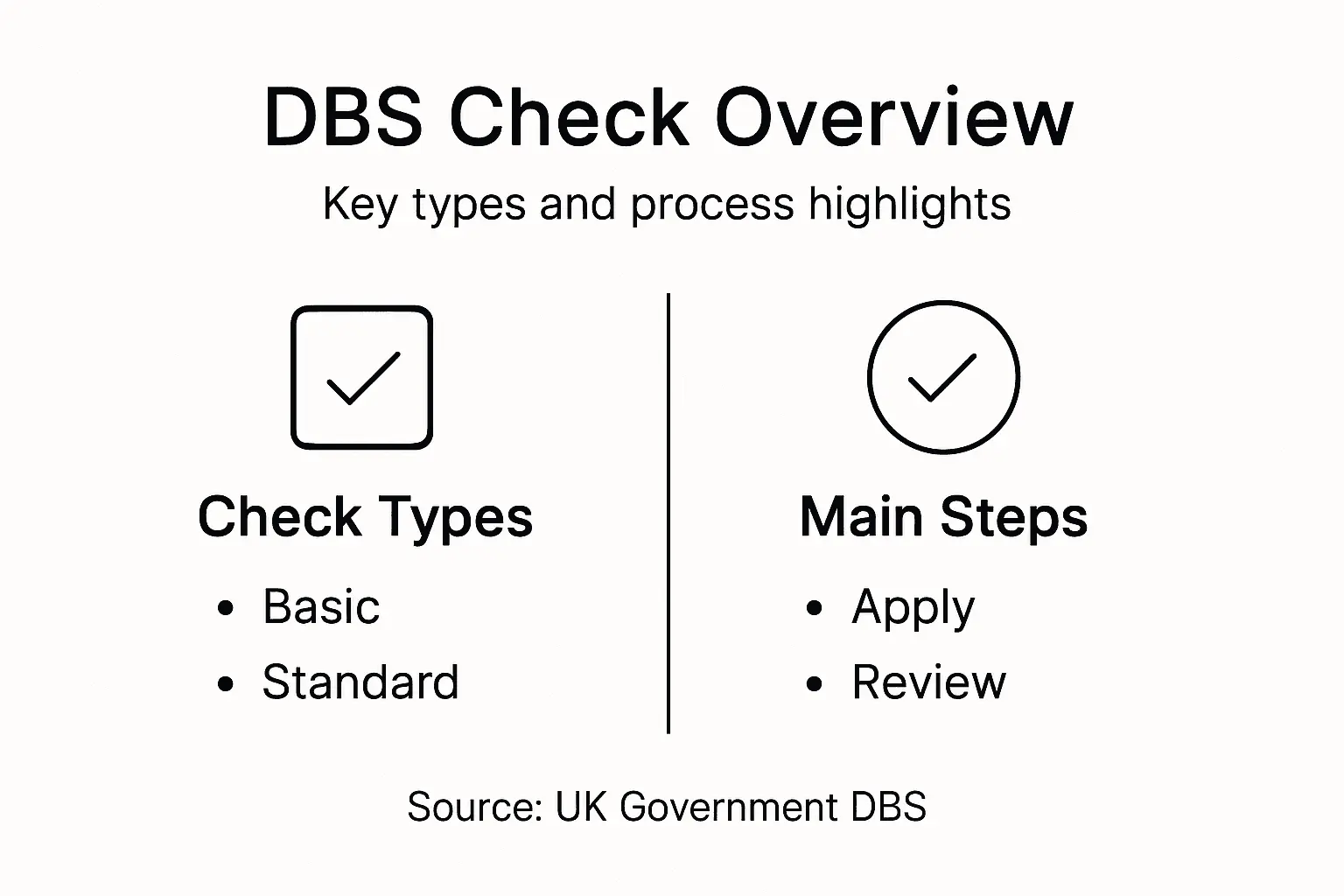
DBS checks are not uniform but come in different levels of detail, typically categorised as basic, standard, and enhanced checks. Each level provides progressively more comprehensive information:
- Basic Check: Shows unspent criminal convictions
- Standard Check: Includes spent and unspent convictions, cautions, reprimands, and warnings
- Enhanced Check: Most comprehensive, including all standard check information plus any additional police intelligence deemed relevant
Pro tip: Always verify the specific DBS check level required for your particular security role, as different positions demand different levels of background screening.
Types of DBS checks for security roles
In the security sector, understanding the different types of Disclosure and Barring Service (DBS) checks is crucial for both employers and job seekers. Standard DBS checks reveal comprehensive criminal histories that help organisations make informed recruitment decisions. These checks are not one-size-fits-all but are tailored to specific job roles and levels of responsibility.
The primary types of DBS checks are categorised into three distinct levels, each providing varying degrees of background information. Security professionals typically encounter the following check levels:
- Basic DBS Check
- Shows only unspent criminal convictions
- Lowest level of disclosure
- Available to individuals for self-checking
- Least detailed background verification
- Standard DBS Check
- Includes both spent and unspent criminal convictions
- Reveals cautions, reprimands, and warnings
- Commonly required for security guard positions
- Provides more comprehensive screening than basic checks
- Enhanced DBS Check
- Most comprehensive background verification
- Includes all standard check information
- Additional police intelligence and contextual information
- Mandatory for roles involving vulnerable populations
- Potential inclusion of barred list checks
Within security roles, the specific check required depends on the nature of the position. Roles with higher levels of responsibility or potential interaction with vulnerable groups typically demand more rigorous screening. Private security positions often require at least a Standard DBS check, while roles in sensitive environments might necessitate an Enhanced check.
Here’s a concise comparison of DBS check levels and their suitability for different security roles:
| DBS Check Level | Suitable Roles | Level of Detail |
|---|---|---|
| Basic | Entry-level security staff | Limited information |
| Standard | Security guards and supervisors | Comprehensive criminal record |
| Enhanced | Work with children or vulnerable adults | Full detail plus police insights |
Pro tip: Always confirm the exact DBS check level required by your prospective employer, as different security positions have varying background screening requirements.
DBS check process and how it works
The Disclosure and Barring Service (DBS) check process involves multiple critical steps designed to ensure comprehensive background verification for potential employees. Employers request checks through authorised channels that require meticulous documentation and personal identification to maintain rigorous screening standards.
The typical DBS check process follows a structured sequence of stages:
- Initial Application
- Employer determines required DBS check level
- Candidate receives application instructions
- Candidate completes official DBS application form
- Identity Verification
- Candidate provides multiple identity documents
- Documents undergo thorough cross-referencing
- Proof of address and personal identification required
- Background Screening
- Criminal record checks performed systematically
- Police records searched for relevant information
- Potential barred list checks conducted
- Information compiled into comprehensive report
- Certificate Issuance
- DBS generates official certificate
- Certificate sent directly to applicant
- Applicant must share certificate with prospective employer
- Employer reviews and verifies certificate details
The entire process typically requires approximately 14 days, though complex cases involving multiple police jurisdictions might extend processing times. Security professionals must understand that each stage is crucial for maintaining industry safety standards and preventing unsuitable candidates from accessing sensitive roles.

Pro tip: Gather and organise all required identity documents in advance to streamline your DBS check application and minimise potential processing delays.
Legal requirements and recent updates
The legal landscape surrounding DBS checks is complex and continually evolving, with multiple legislative frameworks governing how criminal record information is obtained, processed, and managed. Employer obligations require careful compliance with stringent regulations designed to protect both organisational interests and individual privacy rights.
Key legal frameworks governing DBS checks include:
- Rehabilitation of Offenders Act
- Regulates disclosure of criminal convictions
- Determines which convictions become ‘spent’
- Defines exceptions for specific sensitive roles
- Data Protection Act
- Governs personal data processing standards
- Ensures secure handling of sensitive information
- Mandates transparency in data management
- Protects individual privacy rights
- Police Act
- Establishes legal basis for criminal record checks
- Defines permissible information disclosure
- Supports national security screening processes
Recent legislative updates have focused on streamlining verification processes while maintaining robust safeguarding standards. Employers must now navigate increasingly nuanced requirements, including more precise guidelines about which criminal records can be disclosed and under what circumstances.
The ongoing refinement of these legal frameworks reflects a delicate balance between protecting vulnerable populations and ensuring fair treatment of individuals with previous criminal records. Security sector employers must stay continuously informed about these evolving legal standards to maintain compliance and ethical recruitment practices.
For quick reference, here’s how legal frameworks influence DBS check compliance in the security sector:
| Legal Framework | Primary Impact | Key Security Sector Implication |
|---|---|---|
| Rehabilitation of Offenders Act | Defines disclosure limits | Protects candidate rights in recruitment |
| Data Protection Act | Governs data handling | Ensures confidentiality and data security |
| Police Act | Allows record checking | Enables thorough vetting of applicants |
Pro tip: Consult legal professionals specialising in employment law to ensure your organisation’s DBS check procedures remain fully compliant with the latest regulatory requirements.
Implications for security professionals
DBS checks represent a critical professional benchmark for security personnel, fundamentally reshaping employment opportunities and professional credibility within the industry. Professional employment depends on appropriate checks that validate an individual’s suitability for sensitive roles involving public safety and organisational security.
Key professional implications encompass several critical dimensions:
- Employment Eligibility
- Direct impact on job prospects
- Determines access to security roles
- Essential for maintaining professional standing
- Required for legal employment in sensitive sectors
- Professional Reputation
- Demonstrates personal integrity
- Builds trust with potential employers
- Signals commitment to ethical standards
- Differentiates candidates in competitive job markets
- Career Progression
- Regular checks support ongoing professional development
- Compliance with organisational policies enhances career opportunities
- Enables continuous professional credibility
- Supports long-term career stability
Security professionals must recognise that DBS checks are more than bureaucratic procedures. They represent a fundamental mechanism for maintaining industry standards, protecting vulnerable populations, and ensuring that only qualified, trustworthy individuals occupy critical security roles.
Navigating these requirements demands proactive management of one’s professional profile, including maintaining clean criminal records, understanding check processes, and staying updated on legislative changes that might impact employability.
Pro tip: Register with the DBS Update Service to streamline future background checks and demonstrate ongoing professional commitment.
Common challenges and compliance risks
The landscape of DBS checks is fraught with complex challenges that demand meticulous attention from security professionals and employers alike. Navigating regulatory compliance requires careful strategy to mitigate potential legal and professional risks associated with background screening processes.
Key challenges and compliance risks include:
- Application and Processing Risks
- Incorrect personal information submission
- Misidentification of appropriate check level
- Delays in processing background checks
- Incomplete or inaccurate documentation
- Legal and Ethical Compliance
- Preventing discriminatory hiring practices
- Proper handling of sensitive personal data
- Understanding complex conviction filtering rules
- Ensuring fair treatment of candidates
- Data Protection and Privacy
- Maintaining strict confidentiality of DBS information
- Compliance with Data Protection Act requirements
- Secure storage and management of criminal record data
- Preventing unauthorised information disclosure
Security professionals must develop a proactive approach to managing these risks. This involves staying informed about legislative changes, implementing robust internal procedures, and maintaining a comprehensive understanding of legal obligations surrounding criminal record checks.
Effective risk management requires ongoing training, systematic review of screening processes, and a commitment to transparency and fairness throughout the recruitment and vetting process.
Pro tip: Develop a comprehensive internal policy document that clearly outlines DBS check procedures and compliance requirements to minimise potential legal and professional risks.
Secure Your Future with Confidence: Navigate DBS Checks and Find Trusted Security Jobs Today
Understanding the importance of DBS checks is essential for every security professional aiming to build a trustworthy and successful career in the UK. From managing compliance risks to ensuring you meet the right background screening requirements, these checks shape your employment opportunities and professional reputation. If you want to overcome the challenges of navigating DBS processes and secure the right role that matches your qualifications and DBS status, access dedicated tools that simplify your job search and application journey.

Explore tailored security job listings where DBS check requirements are clearly outlined and connect with reputable employers who value compliance and professional integrity. Visit Security Jobs Board to create your profile, upload your CV and set personalised job alerts today. Don’t wait — take control of your career advancement and stay ahead in the competitive security sector by leveraging a platform built specifically for DBS-verified recruitment. Start now at https://www.securityjobsboard.co.uk/ and let us help you bridge the gap between your professional DBS compliance and your next career opportunity.
Frequently Asked Questions
What is the purpose of a DBS check in security jobs?
A DBS check helps employers in the UK make safer recruitment decisions by screening potential employees’ criminal records to protect vulnerable populations and ensure public safety.
What are the different types of DBS checks available?
The three main types of DBS checks are Basic, Standard, and Enhanced checks. Basic checks show unspent convictions, Standard checks include both spent and unspent convictions as well as cautions, and Enhanced checks provide comprehensive information including police intelligence relevant to the role.
How long does the DBS check process take?
Typically, the DBS check process takes around 14 days, but it may take longer if there are complex cases or multiple police jurisdictions involved.
What are the implications of having a DBS check for security professionals?
Having a DBS check is crucial for employment eligibility in security roles, affects professional reputation, and impacts career progression, as many positions require verification of an individual’s integrity and suitability for sensitive roles.


