Find UK Jobs Faster: Use 2–3 Job Search Sites + One Niche Board

Five categories of job search website matter in the UK: aggregators, the national government service, traditional job boards, professional networks and niche boards. Pick two or three general platforms, add one niche board suited to your sector, and set alerts on all of them today. That combination covers volume, verified listings and the specialist relevance that generic sites miss.
TL;DR:
- Using two or three generalist platforms, along with one sector-specific niche board, maximizes relevant job opportunities while avoiding time-wasting duplicates.
- Setting alerts on small, focused sites, like Security Jobs Board for security roles, ensures timely notifications for faster-melting opportunities in competitive sectors.
- Applying selectively with tailored cover letters and making direct contact with recruiters enhances response rates over mass, one-click applications.
- Regularly checking alerts daily and refining CVs for clarity on licenses and certifications improves application quality and success chances.
- Relying on niche boards with sector-specific features and credibility, such as GDPR compliance and professional affiliations, streamlines matching and credibility.
Table of Contents
- What are some job search websites, and what does each one do?
- How to choose which sites to use for your search
- A weekly routine for combining platforms, networking and agencies
- Why niche boards work, and how Security Jobs Board fits in
- Your quick-start checklist for the next seven days
- What actually moves the needle
- Find security roles built for your CV, not buried under everyone else’s
- Sources
- FAQ
What are some job search websites, and what does each one do?
Aggregators pull listings from thousands of company sites, agencies and job boards into one search bar. They give you volume and speed, and their filters let you narrow by salary, location and contract type in seconds. The trade-off is duplication: the same vacancy often appears three or four times under different postings, and aggregators index listings from job boards, company sites and agencies without always removing the repeats.
The national government service works differently. Find a job lets candidates search vacancies, upload CVs and set email alerts across England, Scotland and Wales, and it’s free, with thousands of new listings added daily. It’s also one of the few places that reliably surfaces public-sector and welfare-assisted roles that never make it onto commercial platforms.

Traditional job boards sit closer to the employer. Listings tend to come from the company directly rather than through a scraped feed, which usually means fewer duplicates and more accurate detail on pay and hours. Industry roundups on UK job sites point to this direct-posting model as the main reason traditional boards still outperform aggregators for sector depth.
Professional networks add a different layer entirely: they’re where recruiters go looking for you, not just where you go looking for them. A strong profile on a network can generate inbound contact even when you’re not actively applying.
Then there are niche boards, built around a single industry. For security professionals, that’s Security Jobs Board (Securityjobsboard), a UK platform focused entirely on security vacancies rather than a general feed with a “security” filter bolted on.
- Aggregators: fast, wide coverage, but duplicate listings are common.
- Find a job (GOV.UK): free, government-run, strong for public-sector roles.
- Traditional job boards: direct employer postings, better sector accuracy.
- Professional networks: recruiter visibility and passive discovery.
- Niche boards: sector-specific relevance, smaller but higher-quality pools.
How to choose which sites to use for your search
Match the platform to the role before you match it to convenience. A warehouse operative role and a corporate security manager role need different sites entirely, so start with what the job actually is rather than which app has the nicest interface.
- Check regional coverage. Some boards are London-heavy; others, including Find a job, cover England, Scotland and Wales properly.
- Test the filters. Can you search by shift pattern, SIA licence, or contract type, or just by job title and postcode?
- Compare alert quality. A good alert sends you three relevant roles a day, not thirty vaguely related ones.
- Weigh easy-apply against response rate. Guides on UK job boards warn that one-click applications increase your volume of applications but often lower your reply rate, because employers can tell when a CV wasn’t tailored.
- Apply the 2–3 plus 1 rule. Two or three generalist platforms alongside one niche board is the mix most jobseekers settle on once they’ve tried the alternative of scattering effort across ten sites.
Pro Tip: Set your niche board alert first, not last. Sector-specific roles often close faster than generic ones because the applicant pool is smaller and recruiters move quickly once they find a good match.
A weekly routine for combining platforms, networking and agencies
Job hunting works better as a routine than a scramble. Check your alerts every morning, apply to genuinely matching roles the same day, and save anything uncertain for a second look at the end of the week rather than deleting it outright.
Split your effort deliberately. Use easy-apply on aggregators for volume and practice, but reserve tailored, hand-written applications for roles you actually want. That distinction alone changes how employers read your CV.
- Check alerts daily across your 2–3 generalist platforms and one niche board.
- Send one or two tailored applications per day rather than ten identical ones.
- Message a recruiter or hiring contact directly at least once a week; networking strategies aimed at logistics managers apply just as well to security and other operational sectors.
- Follow up seven to ten days after applying, referencing the specific role and one reason you’re still interested.
Agencies and recruiters fill a gap boards can’t. Many roles, especially in security, never get advertised publicly because a recruiter fills them from an existing candidate pool. Being on that pool’s radar matters as much as any job board search.
Why niche boards work, and how Security Jobs Board fits in
A niche board narrows the applicant pool to people who actually fit the sector, which cuts down on irrelevant applications for employers and speeds up matching for candidates. That focus is the main advantage a specialist site has over a general one, and it’s most valuable in sectors with licensing requirements, shift patterns, or clearances that a generic filter can’t capture.
Security Jobs Board builds around exactly that gap. Candidates can:
- Create a free profile and upload a CV in minutes.
- Set alerts for specific roles, regions or shift types.
- Apply directly to security-specific vacancies, from door supervision to corporate risk management.
- Use it on mobile, since the site is built to be mobile-responsive.
The platform’s BSIA affiliation adds a layer of credibility that generic boards can’t offer, and its GDPR-compliant handling of candidate data matters in a sector where background checks and vetting are already routine. For readers who want a deeper look at how niche matching compares to broad platforms, the advantages of niche job boards for security roles is worth the extra five minutes.
Your quick-start checklist for the next seven days
Momentum matters more than perfection here. A rough version of the right routine beats a perfect version you never start.
- Set alerts on two generalist platforms covering your region and role type.
- Set one alert on a niche board, such as Security Jobs Board if you work in the sector.
- Upload and tidy your CV, checking it lists licences, clearances or certifications clearly near the top.
- Send two tailored applications this week, not ten rushed ones.
- Contact one recruiter or hiring manager directly, even a short message asking about upcoming roles.
Do this once, and the following weeks take a fraction of the effort, because the alerts and profile are already doing the searching for you.
What actually moves the needle
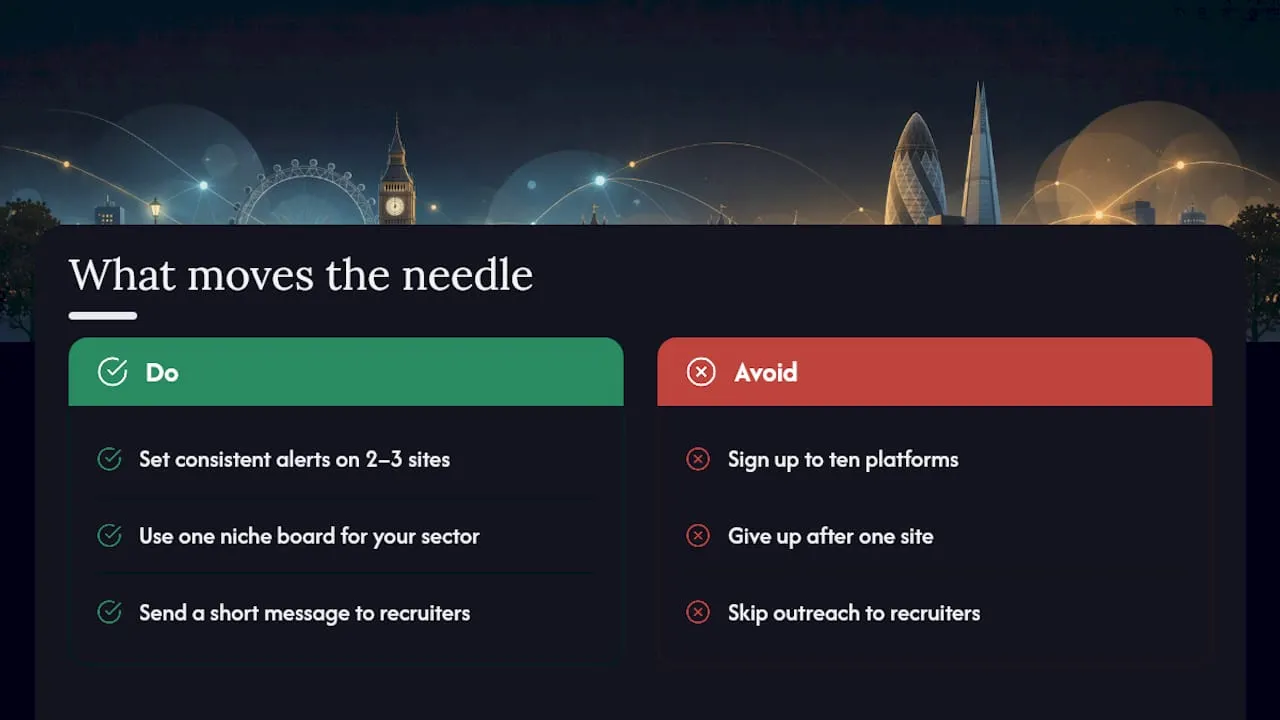
The single habit worth keeping from all of this is boring but effective: consistent alerts on a small, well-chosen set of sites, plus one niche board that actually understands your sector. Most people either drown themselves in ten platforms or give up after one, and both approaches waste time.
Outreach is the part people skip because it feels uncomfortable, yet it’s often what turns an application into an interview. A short message to a recruiter costs you two minutes and can save you weeks of silence from an online form.
— Rob
Find security roles built for your CV, not buried under everyone else’s
If you’ve spent this week wading through general job sites where a “security” search returns retail supervisor roles with a stretch of the imagination, you already know the problem: broad boards weren’t built for sectors with licensing, vetting and shift patterns baked in. Security Jobs Board was.

Candidates get a free profile, CV upload, tailored alerts and mobile access, and the site’s affiliation with the BSIA gives employers and candidates alike a reason to trust who they’re dealing with. If you’re job hunting in Northern Ireland specifically, browse current security roles in Northern Ireland directly, or head to the career advice section first if your CV needs sharpening before you apply. Either way, set your alert today at Securityjobsboard and let relevant roles come to you instead of the other way round.
Sources
For official guidance, GOV.UK’s Find a job service and JobHelp’s job vacancy advice both cover the basics of searching and applying through government channels. For broader platform comparisons, see TechRadar’s UK job site roundup and the Atlas Job guide to UK job boards.
- Where to find job vacancies - National Careers Service
- Best UK job site of 2026 | TechRadar
- The 17 UK Job Boards Ranked: Where the Jobs Actually Are in 2026 | Atlas Job
FAQ
Why is Gen Z struggling to find jobs?
Younger jobseekers often rely too heavily on easy-apply aggregators, which increases application volume without improving reply rates; mixing in direct employer applications and niche boards tends to produce better results.
What are the best UK job search sites?
The strongest approach combines two or three generalist platforms, the free government service Find a job, and one niche board relevant to your sector, such as Security Jobs Board for security roles.
Which UK job site is easiest to use?
Find a job is widely regarded as the simplest starting point since it’s free, government-run and covers England, Scotland and Wales without any sign-up cost or paywall.
What job site has the most UK listings?
Aggregators typically show the highest volume of listings because they pull from multiple job boards and company sites at once, though this also means more duplicate postings to filter through.


