Why Your CV Matters When Applying for Security Jobs

A CV is your golden ticket in the security industry. With employers making decisions in as little as 30 seconds, there is barely time to make a mark. Yet the biggest mistake most jobseekers make is filling it with job history and hoping for the best. Flip the script and you turn a bland CV into a powerful pitch that sharpens your professional appeal far beyond simple work records.
Table of Contents
- What Is A CV And Its Purpose In Job Applications?
- The Importance Of A CV In The Security Job Market
- Key Components Of An Effective CV For Security Roles
- How A CV Influences Employer Decision-Making
- Best Practices For Tailoring Your CV In The Security Industry
Quick Summary
| Takeaway | Explanation |
|---|---|
| Craft a compelling CV narrative | Your CV should tell a story of your professional growth and capabilities, rather than just listing jobs. |
| Highlight specific security skills | Clearly document technical skills and operational experience relevant to the security role you seek. |
| Tailor CV for each job application | Customise your CV for different roles to align closely with job descriptions, enhancing selection chances. |
| Emphasise professional certifications | Showcase relevant security licenses and certifications that validate your expertise and qualifications in the field. |
| Focus on achievements, not just duties | Quantify your achievements in previous roles to demonstrate your impact and effectiveness as a security professional. |
What is a CV and its Purpose in Job Applications?
A CV (Curriculum Vitae) serves as the primary professional narrative for job seekers in the security industry, functioning as a comprehensive document that summarizes an individual’s professional background, skills, and potential. Unlike a simple job history, a CV represents a strategic communication tool that showcases a candidate’s unique professional identity and suitability for specific security roles.
Understanding the Core Purpose of a CV
The fundamental role of a CV in job search is to create a compelling first impression for potential employers. According to CIPD Career Development Research, a well-constructed CV acts as your personal marketing document, highlighting your professional capabilities and differentiating you from other candidates in the competitive security job market.
A CV performs several critical functions:
- Provides a structured overview of professional experience
- Demonstrates relevant skills and qualifications for security positions
- Communicates professional achievements and competencies
- Serves as an initial screening tool for recruiters and hiring managers
Crafting a Professional Security Industry CV
In the security sector, a CV must go beyond generic descriptions and provide specific evidence of professional capabilities. Employers seek detailed insights into a candidate’s technical skills, operational experience, and potential to contribute to organisational security objectives.
Key elements that make a security industry CV stand out include:
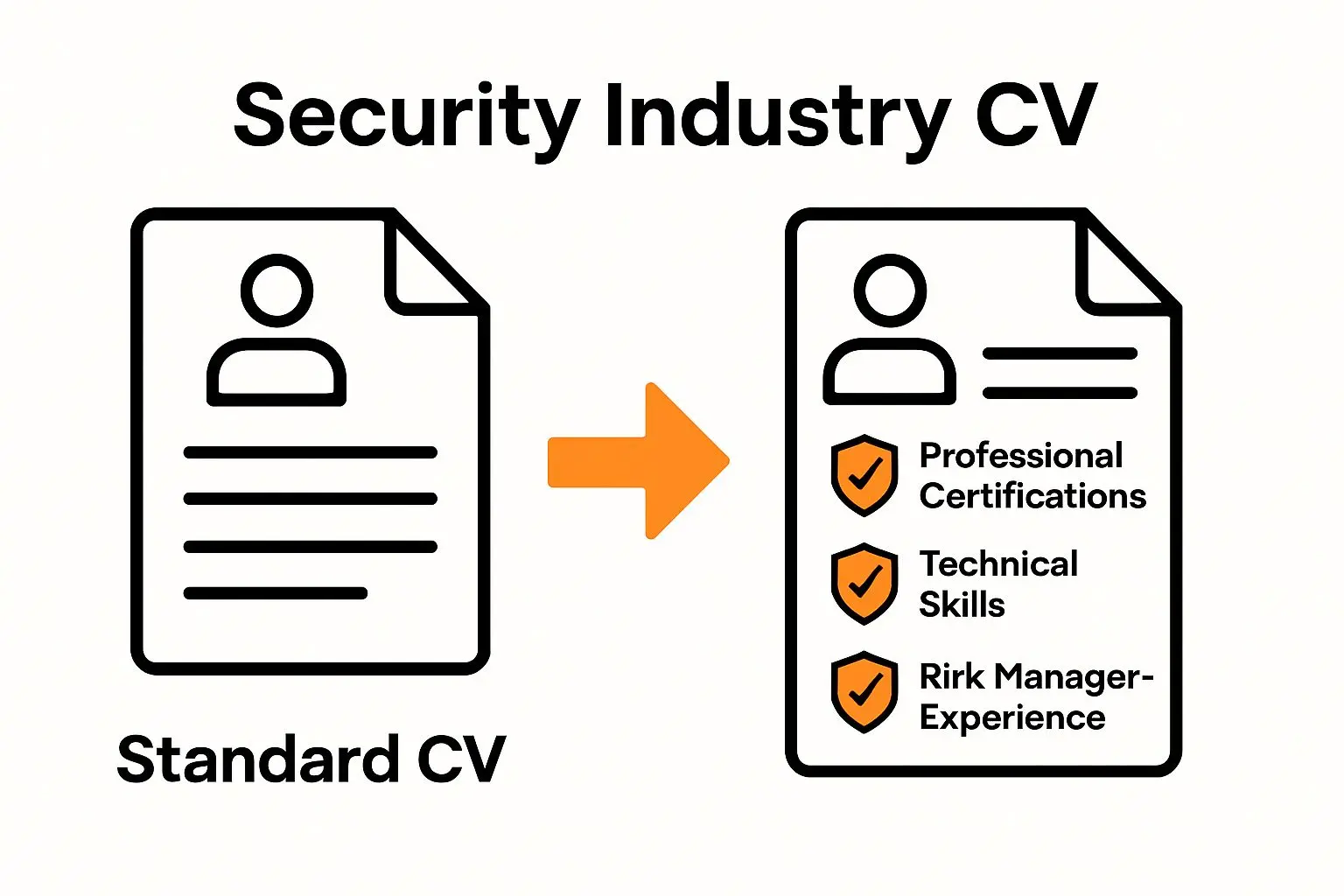
- Detailed description of security certifications and training
- Specific examples of risk management and threat mitigation
- Demonstrable experience in surveillance, access control, or security protocols
- Clear indication of physical and technical security competencies
By presenting a comprehensive yet concise narrative of professional capabilities, jobseekers can significantly enhance their chances of securing interviews and ultimately landing desired positions within the security industry.
To clarify the unique requirements for CVs in the security industry, the following table compares generic CV content with security-specific CV content as discussed in the article.
| Aspect | Generic CV Content | Security Industry CV Content |
|---|---|---|
| Professional Credentials | Basic educational qualifications | Security licences, official certifications, and memberships |
| Work Experience | General job duties and history | Specific operational experience and quantifiable achievements |
| Technical Proficiencies | Basic computer or job-related skills | Detailed security technology and risk management skills |
| Narrative and Branding | Standard career summary | Targeted professional narrative demonstrating sector insight |
| Content Customisation | One-size-fits-all approach | Aligned with each security job description |
| Focus on Achievements | Lists tasks and responsibilities | Emphasises measured impact and professional progression |
| A strategically developed CV transforms from a mere document into a powerful career communication tool. |
The Importance of a CV in the Security Job Market
In the highly competitive security industry, a CV represents far more than a simple employment record. It serves as a critical professional passport that can significantly influence career opportunities and advancement. Security employers are looking for candidates who can demonstrate not just qualifications, but comprehensive professional capabilities and potential for complex operational roles.
Competitive Differentiation in Security Recruitment
The security job market demands precise, targeted documentation that highlights specific competencies. According to UK Security Industry Authority Research, candidates who craft detailed CVs demonstrating specialist skills have substantially higher interview selection rates. A well-structured CV acts as your professional introduction, allowing recruiters to quickly assess your suitability for critical security positions.
Key elements that distinguish top security candidate CVs include:
- Comprehensive documentation of relevant security certifications
- Clear evidence of operational experience
- Specific technical and physical security skill descriptions
- Demonstrated understanding of risk management principles
Strategic CV Development for Security Professionals
Successful security professionals understand that their CV must communicate more than basic employment history. Employers seek comprehensive narratives that reveal professional capabilities, adaptability, and potential for handling complex security challenges. Read more about enhancing your security career prospects through strategic CV development.
Effective security CVs typically emphasize:
- Professional training and specialisation areas
- Specific security technologies and systems expertise
- Incident response and management capabilities
- Continuous professional development commitment
Ultimately, in the security sector, a CV is not just a document but a strategic communication tool. It represents your professional brand, highlighting your unique combination of skills, experiences, and potential contributions to potential employers.
The following table breaks down and explains the key decision-making factors employers consider when screening CVs for security roles, as described in the article.
| Employer Evaluation Factor | Explanation |
|---|---|
| Alignment with Job Requirements | How closely your experience matches the role’s specific demands |
| Technical and Operational Competencies | Evidence of hands-on skills and practical application of security knowledge |
| Quality of Security Certifications | Presence and relevance of licences, certificates, and ongoing professional development |
| Professional Progression Pattern | Demonstrated growth, adaptability, and increasing responsibility over time |
| Complexity of Past Responsibilities | Depth and breadth of roles and challenges handled in previous security positions |
| Communication and Document Quality | Clarity, precision, and professional presentation as a reflection of your discipline |
| By investing time in crafting a precise, comprehensive CV, security professionals can significantly enhance their career opportunities and competitive positioning in this dynamic industry. |
Key Components of an Effective CV for Security Roles
A professionally crafted CV for security roles must go beyond standard employment documentation, presenting a strategic narrative that communicates comprehensive professional capabilities. The security industry demands precision, technical expertise, and clear demonstration of operational competence through every section of the CV.
Professional Credentials and Qualifications
In the security sector, credentials serve as fundamental validators of professional capability. According to Security Industry Authority Guidelines, employers prioritize candidates who can substantiate their professional standing through verifiable qualifications and certifications. Professional documentation should prominently feature:
- Security licensing and official certifications
- Academic qualifications relevant to security studies
- Specialised training programmes and workshops
- Professional memberships in security associations
Technical and Operational Experience Presentation
Employers seek detailed evidence of practical security experience that demonstrates real-world operational skills. Learn how to enhance your security skill set and effectively communicate these capabilities in your CV. Your professional narrative should highlight:
- Specific security technology proficiencies
- Detailed descriptions of previous security roles
- Quantifiable achievements in risk management
- Complex incident resolution experiences
Professional Narrative and Personal Branding
Beyond technical specifications, a compelling security CV requires a coherent professional narrative that communicates your unique value proposition. This involves crafting a document that not only lists experiences but tells a story of professional growth, adaptability, and commitment to the security sector.
A powerful CV transforms from a mere employment record into a strategic communication tool, representing your professional identity. By meticulously detailing your skills, experiences, and potential, you position yourself as a serious, competent security professional ready to meet complex organisational security challenges.
How a CV Influences Employer Decision-Making
In the security industry, a CV operates as a critical screening mechanism that fundamentally shapes an employer’s initial perception of a candidate’s professional potential. Employers use CVs as strategic assessment tools, quickly evaluating a candidate’s suitability for complex security roles through a comprehensive yet concise professional representation.
Initial Screening and Professional Filtration
Employers deploy sophisticated evaluation frameworks when reviewing security professional CVs. According to Prospects Career Development Research, most recruitment decisions are made within the first 30 seconds of reviewing a CV. This brief window demands a compelling narrative that immediately communicates professional credibility.
Key factors employers prioritize during CV screening include:
- Alignment of professional experience with specific job requirements
- Demonstrated technical and operational competencies
- Quality and relevance of security certifications
- Evidence of continuous professional development
Predictive Performance Indicators
A CV serves as more than a historical record. Explore advanced career development strategies to understand how employers interpret professional documentation. Security recruiters use CVs to predict potential performance by assessing:
- Complexity of previous security responsibilities
- Pattern of professional progression
- Breadth and depth of technical skills
- Potential for handling sophisticated security challenges
Psychological Evaluation of Professional Potential
Beyond technical assessment, CVs provide insights into a candidate’s professional psychology. Employers analyze document structure, language precision, and presentation quality as indicators of communication skills, attention to detail, and professional discipline fundamental in security roles.
Ultimately, a CV transcends mere documentation. It represents a strategic communication tool that enables employers to rapidly assess professional capabilities, predict performance potential, and make critical recruitment decisions within an extremely compressed evaluation timeframe.
Best Practices for Tailoring Your CV in the Security Industry
Crafting a CV for security roles demands precision, strategic thinking, and a nuanced understanding of industry-specific expectations. A targeted approach transforms a generic document into a powerful professional marketing tool that speaks directly to potential employers’ specific requirements.
Industry-Specific Content Customisation
Successful security CVs require meticulous customisation that reflects the unique demands of different security roles. According to National Careers Service Guidelines, targeted CVs significantly increase candidate selection rates. Professional tailoring involves:
- Aligning language with specific job descriptions
- Highlighting relevant security certifications
- Emphasising operational expertise matching role requirements
- Demonstrating understanding of sector-specific challenges
Technical Skill Demonstration
Security employers seek candidates who can articulate complex technical capabilities concisely. Explore advanced career development strategies to understand how to effectively communicate technical proficiency. Your CV should strategically showcase:
- Precise security technology proficiencies
- Specific risk management methodologies
- Advanced surveillance and monitoring capabilities
- Incident response and threat mitigation experiences
Professional Narrative Construction
Beyond listing qualifications, a compelling security CV creates a cohesive professional narrative that illustrates career progression, adaptability, and strategic thinking. Successful candidates craft documents that communicate not just what they have done, but their potential to solve complex security challenges.
A professionally tailored CV is more than a document it is a strategic communication tool that bridges individual capabilities with organisational security needs. By understanding and implementing these refined approaches, security professionals can significantly enhance their employability and career prospects.

Stand Out in the Security Industry with a Professionally Crafted CV
Are you finding it difficult to get your security CV noticed by employers? As highlighted in the article, many candidates struggle with demonstrating their true value and technical competencies on paper. In a sector where your CV acts as both your introduction and a key screening tool, missing out on these crucial details can be a real barrier to landing interviews. A well-structured CV that aligns with specific security industry demands can make all the difference between your application being overlooked or shortlisted.

Gain the edge you need right now. Security Jobs Board offers a platform tailored for the UK security sector, making it easy for you to upload your CV, set up targeted job alerts, and connect directly with reputable employers. Maximise your chances of success by taking advantage of our free CV upload feature and explore career development resources designed to sharpen your profile. Advance your career today by joining a trusted community dedicated to helping security professionals like you secure their next opportunity.
Frequently Asked Questions
What is the primary purpose of a CV in the security job market?
A CV serves as a comprehensive document that summarises your professional background, skills, and suitability for specific security roles, acting as your personal marketing tool to create a strong first impression on potential employers.
How can I make my CV stand out in the security industry?
To stand out, ensure your CV includes detailed descriptions of your security certifications, specific examples of your technical skills and operational experience, and clear indications of your competencies in risk management and threat mitigation.
What key components should I include in my security CV?
Your CV should prominently feature professional credentials, such as security licensing, academic qualifications, detailed descriptions of relevant work experience, and evidence of technical proficiencies in security technologies and systems.
How important is customisation when crafting a CV for security roles?
Customisation is vital; tailoring your CV to reflect the specific demands of different security roles significantly increases your chances of selection by aligning your skills and experiences with the job requirements.


